
Choosing the best marine battery switch can get complicated fast—mostly because the “best” one has to work in the real space you have and with the wiring you already planned. A lot of switches list big current numbers, but what matters in a boat is whether the switch can actually be mounted where you need it, accept your cable gauge, and provide the right isolation behavior. I also see buyers run into trouble when terminal/stud size doesn’t match their lugs, forcing messy rewiring or questionable connections. And if the switch will live near a gasoline engine, ignition protection and sealing details aren’t optional. This review compares top on/off and selector marine switches, focusing on what you need to match: amperage, mounting style, and protection features.
For me, the best marine battery switch is more than an on/off button. It should deliver secure, low-resistance electrical contact, resist corrosion from splash and washdown, and—when it’s installed in a gasoline engine compartment—be clearly ignition-protected. Then you have to pick the right function for your system: a single-circuit on/off switch is great for simple battery isolation during storage or service, while a multi-position selector supports starting and emergency combining across banks. Mounting matters too, because engine rooms rarely offer perfect flat panel space. In the sections below, I’m weighing the build signals that matter most for installers: stud/cable compatibility, real switching features, and the protection/compliance language that shows up in the specs.
⚡ Quick Verdict
Our Top Picks at a Glance
| Image | Product | Score | Link |
|---|---|---|---|
 |
Blue Sea Systems m-Series Battery Switch ON/OFF with Knob, 6 🥈 Runner-Up |
8.0/10 |
View on Amazon Free Shipping & 30-Day Returns |
 |
Blue Sea Systems 3000 HD-Series Heavy Duty On-Off Battery Sw 🏆 Editor’s Pick |
9.4/10 |
View on Amazon Free Shipping & 30-Day Returns |
 |
Blue Sea Systems 4‑Position Mini Selector Battery Switch, Re 👑 Premium Pick |
9.1/10 |
View on Amazon Free Shipping & 30-Day Returns |
 |
Seachoice Battery Select Switch, Disconnect Isolator Cutoff, | 7.0/10 |
View on Amazon Free Shipping & 30-Day Returns |
 |
Joinfworld Side Post Battery Disconnect Switch 12V-48V 275A | 6.7/10 |
View on Amazon Free Shipping & 30-Day Returns |
 |
Blue Sea Systems e-Series Battery Switch Selector 4 Position | 8.6/10 |
View on Amazon Free Shipping & 30-Day Returns |
 |
Joinfworld Top Post Battery Disconnect Switch 12V-48V Batter | 6.5/10 |
View on Amazon Free Shipping & 30-Day Returns |
 |
Blue Sea Systems e-Series Battery Switch Single Circuit, On/ | 8.3/10 |
View on Amazon Free Shipping & 30-Day Returns |
 |
Joinfworld Battery Disconnect Switch 12V-48V Waterproof Mari | 6.6/10 |
View on Amazon Free Shipping & 30-Day Returns |
 |
Nilight – 90015A Battery Switch 12-48V Waterproof Heavy Duty | 6.1/10 |
View on Amazon Free Shipping & 30-Day Returns |
📋 How We Evaluated
Evaluation centered on build quality indicators like copper stud design, terminal size, and corrosion resistance. Performance was assessed using stated continuous current, voltage range, and switching style such as make-before-break. Value and user suitability were inferred from protection level claims, installation practicality, and whether Amazon-style rating signals were available, noting that many listings lacked rating data.
Detailed Reviews
Blue Sea Systems m-Series Battery Switch ON/OFF with Knob, 6🥈 Runner-Up
| Mounting Options | Surface, rear, or front mounting |
| Switch Style | On/Off with removable knob |
| Connection Stud Material | Tin-plated one-piece copper studs |
| Ignition Protection | Suitable for gasoline engine rooms |
What We Found
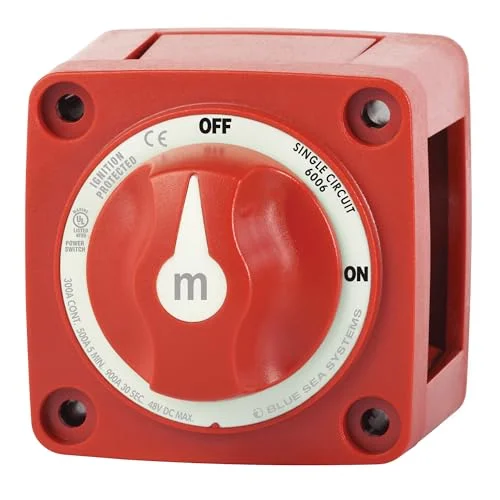
My read on the Blue Sea m-Series 6006 is that it’s built for straightforward battery isolation in tight installations. It’s an on/off style switch with a removable knob, which is the kind of small safety detail that helps reduce accidental current flow during service. Blue Sea also calls out multiple mounting options—front, rear, or surface—which makes it easier to fit into cramped panel layouts. The terminals use tin-plated copper studs intended as a secure connection point for multiple cables, and the listing emphasizes ignition protection for gasoline engine-room placement. What’s missing from the provided details is the specific continuous amperage and cable gauge acceptance, so I wouldn’t treat it as a “drop-in without checking” option if your setup is high-current.
Who It’s For
I would shortlist this if you want simple battery cutoff behavior and you value compact hardware with installation flexibility. It’s a good match for boats where you need a knob you can remove to prevent inadvertent reconnection, and where the panel layout doesn’t allow a single fixed mounting style. It also fits best when your electrical plan already lines up with the stud/cable requirements, since the provided info doesn’t spell out cable capacity here.
✅ Pros
- Compact, multi-mount design helps fit limited mounting areas.
- Removable knob supports safer handling during electrical service.
- Tin-plated copper studs offer a durable multi-cable connection point.
❌ Cons
- Continuous current rating and maximum cable size are not provided in the supplied data.
- On/off functionality lacks the bank combining flexibility found in selector models.
- Limited spec transparency can complicate exact match to high-amp systems.
💬 Our Take
A strong ignition-protected on/off pick where space and accidental activation prevention matter. The lack of explicit amperage and cable sizing in the provided data does make it harder to verify it against higher-crank or larger-cable systems.
Blue Sea Systems 3000 HD-Series Heavy Duty On-Off Battery Sw🏆 Editor’s Pick
| Protection Rating | IP66 waterproof |
| Current Rating | 600A continuous |
| Cable Compatibility | Two 4/0 AWG (95mm²) cables |
| Max Voltage | 32VDC |
What We Found
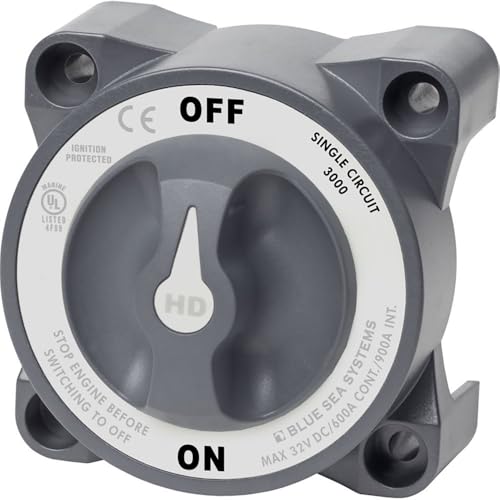
The Blue Sea 3000 HD-Series is the most spec-forward on/off switch in this set. It’s designed for a single battery to a single load group and includes ignition protection for gasoline-powered boats. The listing is clear on sealing, calling out IP66 waterproof performance and referencing ISO 8846 plus ABYC requirements. On the electrical side, it accepts two 4/0 AWG battery cables, which is a big deal if you’re running thick cable without wanting adapters. The switch also cites a 600A continuous rating and includes a 1/2-inch terminal stud size, which should help with secure, high-torque connections. With IP66 sealing and explicit current/cable compatibility shown, it’s the easiest one here to match to a serious engine-room setup.
Who It’s For
I would recommend this for larger boats or higher-demand electrical systems that need robust isolation and thick cable support. It fits well if you already run 4/0 cable and you want a single-bank cut that’s aligned with marine safety expectations—not just generic “heavy duty” language. If your installation sees bilge spray or washdowns, IP66 is also the kind of reassurance that matters.
✅ Pros
- IP66 sealing and ABYC/ISO 8846 references support confidence in harsh locations.
- Accepts two 4/0 AWG cables and delivers a clear 600A continuous rating.
- Ignition-protected construction fits gasoline engine-room installation needs.
❌ Cons
- On/off single-battery behavior cannot replace multi-bank selector use cases.
- Grey styling and mounting details may not fit every helm or panel layout.
- Higher capacity hardware may be more than required for small boats.
💬 Our Take
This is the most confidently specified marine on/off battery switch in the list. IP66 sealing, 4/0 cable support, and a stated 600A continuous rating make it the low-guesswork option.
Blue Sea Systems 4‑Position Mini Selector Battery Switch, Re👑 Premium Pick
| Positions | 4-position selector |
| Switching Method | Make-before-break contact design |
| Emergency Feature | Combine both batteries for starting or essential loads |
| Ignition Protection | Suitable for gasoline engine-room installation |
What We Found
This Blue Sea m-Series 6007 is a compact selector for people who don’t just want isolation—they want operating flexibility. It adds an emergency combine feature so you can draw power from both batteries during engine starting or essential electronics use like radios. The listing also points to ignition protection for gasoline engine-room placement. On the switching behavior side, the model uses make-before-break switching, which helps maintain continuity during transitions between battery banks. Mounting options are flexible too: surface, flush, or rear-panel mounting. Like other Blue Sea options here, it uses copper studs intended for multi-cable terminations, and the compact design is meant to fit where panel space is tight.
Who It’s For
This is for boats with two battery banks where you need starting reliability and an emergency backup path. I’d point you here if you run sensitive electronics and want smooth transitions across banks, not just storage isolation. The emergency combine mode is especially useful on longer outings when one battery may sag. If you’re also willing to pair a selector with basic battery monitoring, it tends to make day-to-day decisions much easier.
✅ Pros
- Emergency combine mode increases starting and radio availability under low-battery conditions.
- Make-before-break contact design supports continuity during bank transitions.
- Multiple mounting options help fit different panel and helm layouts.
❌ Cons
- Selector switching adds complexity versus a basic on/off cutoff.
- Correct use depends on operator habits and battery bank wiring discipline.
- A 4-position selector may be unnecessary for single-battery boats.
💬 Our Take
A feature-rich selector built for real multi-bank situations. Emergency combine plus make-before-break switching makes it the standout option for multi-bank starting and backup.
Seachoice Battery Select Switch, Disconnect Isolator Cutoff,
| System Voltage Limit | Under 50V |
| Compliance Signals | UL listed, ignition protected, CE approved |
| Continuous Rating | 250A continuous |
| Intermittent Rating | 360A intermittent |
What We Found
The Seachoice dual battery select switch is aimed at switching between batteries for starting, charging, or parallel operation. The listing highlights compliance signals—UL listed, ignition protected, and CE approved—which I would look for when you’re trying to confirm the basics for a marine-adjacent DC setup. It supports systems under 50V, which expands compatibility across different boats and trailers. In the provided data, the key electrical details include a 250A continuous rating and 360A intermittent capacity. It also has a defined physical size for planning your panel layout. Functionally, it’s a battery selection switch rather than purely a storage cutoff, but what’s missing from the provided details is the waterproof/IP sealing performance and clear mounting approach, which matters if it’s going to sit in a splash-prone or engine-room environment.
Who It’s For
I’d consider this for moderate systems that need battery selection for charging or operation, especially if you’re working on a budget. It can also make sense where compliance language matters and your system stays under 50V. That said, if you’re relying on heavy 4/0 cable or very high cranking demands, I would double-check whether the ratings feel like a comfortable match for your specific loads. It’s best when the installation environment is reasonably protected and splash exposure is controlled.
✅ Pros
- Clear continuous and intermittent ratings support realistic current planning.
- UL and CE compliance plus ignition protection improve confidence in DC switching.
- Compact physical size helps with modest panel and control space needs.
❌ Cons
- No IP waterproof rating information is included in the provided data.
- Ratings may limit suitability for larger twin-bank, high-amp cranking setups.
- Dual battery selection does not equal a high-capacity combine feature.
💬 Our Take
A reasonable selector for moderate setups where compliance language covers the basics. The absence of explicit waterproof and mounting details in the provided data keeps it from landing at the same confidence level as the Blue Sea models.
Joinfworld Side Post Battery Disconnect Switch 12V-48V 275A
| Operating Voltage Range | 12V-48V |
| Continuous Rating | 275A DC continuous (1hr) |
| Cranking Rating | 1250A DC cranking (10 sec) |
| Stud Size | 2 x 3/8″ (M10) |
What We Found
The Joinfworld side post cutoff switch is built around an on/off 2-position battery cut for 12V to 48V systems. The listing provides performance numbers for 275A continuous, 455A intermittent, and 1250A cranking for short bursts. Stud size is specified as 2 x 3/8-inch (M10), which fits many side-post battery layouts. It claims direct side-post compatibility by including copper conductive sheets and mounting brackets, which is helpful if you’re trying to avoid extra adapters during installation. There’s also a rear cover designed to insulate terminals to reduce short-circuit risk, and the housing is ABS plastic for durability. One more install-friendly claim is that it can be locked together with other switches for bigger battery bank systems. The biggest gap in the provided data is that it doesn’t cite IP waterproof level or ignition-protection standards—two things I’d want to see for engine-room placements near gasoline systems.
Who It’s For
I think this suits DIY installers who want a space-saving side-post disconnect and an easier wiring path. It also fits boats (and RV/off-road setups) where you need to stop parasitic drain during storage. The high cranking rating supports typical starting bursts, but I’d steer it toward installations away from higher engine-room ignition-risk exposure. Value is strongest when affordability and straightforward clamp-on connectivity are your priority.
✅ Pros
- Includes copper conductive sheets and brackets for easier side-post installations.
- High cranking rating supports brief starting loads.
- Rear cover helps insulate terminals against accidental shorting.
❌ Cons
- No explicit IP waterproof or ignition-protection standard is provided in the supplied data.
- Stud and cable capacity details beyond M10 are not specified.
- ABS housing can vary in long-term heat and corrosion resilience versus sealed marine units.
💬 Our Take
A practical budget-friendly cutoff for many DC setups. Without clear engine-room sealing and ignition-protection details, I wouldn’t treat it as top-tier confidence for fully exposed gasoline compartment installs.
Blue Sea Systems e-Series Battery Switch Selector 4 Position
| Circuit Positions | 4-position selector |
| Voltage Rating | 32V DC |
| Current Rating | 325A |
| Stud Design | One-piece copper studs, 7/8″ long |
What We Found
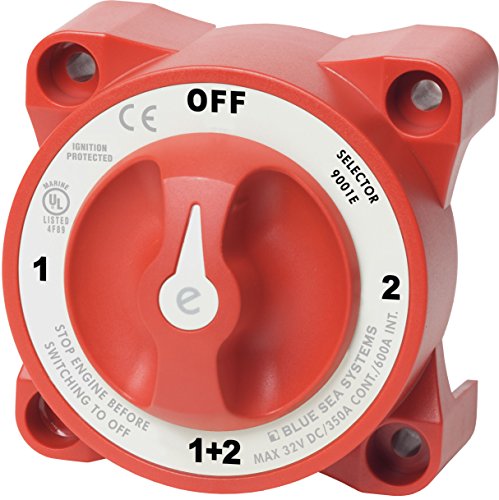
Blue Sea’s e-Series 9001e is a compact 4-position selector for 32V DC with a stated 325A rating. The listing calls out ignition protection and positions it for gasoline engine-room installation. Termination is handled with one-piece copper studs that are listed as 7/8-inch long and designed to accept multiple cables, which helps with secure lugs without bulky adapter hardware. Usability is addressed with tactile textures on the face for operation by feel—useful in low-light conditions or emergency situations. For installation flexibility, the listing includes surface and rear-panel mounting options. As a selector, it manages battery bank behavior rather than only isolating one bank for service.
Who It’s For
This is a good fit for boats running 32V DC that need multi-bank management rather than a simple cutoff. I’d point you here if you want ignition-protected selector hardware for a gasoline engine compartment and you care about being able to operate the switch by touch if visibility is poor. Rear mounting options are a real plus when you can run cables behind the panel. It’s also an attractive alternative to the m-Series 6007 when you specifically need 32V and a compact footprint.
✅ Pros
- Ignition-protected design supports safer engine-room placement on gasoline boats.
- Tactile operation helps use the switch in low-light conditions.
- Compact footprint and multiple mounting options simplify real installations.
❌ Cons
- Provided data lacks detailed cable gauge and terminal size specifics for exact wire matching.
- Selector use adds operational complexity compared with on/off isolation.
- May be overkill for single-battery setups.
💬 Our Take
A well-rounded 32V selector with ignition protection and low-light usability. If you need a selector but 32V compatibility matters, it’s an easy alternative to the m-Series 6007.
Joinfworld Top Post Battery Disconnect Switch 12V-48V Batter
| Operating Voltage Range | 12V-48V |
| Continuous Rating | 250A DC continuous |
| Cranking Rating | 1000A DC cranking |
| Circuit Type | 2-way on/off |
What We Found
This Joinfworld unit is a negative-side disconnect designed for 12V to 48V systems. The listing states 250A continuous and 1000A cranking, and it’s described as a two-way on/off circuit type. It includes a negative battery clamp and a tapered post intended to make installation easier. Like other Joinfworld models here, the housing is ABS plastic, with copper components intended to improve conductivity. The purpose is to prevent excessive discharge when the boat/vehicle sits idle. The main limitation for marine engine-room confidence is that the provided details don’t cite IP waterproof level or ignition-protection/compliance specifics, which makes it harder to justify for gasoline compartment installations.
Who It’s For
I’d consider this if you want a simpler negative-side disconnect rather than a multi-position selector. It’s well matched for boats, RVs, or vehicles stored for long periods where you need quick isolation from parasitic drain. The cranking rating supports starting bursts, and the on/off logic is easy to communicate to a crew. I’d only place it where it won’t be exposed to engine-room ignition-risk conditions without additional protection measures.
✅ Pros
- Negative-side disconnect style can simplify many DIY battery setups.
- Copper clamp and tapered post design supports reliable conductivity.
- Clear on/off operation reduces user error versus multi-position selectors.
❌ Cons
- No explicit waterproof or ignition-protection rating is provided in the supplied data.
- Top-post mounting may not fit all battery layouts without adapter work.
- Electrical sizing details beyond amperage are not included.
💬 Our Take
A straightforward negative-side disconnect for general DC isolation. The missing sealing and ignition-protection evidence keeps it behind more explicitly marine-specified options.
Blue Sea Systems e-Series Battery Switch Single Circuit, On/
| Circuit Control | Single circuit on/off |
| Voltage Rating | 48V DC |
| Current Rating | 350A |
| Stud Material | Tin-plated copper studs |
What We Found
The Blue Sea e-Series 9003e is a single-circuit on/off battery switch for 48V DC with a stated 350A rating. It’s built for isolating one battery bank for maintenance or storage, and its compact design supports tighter installations with surface or rear-panel mounting options. Like other Blue Sea models, it uses tin-plated copper studs meant for secure, high-torque connections. Usability includes a textured knob and face so you can switch it by touch when visibility drops. Because it’s single-circuit, it avoids the selector logic mistakes that can happen when people end up switching to the wrong bank.
Who It’s For
This is for 48V systems where you mainly need reliable battery isolation, not multi-bank selection. I’d shortlist it if you store your boat for weeks and want a single dependable cutoff for maintenance. It’s also useful when you expect nighttime work or emergency docking—tactile actuation helps. And it makes sense when you have limited panel space because the compact form and mounting options reduce the need to compromise on layout.
✅ Pros
- Single-circuit isolation minimizes operational complexity and wiring mistakes.
- Tin-plated copper studs support secure multi-cable terminations.
- Low-light tactile knob and face improve usability during inspections.
❌ Cons
- Provided data does not include IP sealing or ignition-protection detail.
- No explicit cable gauge or terminal size is included for exact wire matching.
- Not suited for multi-bank starting strategies requiring combine functions.
💬 Our Take
A strong 48V on/off isolator with practical usability features. It doesn’t match the most explicit waterproof/ABYC-style specification detail found in the top sealed options, but it still reads as a quality choice.
Joinfworld Battery Disconnect Switch 12V-48V Waterproof Mari
| Operating Voltage Range | 12V-48V |
| Continuous Rating | 275A DC continuous (1hr) |
| Cranking Rating | 1250A DC cranking (10 sec) |
| Stud Size | 2 x 3/8″ (10mm) |
What We Found
This Joinfworld master cutoff is an on/off battery disconnect for 12V to 48V, with electrical ratings provided in the listing. It lists 275A continuous (1 hour), 455A intermittent (5 minutes), and 1250A cranking (10 seconds), which aligns with the kind of short-burst demand you see at engine start. Stud size is given as 2 x 3/8-inch (10mm), and it notes M10 tinned copper studs and nuts to support conductivity. The rear cover is intended to insulate the terminals to reduce short risk, and the housing is ABS plastic for durability. It also claims it can stand alone or lock with other switches, which can matter if you’re building a larger system. The big missing pieces in the provided data are the lack of a specific IP waterproof rating, ignition-protection/compliance standards, and clear marine-grade sealing evidence.
Who It’s For
I’d consider this for anyone who wants a straightforward master cutoff for DC 12V to 48V and doesn’t want selector complexity. It fits boats and RVs where you need to eliminate battery drain during storage, and the high cranking capacity supports typical start bursts. If your installation can tolerate some supplemental sealing or lives in a more protected location, the simple on/off behavior is easy to run and teach to a crew. If you’re targeting an engine-room placement with high exposure, I’d treat it as a “check sealing details carefully” option.
✅ Pros
- Provides clear continuous, intermittent, and cranking ratings for DC planning.
- Rear cover insulation helps reduce accidental terminal shorts.
- M10 tinned copper studs support more reliable electrical conductivity.
❌ Cons
- “Waterproof” is stated, but no IP rating appears in the provided details.
- No ignition-protection compliance data is included for gasoline engine-room placements.
- Cable and terminal sizing guidance beyond stud diameter is limited.
💬 Our Take
A capable budget master disconnect with strong current numbers on paper. The missing IP level and ignition-protection specifics reduce confidence for fully exposed gasoline engine-room installs.
Nilight – 90015A Battery Switch 12-48V Waterproof Heavy Duty
| Operating Voltage Range | 12V-48V |
| Continuous Rating | 275A DC continuous at 12V |
| Intermittent Rating | 455A DC intermittent at 12V |
| Cranking/Momentary | 1250A momentary at 12V |
What We Found
The Nilight 90015A is an on/off battery power cut master for 12V to 48V with heavy-duty performance claims. The switch uses ABS plastic and includes a rear cover intended to insulate terminals to reduce short-circuit risk. The listing cites 275A continuous at 12V, 455A intermittent at 12V, and 1250A momentary at 12V—numbers that match common cranking-and-isolation use cases. The included mounting hardware includes four bolts, which supports a simple DIY installation. It’s positioned as a way to isolate the battery and stop power draw when the vehicle or boat sits idle. What I can’t verify from the provided data is an IP waterproof rating or ignition-protected certification, so engine-room suitability in gasoline compartments is harder to confirm.
Who It’s For
This is for owners who want a simple master cutoff for DC 12V to 48V vehicles and boats, especially for storage and parasitic-drain control. The rated cranking current supports starting loads for many setups, and the included hardware is convenient for straightforward mounting. I’d place it in installations with controlled splash exposure or where you can add extra sealing. For high-certainty marine engine-room compliance, I would personally gravitate toward a more spec-rich branded option.
✅ Pros
- High cranking and intermittent ratings cover short starting demands.
- Rear cover insulation supports safer terminal separation.
- Basic mounting hardware is included for straightforward installs.
❌ Cons
- No IP rating or ignition-protection standard is provided in the supplied data.
- Ratings are stated for 12V, leaving uncertainty across the full 12V-48V range.
- Tin plating, stud size, and cable gauge compatibility details are not fully specified.
💬 Our Take
A budget on/off disconnect with strong headline current ratings. Because the provided info doesn’t confirm marine sealing and ignition protection, it’s a riskier buy than the more explicitly marine-specified Blue Sea options.
What to Look For Before Buying
A reliable marine battery switch comes down to two things: the electrical match and the installation protection. I would start by matching the switch’s continuous current and voltage to the real loads in your battery bank—and confirm it supports your cable gauge and terminal/stud size. Next, I’d choose the function type that matches how your boat works: on/off for isolation during storage or service, or a selector for starting and bank combining. If you’re installing in a gasoline engine room, I would prioritize ignition protection and explicit waterproof sealing claims like an IP rating (for example, IP66).
Check Match amperage, cable gauge, and stud size
Look for a stated continuous current rating, not just cranking. Verify the switch accepts your existing cable gauge and terminal size. Confirm stud diameter and the number of cables each stud can hold. Tight connections reduce voltage drop and heat. Plan for lugs and torque to avoid loose hardware.
Value Choose the right switch type for the job
Use a single-circuit on/off switch when your goal is simple isolation for maintenance or storage. Choose a multi-position selector when you need to select banks for starting, charging, or emergency combining. Emergency combine is especially useful if one bank might be weaker at the worst time. If you’re comparing selector switches, I would also pay attention to the switching behavior (for example, make-before-break) because it affects how power transitions during bank changes. Avoid selector complexity if your boat only needs a reliable storage cutoff.
Rating Prioritize marine-grade protection and compliance signals
For gasoline engine-room installations, ignition-protected language is a big deal—look for explicit “ignition protected” wording. Waterproof sealing matters for bilge splash, washdowns, and condensation, so I’d prefer products that provide an IP rating instead of vague “waterproof” claims. When you don’t see rating data clearly, rely more on engineering specs and compliance references (like ABYC-aligned language). If the listing doesn’t back it up, I treat it as less certain.
Verify Plan mounting and usability in real conditions
Before you buy, check how it mounts: surface, flush, or rear-panel. Make sure the physical layout lets you route cable cleanly and that the cover/face can close properly. I also look for usability cues like tactile operation for glove-on switching or low-light situations—especially if your battery switch will be near the helm or in a dark engine compartment. Removable knobs can be a practical safety touch during service. And for DIY installs, confirm the included hardware matches your battery terminal style and the stud connections you’ll actually be using.
Frequently Asked Questions
What type of marine battery switch is best: on/off or selector?
On/off switches isolate one battery bank for storage and maintenance. Selector switches manage multiple batteries for starting, charging, and emergency bank combining. If your boat uses two battery banks and you need operational flexibility, go with a selector. If your priority is simple cutoff control, an on/off switch is usually the better fit.
Do marine battery switches need ignition protection for gasoline engine rooms?
Yes—ignition protection matters when the switch is located inside a gasoline engine compartment. Look for explicit “ignition protected” wording and any related compliance references. This helps reduce the risk of the switch acting as an ignition source near fuel vapors. For non-engine-room locations, the requirements may be less strict, but it still depends on where the switch is installed.
How important is IP waterproof rating for a battery switch?
Water exposure can corrode terminals and degrade connections over time, so an IP rating gives you a clearer expectation of sealing performance. IP66 is a strong signal for splash and water-jet resistance. If the listing only says “waterproof” without an IP code, I would treat the sealing confidence as lower. Bilge-prone boats benefit the most from explicit sealing information.
What current rating should be used for marine battery switches?
I focus on the continuous rating for how the switch performs during normal operation and charging, not just engine start. Cranking ratings cover brief, high-current moments. Match the switch to your system’s worst-case load and confirm it also supports your cable and terminal connections. If you’re on the fence, choosing a higher continuous rating generally gives more margin.
Can a battery switch replace proper battery disconnecting and safety practices?
A battery switch helps isolate the electrical system, but it doesn’t replace all safety steps. You still need proper fusing, correct wire sizing, and properly torqued connections. Lockout practices can prevent accidental reconnection during service. And always confirm polarity and terminal type before final installation.
🎯 Final Verdict
Blue Sea Systems 3000 HD-Series Heavy Duty On-Off Battery Switch is the best marine battery switch choice here because it pairs IP66 waterproof sealing with an ignition-protected design and a concrete 600A continuous rating—plus it directly accepts two 4/0 AWG cables. That combination removes a lot of the guessing that comes with budget switches. If you specifically need multi-bank behavior, the closest alternative is the Blue Sea Systems 4-Position Mini Selector 6007 for emergency combining and bank selection during starting or radio use. Whichever one you pick, verify cable gauge, stud size, and your mounting plan first—then install with correct lug torque.

- 10 Marine Diesel Additive Focused On Biocide, Corrosion Control, And Lubricity 2026 - June 22, 2026
- 10 Marine Diesel Confidence Kit: Additives, Filters, And Fuel Care Essentials 2026 - June 22, 2026
- 10 Marine Cranking Battery Picks For Reliable Starts In Cold Water And Long Sessions 2026 - June 22, 2026