Picking the best marine AGM batteries gets tricky because you’re often asking one battery to do two different jobs. Many boats need dependable cranking to start, plus deep-cycle-style power for trolling motors and everyday electronics. It’s also where a lot of shoppers get burned—mismatched capacity for their actual loads, unclear reserve/runtime expectations, and batteries that don’t tolerate vibration as well as advertised. In this review, I’m comparing popular AGM dual-purpose and deep-cycle options across common marine group sizes, with an eye on starting power, cycle capability, sealing design, and whether the battery feels like the right match for typical boat and RV setups.
A marine AGM battery has to handle vibration, repeated cycling, and charging conditions that don’t always stay perfect (alternators, chargers, and real-world usage). Dual-purpose models make sense when you want one battery that can both start the engine and keep powering accessories without needing a second unit. Deep-cycle models are better when the priority is sustained discharge for trolling, fish finders, lights, and other onboard gear. If the listing points to pure-lead AGM construction, that’s usually aimed at improving life under frequent cycling. And when brands mention quick charging, I treat it as “only useful if your charging system can match the recommended voltage/current limits.”
⚡ Quick Verdict
Our Top Picks at a Glance
| Image | Product | Score | Link |
|---|---|---|---|
 |
Interstate Batteries Marine/RV Battery 12V 100Ah 825CCA Dual Editor’s Pick |
8.6/10 |
View on Amazon Free Shipping & 30-Day Returns |
 |
Weize BCI Group 31M Dual Purpose AGM Battery, 240RC 825CCA 1 🥈 Runner-Up |
8.2/10 |
View on Amazon Free Shipping & 30-Day Returns |
 |
Newport 12V50Ah Deep Cycle Heavy-Duty Marine Battery, Lightw 💵 Budget Pick |
6.8/10 |
View on Amazon Free Shipping & 30-Day Returns |
 |
Interstate Batteries Marine Deep Cycle Battery 12V 100Ah 925 👑 Premium Pick |
9.1/10 |
View on Amazon Free Shipping & 30-Day Returns |
 |
Weize Dual Purpose AGM Battery BCI Group 24M, Starter & Deep | 7.7/10 |
View on Amazon Free Shipping & 30-Day Returns |
 |
Interstate Batteries Marine/RV Battery 12V 70Ah 750CCA (24M- | 7.6/10 |
View on Amazon Free Shipping & 30-Day Returns |
 |
UPLUS BCI Group 27M Dual Purpose Marine Battery, 12V 92Ah 80 | 7.9/10 |
View on Amazon Free Shipping & 30-Day Returns |
 |
Mighty Max Battery MM-G24M, 12V 90Ah, Group Size 24M Deep-Cy | 7.3/10 |
View on Amazon Free Shipping & 30-Day Returns |
 |
OPTIMA® Batteries High Performance D34M BLUETOP® Dual Purpos | 8.4/10 |
View on Amazon Free Shipping & 30-Day Returns |
 |
Renogy Deep Cycle AGM 12 Volt 100Ah Battery, 3% Self-Dischar | 7.0/10 |
View on Amazon Free Shipping & 30-Day Returns |
📋 How We Evaluated
These options were evaluated on build approach and durability signals like sealed AGM construction, vibration resistance claims, and plate design. Performance focus included cranking strength metrics, reserve capacity where provided, and deep-cycle orientation for accessories and trolling use. Value assessment considered stated capacities, charging requirements, and typical Amazon-style rating signals; however, no ratings were provided here, so suitability relied more heavily on specifications and application fit.
Detailed Reviews
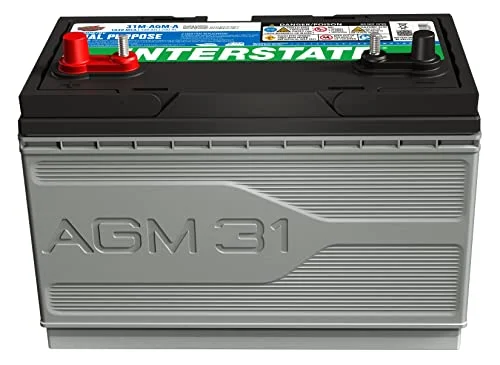
Interstate Batteries Marine/RV Battery 12V 100Ah 825CCA DualEditor’s Pick
| Voltage | 12V |
| Capacity | 100Ah |
| Cold Cranking Amps | 825CCA |
| Group Size | 31M |
What We Found
Interstate’s 12V 100Ah 825CCA Group 31M-AGM-A is built around a dual-purpose AGM idea: it’s meant to handle both cranking for starting and deeper cycling for accessory power. The listing leans into “pure, non-alloy lead” and thick-plate construction, positioning it as a battery that can be discharged and recharged repeatedly without chewing through its lifespan. Interstate also frames this as marine/RV tough, with rugged-use intent rather than a light-duty role. On paper, the 825 CCA headline plus 100Ah capacity line up with what many Group 31 dual-purpose replacements are expected to cover. My read is that the messaging matches boats that cycle the battery often—especially between charges.
Who It’s For
I’d shortlist this Interstate model if you’re trying to run a single-battery setup that has to crank and also power a trolling motor plus onboard electronics (lights, navigation gear, pumps, and so on). It fits weekend-style fishing trips where the battery isn’t staying fully topped off all the time. The Group 31 footprint is also a good match for boats and RV compartments that already fit larger cases. If your alternator and AGM-compatible charger align with AGM charging expectations, the emphasis on longer service life and recharging is easier to take seriously.
✅ Pros
- Pure lead, thick-plate construction is designed for repeated cycling instead of short, shallow use.
- Dual-purpose layout supports both engine cranking and extended trolling and accessory loads.
- Marine/RV positioning suggests a focus on rugged conditions and vibration tolerance.
❌ Cons
- Price and verified user rating signals were not provided, which limits value confidence.
- No reserve-capacity figure was listed, so sustained runtime expectations remain indirect.
- Compatibility depends on terminal layout and the Group 31M physical dimensions.
💬 Our Take
This looks like a dependable dual-purpose choice for people who want one marine AGM to cover cranking and meaningful deep-cycle behavior. The pure-lead, thick-plate angle is especially relevant for frequent cycling.
Weize BCI Group 31M Dual Purpose AGM Battery, 240RC 825CCA 1🥈 Runner-Up
| Voltage | 12V |
| Capacity | 110Ah |
| Cold Cranking Amps | 825CCA |
| Group Size | 31M |
What We Found
Weize’s Group 31M dual-purpose AGM is aimed at covering both starting and deep-cycle use for marine and RV setups. The listing calls out 825CCA and 110Ah, which gives you a strong starting figure while still promising enough usable energy for accessory runtime. It’s a sealed AGM design with an approach meant to improve safety in tighter compartments. Weize also highlights low internal resistance and high output power, which is the kind of claim that’s meant to translate to better efficiency over time. Charging guidance is spelled out with a constant-voltage target (14.4V) and a maximum current/time window, plus a note about vibration resistance (including a “20x” style comparison versus flooded batteries). My read is that it’s a feature-dense alternative when you want dual-purpose in a Group 31 size without the higher-tier pricing of some premium labels.
Who It’s For
This one fits if you want a dual-purpose Group 31M with sealed convenience and solid cranking numbers, and you plan to run it as the single battery for both starting and ongoing loads (trolling motor, lights, pumps, electronics). It also makes sense for RV use when you’re cycling between charges and you care about the battery being AGM-sealed and less hassle. It’s especially relevant for buyers whose chargers can deliver the AGM-compatible voltage profile the listing calls for—because the quick-charge claim is only useful when charging discipline matches the instructions.
✅ Pros
- Sealed, valve-regulated AGM design improves safety and helps resist vibration-related stress.
- Dual-purpose specification supports starting plus deep discharge for trolling and electronics.
- Charging instructions provide a practical path to faster turnaround when equipment matches.
❌ Cons
- Charging guidance requires strict voltage and current control; mismatched chargers can reduce life.
- No reserve capacity metric was provided, so deep runtime depends on system draw.
- Lack of price and rating data limits confidence in long-term value.
💬 Our Take
Weize brings a lot of claims—capacity, charging guidance, and a sealed dual-purpose build—in a Group 31M package. If your charging setup can follow those AGM parameters, it’s a strong contender.
Newport 12V50Ah Deep Cycle Heavy-Duty Marine Battery, Lightw💵 Budget Pick
| Voltage | 12V |
| Capacity | 50Ah |
| Construction | Sealed AGM (leak-proof) |
| Weight | 32 lbs |
What We Found
Newport’s 12V 50Ah sealed AGM deep-cycle battery is focused on portability and trolling-motor compatibility. The listing highlights a lightweight build (32 lb), which can make installation and tray handling easier—especially compared with heavier deep-cycle options. Because it’s sealed AGM, it’s designed to be leak-proof for marine conditions where you want less mess and less maintenance. Capacity is clearly stated at 50Ah, which puts it in the smaller battery class aimed at steady accessory loads rather than major high-CCA starting demand. What’s notable is what the listing doesn’t include: there are no CCA/MCA or reserve-capacity style numbers. That omission makes cold-start expectations harder to quantify, even though the deep-cycle intent is clear.
Who It’s For
I’d aim this Newport battery at shoppers who care more about weight and deep-cycle runtime than brute cranking power. It’s a better match for smaller boats, as a secondary battery, or when it’s paired with a dedicated starting battery. If your trolling motor draw is steady (and you’re not relying on the battery to do heavy cold starts), the design intent fits well. It can also work for RV and cabin setups where you want compact, sealed AGM power for electronics and basic appliances.
✅ Pros
- Lightweight 32 lb design makes installation and handling easier on boats.
- Sealed AGM construction supports safer mounting and maintenance-free use.
- Trolling motor compatibility aligns with steady discharge use patterns.
❌ Cons
- No starting power ratings are provided, which limits use for cold cranking.
- 50Ah capacity may be insufficient for larger electronics loads or long trolling sessions.
- No reserve capacity or cycle-life details were provided in the listing.
💬 Our Take
This is a small-capacity sealed AGM made for trolling-focused use. If you need strong engine starting in cold conditions, it’s the type of battery that can turn into a poor fit.
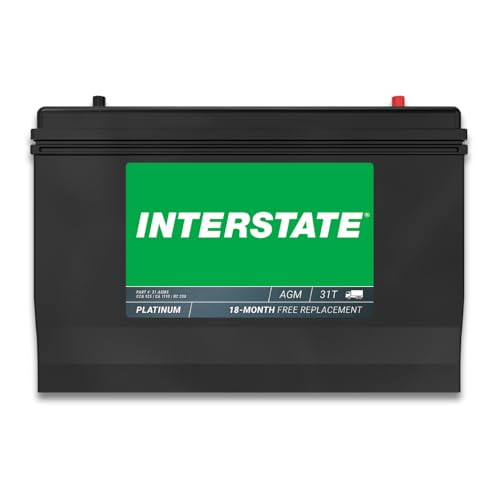
Interstate Batteries Marine Deep Cycle Battery 12V 100Ah 925👑 Premium Pick
| Voltage | 12V |
| Capacity | 100Ah |
| Cold Cranking Amps | 925CCA |
| Group Size | 31 |
What We Found
Interstate’s 12V 100Ah 925CCA Group 31-AGM5 Pure Matrix Power is presented as a pure lead AGM built for heavier auxiliary loads and starting. The listing stresses extreme deep-cycle performance, including thick-plate construction that supports continuous discharge and frequent recharge cycles without big lifespan drops. Interstate also positions the battery as lasting significantly longer than conventional flooded and alloy AGM options. The use cases they list are broad—trolling motors, audio systems, depth finders, and windlass-style gear—so the accessory demand angle is front and center. The 925 CCA figure stands out versus many dual-purpose options in the same capacity band, which helps starting confidence if you’re depending on that same battery. The listing also makes the intent clear that it’s not meant as a replacement for automotive or mobility battery applications.
Who It’s For
This is the type of battery I’d point at for higher-demand boats that run multiple electronics and accessories but still need reliable starts. If you’re powering fish finder suites, pumps, and other onboard loads, and you’ve got a Group 31 compartment that can accept the case size, it lines up well. It’s especially attractive for users who expect to cycle the battery and want deep-cycle orientation plus pure-lead positioning.
✅ Pros
- 925CCA provides strong cranking headroom for demanding starting conditions.
- Pure lead AGM with thick plates targets longer life under deep discharge cycling.
- Designed to support both engine starting and heavy accessory loads.
❌ Cons
- Price and rating signals were not provided, which makes cost-per-performance hard to verify.
- No reserve-capacity figure appears, so runtime math depends on your load draw.
- Higher cranking focus can tempt overuse in applications that need dedicated deep-cycle capacity.
💬 Our Take
This earns the top-pick slot for pairing a very high 925CCA starting number with deep-cycle intent for accessory-heavy marine electronics. The pure-lead thick-plate design is a strong match for frequent cycling.
Weize Dual Purpose AGM Battery BCI Group 24M, Starter & Deep
| Voltage | 12V |
| Capacity | 90Ah |
| Cold Cranking Amps | 550CCA |
| Group Size | 24M |
What We Found
Weize’s Group 24M dual-purpose AGM is designed to start engines and also support deeper discharge for marine and RV use. The listing includes a full spec set for that purpose: 12V, 90Ah, 550CCA, and 150RC-style reserve-capacity information, which helps you estimate sustained power better than CCA alone. It emphasizes low internal resistance and high output power through AGM technology. Sealed construction, including specialized valves and leak-proof design, is meant to handle vibration and reduce corrosion risk. Charging instructions are included with a constant voltage of 14.4V plus a max current and time limits, which can matter when you’re trying to charge efficiently without overdoing it. There’s also a two-year guarantee claim that adds a layer of risk protection. Since this is a Group 24M size, it’s generally aimed at installations that need a more compact option than Group 31.
Who It’s For
I’d put this on the list for boats and RVs that want dual-purpose function in a Group 24M footprint. It’s a good fit for mid-size trolling motor setups and regular electronics loads when you’d rather not add a separate deep-cycle battery. The 90Ah capacity supports meaningful runtime, but it’s still a smaller capacity than Group 31-style cases, so load management matters. It works best when the charging system can maintain AGM-safe voltage and avoid overcharging.
✅ Pros
- Group 24M size fits tighter compartments while still offering dual-purpose output.
- Reserve-capacity figure (150RC) adds clarity for sustained accessory loads.
- Sealed AGM and leak-proof design support safer mounting and vibration tolerance.
❌ Cons
- Charging speed claims depend on strict adherence to the listed AGM charging profile.
- No terminal type dimensions were provided, so fitment needs confirmation.
- Rating and price data were not included, limiting value checks.
💬 Our Take
A practical dual-purpose Group 24M pick that includes reserve-capacity guidance. It tends to make the most sense when your charger settings match the AGM instructions.
Interstate Batteries Marine/RV Battery 12V 70Ah 750CCA (24M-
| Voltage | 12V |
| Capacity | 70Ah |
| Cold Cranking Amps | 750CCA |
| Group Size | 24 |
What We Found
Interstate’s 12V 70Ah 750CCA pure lead AGM dual-purpose battery uses a Group 24 size, targeting starting plus trolling and accessory power. The listing emphasizes pure, non-alloy lead and thick plates for better cycle life, along with service-life improvements of “2x” versus conventional alloy AGM and “3x” versus flooded batteries. It also frames the battery as able to run a trolling motor even when the motor is off, which matches people who want one battery covering both starting and sustained powering. The 750 CCA headline is a strong starting number for a 70Ah class battery. One limitation in the listing, though: there’s no reserve-capacity figure. That makes it harder to translate deep-discharge expectations into real runtime confidence.
Who It’s For
This suits smaller marine and RV electrical systems where Group 24 makes more sense. It’s a good match for occasional trolling sessions and onboard loads like lighting, pumps, and navigation electronics. If you’re choosing a sealed AGM that can handle vibration and repeated cycling, the Group 24 format also keeps install complexity down. I’d focus on this if you have an AGM-compatible charger and you’re comfortable with realistic capacity expectations for 70Ah-class batteries.
✅ Pros
- Pure lead AGM and thick plate messaging targets longer life under repeated cycling.
- Dual-purpose design supports both cranking and trolling motor power from one battery.
- Strong 750CCA rating improves starting confidence for its size class.
❌ Cons
- No reserve capacity metric is provided, making runtime forecasting less exact.
- 70Ah capacity may require careful load management for longer trolling trips.
- Price and user rating data were not available to judge value.
💬 Our Take
Interstate’s Group 24 AGM is a strong single-battery choice for smaller rigs. The missing reserve-capacity detail keeps my runtime confidence lower than it is for competitors that include RC.
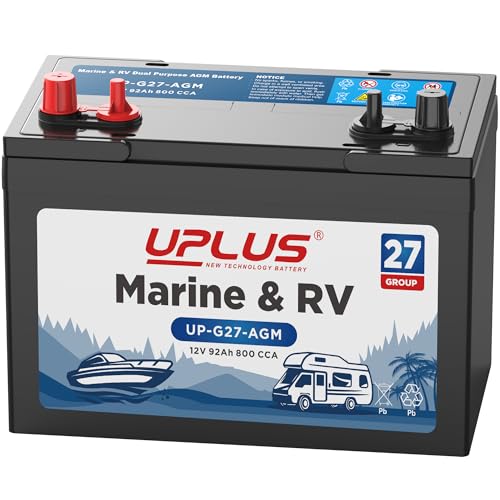
UPLUS BCI Group 27M Dual Purpose Marine Battery, 12V 92Ah 80
| Voltage | 12V |
| Capacity | 92Ah |
| Cold Cranking Amps | 800CCA |
| Reserve Capacity | 175RC |
What We Found
UPLUS’s Group 27M dual-purpose AGM lists 12V, 92Ah, 800CCA, and 175RC. That combination is trying to cover both starting strength and sustained run capability, with reserve capacity offering a clearer picture of long-load behavior than CCA alone. The listing also includes dimensions and weight, which helps when you’re sanity-checking whether the battery actually fits before ordering. Uplus emphasizes vibration resistance and thicker full-frame cast plates intended to hold up to wave pounding and trailer transport stress. It also makes the usual AGM point that AGM construction is inherently better at vibration tolerance than flooded designs. There’s a claim that it can start engines up to 350HP—useful as a marketing signal, but I’d still validate against your actual starter draw. Overall, the result is a spec-forward dual-purpose battery aimed at mid-to-larger marine use where you want more reserve than Group 24 class options.
Who It’s For
I’d consider this if you want more reserve than Group 24 dual-purpose units, but you still want one battery for cranking and deep-cycle-style accessory loads. The 175RC is the part that appeals if you run electronics and lights for extended periods. It also fits people who frequently transport boats over rough trailer routes. The practical checklist item here is fit: use the provided LxWxH dimensions, and make sure your charging equipment supports AGM charging expectations.
✅ Pros
- 175RC reserve capacity helps estimate longer accessory runtime better than CCA-only listings.
- Thicker full frame cast plates and vibration resistance claims target real marine abuse.
- Provided dimensions reduce fitment guesswork for Group 27M compartments.
❌ Cons
- Engine horsepower start claim needs validation against actual cold-crank requirements.
- No detailed cycle-life or pure-lead versus alloy composition is specified in the listing.
- Price and ratings were not included, limiting value comparison.
💬 Our Take
UPLUS offers a well-specified Group 27M dual-purpose battery with 175RC for sustained loads. If your boat sees rough travel, the vibration-focused construction claims are especially relevant.
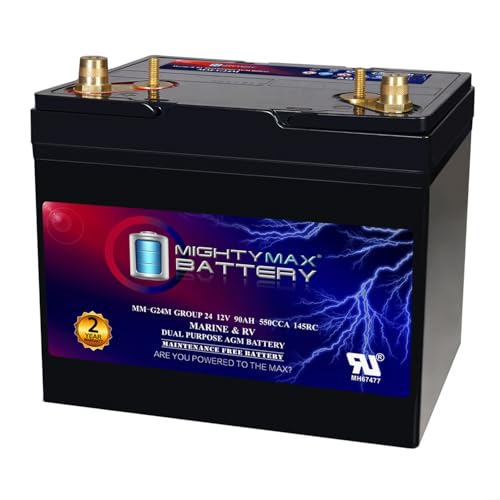
Mighty Max Battery MM-G24M, 12V 90Ah, Group Size 24M Deep-Cy
| Voltage | 12V |
| Capacity | 90Ah |
| Cold Cranking Amps | 550 CCA |
| Reserve Capacity | 145 RC |
What We Found
Mighty Max’s MM-G24M is a Group 24M deep-cycle AGM that also aims to cover dual-purpose starting and deeper discharge. The listing calls out 12V, 90Ah, and 550 CCA, plus 700 MCA and 145 RC. It also includes a cycle-life claim of up to 700 cycles at 50% depth of discharge, which is a more useful way to frame cycle expectations than generic “long life” wording. The sealed, spill-proof, maintenance-free nature is meant to keep it straightforward for marine and road use without watering. The description frames it as usable on water, road, or off-grid, which suggests the battery is meant to serve beyond only one narrow application. The cranking durability focus is there, but the cycle-life claim is tied to a specific depth-of-discharge condition—something that matters when you look at real usage patterns.
Who It’s For
This is a good match if you need Group 24M AGM capacity with both starting capability and deep-cycle runtime for onboard electronics and moderate trolling. It makes the most sense for owners who tend to cycle around 50% depth of discharge and will keep charging discipline on track. The 90Ah capacity gives meaningful runtime without jumping up to the bigger, heavier cases. It’s also appealing if you strongly prefer maintenance-free, spill-proof mounting for safer installs.
✅ Pros
- Spill-proof maintenance-free AGM construction fits marine safety requirements.
- 700 MCA and 550 CCA support reliable starting for most typical setups.
- Cycle-life claim targets meaningful longevity under 50% depth-of-discharge.
❌ Cons
- Cycle-life claim depends heavily on how the battery is used and charged.
- No pure-lead versus alloy composition details appear in the listing.
- Price and rating signals are missing, limiting confidence in overall value.
💬 Our Take
Mighty Max balances cranking and deep-cycle ratings in a compact Group 24M format. The cycle-life claim looks promising, but performance will depend heavily on how you charge and how deep you routinely discharge.
OPTIMA® Batteries High Performance D34M BLUETOP® Dual Purpos
| Voltage | 12V |
| Cold Cranking Amps | 750 CCA |
| Capacity | 55 AH (C20) |
| Reserve Capacity | 120 minutes |
What We Found
Optima’s D34M BLUETOP dual-purpose AGM uses spiral technology and claims 99.99% pure lead, positioning it as a step up from flat-plate designs. The listing includes a strong cranking profile with 750 cold cranking amps and a 55Ah C20 capacity. It also provides a reserve capacity of 120 minutes, which helps support the runtime argument beyond just starting. Optima’s messaging focuses on consistent performance and strong starting even in bad weather, plus high vibration resistance and up to three times longer life versus standard flooded batteries. It’s also maintenance-free and includes dual terminal options along with stainless stud posts for flexible mounting and cable routing. Specs are clear, but the D34M capacity is smaller—so it may require careful power budgeting if your trolling loads are heavy.
Who It’s For
I’d place this on the shortlist for boaters who prioritize vibration resistance and dependable starting in a compact AGM package. It’s often a better fit for setups with lighter accessory demands, or for people using it as a starting battery paired with a larger deep-cycle bank. The 55Ah capacity can also be helpful where compartment size is tight and the battery weight matters. If you’re comfortable sizing your battery bank to your trolling and electronics draw (rather than expecting one small battery to do everything), the design approach is a good match.
✅ Pros
- Spiralcell technology using 99.99% pure lead is designed for strong, consistent starting.
- High vibration resistance supports marine stability and durability.
- Dual terminal options and maintenance-free construction simplify installation.
❌ Cons
- C20 capacity is lower than many Group 24/27 dual-purpose alternatives, limiting deep-cycle runtime.
- Price and user rating data were not provided for value verification.
- Reserve capacity is time-based but does not replace full runtime calculations for varied loads.
💬 Our Take
Optima’s BLUETOP stands out for its spiralcell pure-lead durability and strong starting in high-vibration environments. It’s best when you value cell design quality over maximum Ah capacity.
Renogy Deep Cycle AGM 12 Volt 100Ah Battery, 3% Self-Dischar
| Voltage | 12V |
| Capacity | 100Ah |
| Self-Discharge | 3% rate |
| Max Discharge Current | 1100A (5 seconds) |
What We Found
Renogy’s 12V 100Ah deep-cycle AGM battery emphasizes energy stability and safety more than cranking dominance. The listing calls out a 3% self-discharge rate and a sealed AGM design aimed at reducing troubleshooting and improving safe operation. It also includes an extreme max discharge current of 1100A for 5 seconds, which is the kind of spec that supports short high-current surges. The listed operating temperature range (-4 to 140°F) suggests it’s designed for wide climate use in RV and off-grid situations. The product also claims it can be used in series and parallel configurations up to four in parallel, which is helpful if you’re building a battery bank. The tradeoff is that the listing focuses on discharge behavior and appliance use rather than engine-cranking metrics like CCA, so starting suitability from a single unit isn’t as clear.
Who It’s For
Renogy is a fit for RV, camping, and off-grid users who want sealed deep-cycle capacity for running appliances and electronics. It also works for marine accessory power when sustained discharge matters more than cranking performance. The 100Ah capacity can support moderate inverters, fridges, and lighting loads if the charger and wiring match the battery properly. If you plan to build a larger bank, the parallel configuration support is a plus—assuming you also use compatible battery management practices and chargers.
✅ Pros
- Low 3% self-discharge rate supports longer storage readiness.
- Temperature range claims broaden usability across cold and hot climates.
- Sealed AGM design improves safety for RV and cabin environments.
❌ Cons
- No cranking amps are listed, so engine starting suitability remains uncertain.
- Appliance-focused claims may not translate directly to trolling motor runtime without load sizing.
- Price and ratings are not provided, limiting value and durability verification.
💬 Our Take
Renogy looks like a strong deep-cycle AGM for accessory and off-grid loads. If you need high-confidence engine cranking from a single battery, it’s not the clearest match based on the listing details.
What to Look For Before Buying
Start with the required group size and physical dimensions, because marine AGM batteries often fail at the fitment stage more than people expect. Then match the battery type to what you actually do: dual-purpose batteries handle cranking plus cycling, while deep-cycle models are better for sustained trolling and electronics power. Next, double-check charging compatibility—does your charger or alternator stay within AGM-safe voltage limits? Finally, when available, rely on ratings and real feedback, because CCA and Ah numbers alone don’t tell you how the battery will age under your specific discharge and recharge pattern.
Check Match group size, terminals, and compartment space
Marine battery replacements have to match the group size and terminal layout, not just the voltage. Some listings provide dimensions and weights—use that info before you order. Also verify whether the positive/negative terminal locations line up with your existing wiring and whether dual-terminal setups are compatible with your cables. Don’t ignore weight, either: it affects lifting, tray strength, and install comfort. If your compartment is tight, I’d prioritize models with documented sizing like Group 24M or D34M that clearly state dimensions.
Value Balance CCA needs with deep-cycle runtime
Dual-purpose AGM batteries combine starting and cycling, but they’re still balancing two jobs. Higher CCA can help with starting confidence; higher Ah and reserve capacity (RC) support longer sustained power. If you troll for long periods, I’d prioritize RC or deep-cycle orientation over cranking specs alone. For heavy accessory loads, stepping up in Ah usually reduces recharge stress day-to-day. If you’re truly running one battery for everything, choose a model that backs its deep-cycle intent with clear specs like RC and/or deep-cycle construction cues (like thick plates or pure-lead design).
Rating Use rating signals and spec clarity together
Ratings can point out issues like early capacity loss or charger incompatibility, but they’re not always present. When ratings are missing, spec clarity matters more. I would look for reserve capacity (RC) when possible, straightforward charging requirements, and confirmation that it’s a sealed AGM build with valve regulation. If the listing includes cycle-life context (for example, performance at a specific depth of discharge), that’s more informative than a vague lifetime claim. Be cautious with listings that only provide CCA and don’t offer any deep-cycle indicators for how it behaves under discharge.
Verify Confirm charger profile and charging discipline
AGM batteries are picky about charging voltages and current limits. Some listings include specific guidance like constant voltage near 14.4V and a maximum charging current with time limits. If you use an automotive charger profile meant for other chemistries—or let charging run uncontrolled—you can shorten battery life. I’d also match your alternator output and settings to AGM needs, especially if a listing highlights quick-charge behavior. Finally, plan recharging based on your discharge depth, not just how the battery seems to recover after one trip.
Frequently Asked Questions
Are dual-purpose marine AGM batteries good for trolling motors?
Yes—dual-purpose marine AGM batteries can run trolling motors, especially when the listing shows real deep-cycle intent and the battery has enough reserve capacity (or Ah) for your expected runtime. The practical limiter is your trolling motor’s amp draw and how deeply you discharge between charges. For very long trolling sessions, a dedicated deep-cycle battery bank can outperform a single dual-purpose battery. Either way, size to your expected amp-hours and avoid deeper discharges than the battery chemistry is meant to handle.
What matters more: CCA, Ah, or reserve capacity (RC)?
CCA is mainly about cold-start strength. Ah tells you the total stored energy available for longer discharge periods. RC (reserve capacity) is a time-based way to describe how long the battery can sustain a specified load. On boats running electronics plus trolling, Ah and RC usually matter more for everyday comfort. If you need dependable engine starts, CCA stays important.
How can charging impact AGM battery lifespan?
Charging can make or break AGM lifespan. AGM batteries need AGM-compatible charging voltage and current limits so you avoid overcharging and unnecessary plate stress. Some listings provide explicit voltage guidance and maximum charge current/time windows—those details matter. Quick-charge claims only hold up when your charger can match the recommended AGM parameters. On the flip side, frequent undercharging can shorten life by increasing sulfation risk. A smart AGM charger typically improves consistency between trips.
Do sealed AGM batteries handle vibration better than flooded batteries?
Sealed AGM batteries generally handle vibration better because the electrolyte is immobilized and the design is valve-regulated. Many marine listings also emphasize vibration resistance compared with flooded batteries. Still, mounting method is a big factor—use a stable tray and proper straps so the battery isn’t bouncing around. Poor installation can reduce longevity even if the AGM construction is designed for vibration.
Can these AGM batteries be used in series or parallel for more capacity?
Some AGM models explicitly support series or parallel configurations for battery banks. Renogy, for example, mentions parallel support up to four units and provides series guidance. Series wiring increases voltage, while parallel increases total capacity (Ah). Either way, proper fusing, matched battery ages, and a charger that’s compatible with your bank setup are essential. Mixing brands or using older batteries together can cause imbalance and early failure.
🎯 Final Verdict
Interstate’s 12V 100Ah 925CCA Group 31-AGM5 Pure Lead AGM earns my top pick for combining very strong cranking with serious deep-cycle and accessory capability. The thick-plate, pure-lead approach is aimed at better life under repeated cycling, and the 925CCA rating supports dependable starts. As a strong alternative, Weize’s Group 31M dual-purpose AGM balances sealed safety with quick-charge guidance and solid cranking at 825CCA. Before deciding, verify group size fit and confirm your charger’s AGM settings are compatible—then pick the battery that matches your expected discharge depth rather than just your starting needs.