When people search for the best lithium RV battery, they usually start with amp-hours and move on. But one thing quietly wrecks winter performance: using the wrong charging setup for your lithium pack. If the BMS restricts charging below freezing (or your charger won’t respect lithium charging voltages), the battery can’t refill properly. The result is poor solar/alternator recharge, more frequent cut-outs, and faster wear over time. The lithium RV battery you actually want should be built for deep cycling, fit common battery-box sizes, and include real safety controls—especially low-temperature cut-offs and current protection—so your setup works when conditions aren’t ideal. In this roundup, I focused on LiFePO4 packs that are designed for mobile, off-grid power systems.
For most RV house-power setups, I look for LiFePO4 chemistry plus a BMS that matches your inverter loads and charging environment. Low-temperature protection matters as much as cycle life, because lithium batteries can’t be treated like lead-acid in winter—charging behavior is the catch. I also check whether the listing clearly frames the battery as energy storage (not engine starting) and whether the pack is a true drop-in for your battery box and terminals. Bluetooth monitoring is a nice extra for tracking state of charge and temperature, but I treat it as secondary to core protections and documented charging behavior. Below, I weighed the safety controls, the clarity of cycle-life claims, and how each option should fit into common RV and solar charging workflows.
⚡ Quick Verdict
Our Top Picks at a Glance
| Image | Product | Score | Link |
|---|---|---|---|
 |
12V 100Ah LiFePO4 Lithium Battery, Group 31 Deep Cycle with 🏆 Editor’s Pick |
8.9/10 |
View on Amazon Free Shipping & 30-Day Returns |
 |
2 Pack 12V 100Ah LiFePO4 Batteries, Ultra-Light 21.9lb Each, 🥈 Runner-Up |
8.2/10 |
View on Amazon Free Shipping & 30-Day Returns |
 |
ECO-WORTHY 12V 280Ah Metal Case LiFePO4 Lithium Battery with | 7.5/10 |
View on Amazon Free Shipping & 30-Day Returns |
 |
12V 100Ah LiFePO4 Lithium Battery, BCI Group 24 Deep Cycle S | 8.0/10 |
View on Amazon Free Shipping & 30-Day Returns |
 |
GoKwh 12V 320Ah LiFePO4 Lithium Battery with Bluetooth APP, | 7.8/10 |
View on Amazon Free Shipping & 30-Day Returns |
 |
12.8V 300Ah Self-Heating LiFePO4 Lithium Battery with APP Mo | 7.4/10 |
View on Amazon Free Shipping & 30-Day Returns |
 |
dumfume 12V 150Ah Lithium LiFePO4 Deep Cycle Battery Recharg | 6.9/10 |
View on Amazon Free Shipping & 30-Day Returns |
 |
Litime 12V 300Ah LiFePO4 Battery, 12 Volt RV Lithium Battery | 8.1/10 |
View on Amazon Free Shipping & 30-Day Returns |
 |
Litime 12V 320Ah Mini Lithium LiFePO4 RV Battery with Blueto | 7.7/10 |
View on Amazon Free Shipping & 30-Day Returns |
 |
Dyness 12V 100Ah LiFePO4 Lithium Battery (2 Pack) BCI Group | 8.4/10 |
View on Amazon Free Shipping & 30-Day Returns |
📋 How We Evaluated
Build quality and safety design drove the evaluation, with extra weight on BMS protection functions and low-temp cut-off claims. Performance-focused criteria included rated capacity, deep-cycle suitability, and charging guidance for LiFePO4 voltages. Value and user suitability also mattered, but no consistent Amazon rating data appeared, so decisions relied more on spec clarity and realistic use cases for RV, marine, and off-grid storage.
Detailed Reviews
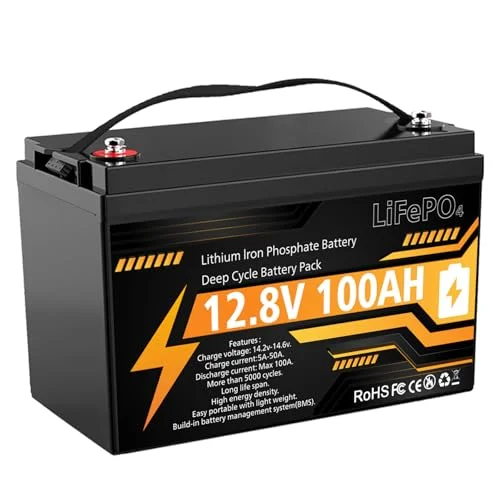
12V 100Ah LiFePO4 Lithium Battery, Group 31 Deep Cycle with 🏆 Editor’s Pick
| Battery Type | 12V LiFePO4 (Group 31) |
| Capacity | 100Ah (1280Wh) |
| BMS Rating | 100A smart BMS |
| Low-Temp Charging Cut-Off | Charging paused below 32°F (0°C) |
What We Found
This 12V 100Ah LiFePO4 battery is aimed at RV house power and solar storage, and it’s built around a compact Group 31 footprint. It weighs about 24 lbs and is marketed as a drop-in replacement for BCI Group 31 battery boxes, which matters if you’re upgrading without changing your compartment. The safety story centers on an upgraded 100A smart BMS protecting against overcharge, over-discharge, over-current, and short circuits. What I like for cold-season use is the stated low-temp charging behavior: it pauses charging below 32°F (0°C) to help prevent cell damage in freezing conditions. For lifespan, it cites 15,000+ cycles at 60% DOD and a 10-year service life. Charging is described with a 14.6V 20A LiFePO4 charger reaching full charge in about five hours, and the battery also supports expansion up to 4S4P for bigger off-grid setups.
Who It’s For
I’d shortlist this if you want a straightforward Group 31 lithium upgrade for RV house batteries or a marine trolling-motor/auxiliary bank where space is limited. The 100A BMS rating fits moderate inverter and accessory loads, especially when your system stays within normal lithium charging-voltage rules. If you like the idea of starting with one battery and scaling later, the stated 4S4P expandability is a plus. It’s geared more toward long-term cycling than quick payback.
✅ Pros
- Includes a 100A smart BMS with multiple hard protections, reducing risk in RV electrical setups.
- Low-temperature charging cut-off around 32°F helps preserve cells during cold camping.
- Drop-in Group 31 fit and lightweight construction simplify replacement versus lead-acid packs.
❌ Cons
- Exact terminal type, wiring guidance, and charge taper behavior depend on the included specs beyond the listing summary.
- The fast-charge claim assumes a compatible LiFePO4 charger and correct voltage settings.
- Capacity-life claims vary by depth-of-discharge and temperature, which requires careful real-world usage.
💬 Our Take
My read is that this is one of the more dependable “winter-capable” lithium picks in the set because the low-temperature charging cut-off is explicitly called out alongside a 100A BMS. That combo directly targets the most common lithium RV failure mode—trying to charge in freezing temps without the pack behaving correctly.
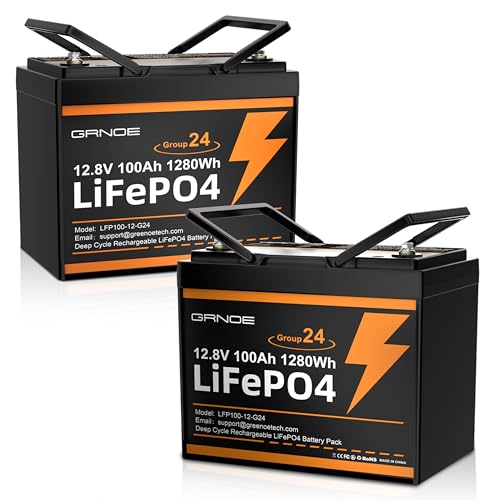
2 Pack 12V 100Ah LiFePO4 Batteries, Ultra-Light 21.9lb Each,🥈 Runner-Up
| Battery Type | 12V LiFePO4 (2-pack) |
| Capacity Per Battery | 100Ah |
| BMS Rating | 100A smart BMS |
| Form Factor | BCI Group 24 size |
What We Found
This is a 2-pack bundle of 12V 100Ah LiFePO4 batteries designed for buyers who want more house capacity without jumping straight to a single larger unit. Each battery uses Grade-A LiFePO4 cells and includes a 100A smart BMS with protection for overcharge, over-discharge, over-current, overvoltage, and short-circuit conditions. The listing also claims dustproof, moisture-proof, and salt-spray resistance, which is relevant if your RV sits in wet conditions or you’re using it in a marine setup. On the physical side, it lists about 21.9 lbs per battery and fits BCI Group 24 battery boxes. For scaling, it supports 4S4P expansion up to a 51.2V 400Ah bank. The rest of the marketing pushes real-life usage scenarios like “runs everything” style examples.
Who It’s For
I’d point people here when the Group 24 footprint is what you need, but you still want lithium benefits and longer cycling than lead-acid. It works well for RV trailers that need extra runtime for heavier use and for marine house-bank setups where you’re replacing older battery banks. If you’re building toward a multi-battery system, the series/parallel expansion option makes it easier to grow than buying only one fixed-capacity unit.
✅ Pros
- Buying two batteries increases usable capacity quickly without changing battery box size.
- Each unit includes a 100A BMS for strong protection against common lithium failure modes.
- Expansion support and tight weight make it practical for DIY off-grid builds.
❌ Cons
- Two-pack systems require careful monitoring of balance across charge cycles to avoid mismatched performance.
- Runtime claims for specific devices depend heavily on inverter efficiency and actual draw.
- No Prime listing and no rating data appear, so confirmation via independent reviews and warranty terms is important.
💬 Our Take
This one makes the most sense as an “add capacity quickly” lithium option in a Group 24 space—especially if you’re pairing it with a charger that’s set up for LiFePO4.
ECO-WORTHY 12V 280Ah Metal Case LiFePO4 Lithium Battery with
| Battery Type | 12V LiFePO4 (metal case) |
| Capacity | 280Ah (3584Wh Max) |
| BMS Rating | 200A BMS |
| Monitoring | Bluetooth app |
What We Found
The ECO-WORTHY 12V 280Ah LiFePO4 battery leans hard into physical durability and simplified installation thanks to its metal case design. The heavy-duty enclosure is positioned to improve heat resistance and fire protection, and it includes a weak-current power switch for one-touch output cut-off during safer installation or maintenance. It also states that no external battery box is required, using a rugged metal shell with four mounting feet for direct RV or camper installation—useful if you don’t have room for a separate box. Bluetooth monitoring is included for app-based visibility (voltage, capacity, and charge/discharge status), and it mentions shock/vibration resilience through internal structure and reinforced design. Safety is covered with a BMS and low-temperature charging cut-off, though the actual temperature thresholds aren’t provided in the details shown here.
Who It’s For
This battery targets people who prioritize a protective enclosure and cleaner mounting over lightweight convenience. It fits RVs and campers that want direct installation and more impact protection, and the 280Ah capacity suits longer off-grid stays, bigger fridge loads, and larger solar arrays. Bluetooth is a good match if you want quick diagnostics without extra meters. I’d also consider it for fleet-style use where vibration resistance matters more than getting the lightest pack.
✅ Pros
- Metal case design aims to improve heat and fire safety while enabling direct mounting in an RV.
- Bluetooth monitoring adds convenient visibility into battery status without additional hardware.
- Reinforced structure and internal holders support vibration-prone travel use.
❌ Cons
- The provided information does not specify exact low-temperature charging and discharge thresholds.
- Heavy metal enclosure generally reduces portability and may complicate mounting in tight bays.
- Random exterior label style suggests cosmetic inconsistency, which may matter to some buyers.
💬 Our Take
My take is that the metal enclosure plus app monitoring makes it appealing, but I’d be cautious because the low-temperature charging specifics are missing in the information provided here.
12V 100Ah LiFePO4 Lithium Battery, BCI Group 24 Deep Cycle S
| Battery Type | 12V LiFePO4 (Group 24) |
| Capacity | 100Ah (1280Wh) |
| BMS | Integrated BMS with over-temp protections |
| Low-Temp Protection | Charging disabled below 32°F (0°C) |
What We Found
SUPER EMPOWER’s 12V 100Ah LiFePO4 battery is clearly framed as an energy-storage unit, not for engine starting or cranking. It uses Grade A+ cells and lists deep-cycle performance claims of about 5,000 cycles at 100% DOD, 6,000 cycles at 80% DOD, and up to 15,000 cycles at 60% DOD. Protection-wise, it includes a BMS for overcharge, over-discharge, overcurrent, short circuit, and temperature extremes. Fit is a big part of the pitch: it’s built as a BCI Group 24 drop-in, with M8 terminals, dimensions around 6.49″ x 10.24″ x 8.98″, and a weight about 21.6 lbs. Charging guidance is also laid out in the summary, recommending LiFePO4 chargers in the 14.4–14.6V CC/CV range. Cold behavior is explicitly described: charging pauses below 32°F (0°C), discharge stops around -20°C (-4°F), and it resumes above 5°C (41°F).
Who It’s For
I’d recommend it to RV owners upgrading from lead-acid or AGM who want a clear Group 24 replacement with practical lithium charging guidance. It fits well in solar systems using MPPT/PWM controllers set to lithium mode. Because it’s not for cranking, it’s best treated as a house battery for lights, water pumps, and in-cabin electronics. If you camp in cold weather, the stated charging and discharge temperature behavior is a real advantage.
✅ Pros
- Clear cold-weather protection thresholds help prevent incorrect charging in winter storage.
- Provides a true Group 24 drop-in fit with M8 terminals and lead-acid replacement intent.
- Explicit charging guidance supports correct lithium voltage settings for solar and DC-DC systems.
❌ Cons
- Cycle-life claims assume specific testing conditions and may not match all real-world usage depths.
- No BMS amp rating appears in the provided summary, limiting load-compatibility confidence.
- Not intended for engine starting, which may surprise buyers expecting a hybrid function.
💬 Our Take
This comes across as an installation-friendly Group 24 lithium battery with unusually clear cold behavior and charging compatibility—exactly what I want when I’m trying to avoid winter lithium headaches.
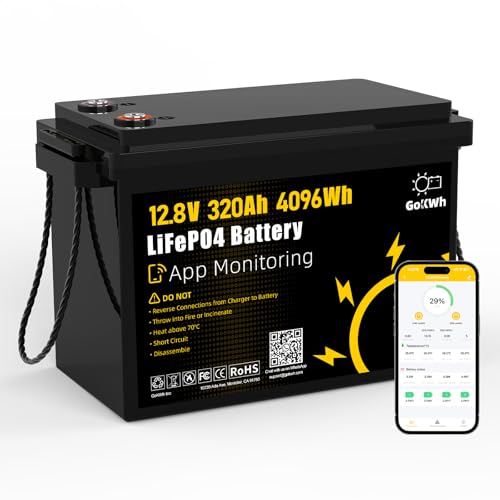
GoKwh 12V 320Ah LiFePO4 Lithium Battery with Bluetooth APP,
| Battery Type | 12.8V LiFePO4 (12V nominal class) |
| Capacity | 320Ah (4096Wh) |
| BMS Rating | 200A BMS |
| Low-Temp Protection | Discharge cut-off below -20°C (-4°F) |
What We Found
GoKwh’s 12V 320Ah LiFePO4 battery targets larger RV and off-grid energy storage needs and includes Bluetooth monitoring plus a built-in 200A BMS. It claims 4096Wh of energy from a 12.8V nominal battery and uses Bluetooth 5.0 to show live data like voltage, SOC, current, and temperature in a smartphone app. For safety, the 200A BMS is meant to protect against overcharge, over-discharge, short circuit, over-current, and overheating. Low-temperature protection is included via a discharge cut-off below -20°C (-4°F), which helps keep operation safer in cold conditions. The listing also describes an expandable 4P4S architecture that supports systems up to 51.2V (and very large energy banks). The positioning is aimed at RV appliances, Starlink, and camping electronics where steady output matters.
Who It’s For
I’d shortlist this for RVs, van builds, and cabins that run more than basic lights and need longer autonomy between charges. Bluetooth monitoring helps if you’re trying to spot charging issues early and manage your off-grid routine more confidently. It’s also a fit for solar setups where you might expand using series/parallel design. That said, it’s best when you already know the physical space and wiring plan you’ll need for a 320Ah-class pack.
✅ Pros
- High capacity and 200A BMS make it suitable for bigger RV electrical systems.
- Bluetooth monitoring provides practical visibility into temperature and current draw.
- Expandable system support fits multi-year off-grid growth plans.
❌ Cons
- The provided summary does not specify low-temperature charging cut-off values, which matter for winter recharge.
- Very large capacity may require careful installation planning and proper wire sizing for safe continuous loads.
- No Amazon rating data appears, so verification of real-world durability should rely on user feedback.
💬 Our Take
Strong capacity and monitoring for long off-grid stays—but my confidence is reduced because the low-temperature charging behavior isn’t clearly defined in the details provided here.
12.8V 300Ah Self-Heating LiFePO4 Lithium Battery with APP Mo
| Battery Type | 12V class LiFePO4 with self-heating |
| Capacity | 300Ah (3840Wh) |
| BMS Rating | 200A BMS |
| Monitoring | APP monitoring |
What We Found
This 12.8V 300Ah battery is built around self-heating, and that design choice is clearly meant to improve winter usability. It claims over 5,000 charge-discharge cycles at 100% depth of discharge, aiming to beat lead-acid lifespans for repeated cycling. Safety is handled with an advanced BMS that includes overcharge, over-discharge, low-temperature charging protection, overcurrent, and short-circuit controls, plus automatic cell balancing. The self-heating feature is intended to warm the pack before energy exchange so charging and discharging are smoother in cold temperatures. Bluetooth app monitoring is included for real-time observation of current, voltage, and temperature. It’s positioned for RV, trolling motor, marine, solar, camping, backup power, and off-grid use. Compared with non-heated packs, self-heating can reduce winter limitations, though real results depend on how much power the heater draws and how the control logic decides when to heat.
Who It’s For
This is the one I’d point to first for cold-climate RVers who want charging capability in winter—not just “it won’t break in the cold.” The self-heating feature is most useful in scenarios where a standard LiFePO4 pack would otherwise pause charging. It’s also a good match if you want app monitoring for real-time diagnostics during a trip. The 300Ah size supports longer fridge, lighting, and communications runs, assuming your power budget accounts for heater draw.
✅ Pros
- Self-heating is a meaningful advantage for cold-weather charging and winter usage continuity.
- Includes a feature-complete BMS with balancing and multiple safety protections.
- Bluetooth app monitoring supports proactive maintenance and troubleshooting.
❌ Cons
- Cycle-life and cold-performance claims may vary depending on heating behavior and ambient conditions.
- Self-heating adds complexity and can increase total energy consumption in deep winter.
- The provided summary does not include exact temperature thresholds for charging and discharge cut-offs.
💬 Our Take
My take is that this is the most cold-weather-forward concept in the list because self-heating directly targets frozen charging limits. Still, I’d want to verify how the heating control behaves in your actual temps before relying on it.
dumfume 12V 150Ah Lithium LiFePO4 Deep Cycle Battery Recharg
| Battery Type | 12V LiFePO4 (deep cycle) |
| Capacity | 150Ah (1920Wh) |
| BMS Rating | 100A BMS |
| Charge/Use Temperature Note | Performance requires temperatures of 5°C or higher |
What We Found
DUMFUME’s 12V 150Ah LiFePO4 deep-cycle battery emphasizes usable energy capacity, manageable weight, and standard lithium protections. It claims 1920Wh of energy and a cycle life above 4,000 cycles (to 80% capacity). The pack uses a built-in 100A BMS for overcharge, over-discharge, short circuit, and overheating protection. The listing also notes energy-storage-only use and says it needs a full maintenance cycle every six months during extended storage, which is unusual, but it aligns with some lithium storage guidance. Physically, it weighs about 22.05 lbs and measures around 13.05 x 6.78 x 8.66 inches, designed for compact placement in RV bays. Temperature protection is included, with a stated requirement of 5°C or higher for battery performance, and a warning that return shipping for low-temperature charging issues isn’t covered. Expansion is supported via up to 4S4P connections.
Who It’s For
I’d consider it for RV and off-grid users who want a mid-size 150Ah lithium pack without going all the way to the heavier 200–320Ah class. It fits solar backup and weekend camping where energy density and installation ease matter. The expansion option makes it attractive for DIY builders who want to scale voltage or capacity later. If you store batteries seasonally, you’ll need to follow the periodic cycling guidance mentioned in the listing, and you’ll want to stay within the stated temperature requirements to avoid charging-related problems.
✅ Pros
- Compact size and low weight support easier RV and van installations.
- Includes a 100A BMS for key protections against overcharge and short circuits.
- Provides series/parallel expansion support for custom off-grid systems.
❌ Cons
- Low-temperature charging and discharge thresholds are not precisely listed in the provided summary.
- Seasonal storage guidance and maintenance cycling requirement add owner overhead.
- Cycle-life claim uses a limited condition (to 80% capacity), which can reduce expected usable years.
💬 Our Take
This is a reasonable 150Ah choice for temperate climates and modular DIY setups, but the stricter temperature performance notes and limited cold-charging clarity keep it from being a higher-confidence winter pick.
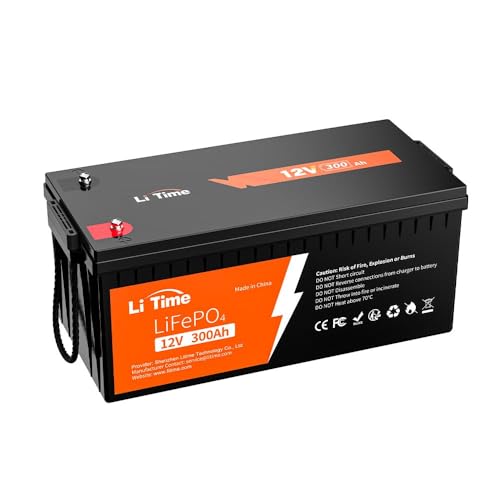
Litime 12V 300Ah LiFePO4 Battery, 12 Volt RV Lithium Battery
| Battery Type | 12V LiFePO4 (EV-grade cells) |
| Capacity | 300Ah (3840Wh) |
| BMS Rating | 200A BMS (ETL-tested) |
| Scalability | 4P4S expandable |
What We Found
Litime’s 12V 300Ah LiFePO4 battery is aimed at larger RV power needs and home backup style use, featuring a 200A BMS plus scalability claims. It uses EV-grade cells and states an ETL-tested 200A BMS that protects against overcharge, over-discharge, over-current, and short circuits. It also claims scalability up to 40.96kW via 4P4S, positioning it as a building-block for bigger installations. Cycle life is described as 10+ years with 4,000 cycles at 100% DOD, emphasizing deep cycling versus typical lead-acid limitations. Capacity is reported as 3840Wh, and it lists a maximum 2560W load. It’s also marketed as lightweight—about one-third the weight of lead-acid equivalents. The included cost-savings wording is more value framing than a technical performance spec.
Who It’s For
This fits users who want a larger 300Ah class energy bank for RV travel trailers, solar storage, or home backup. The 200A BMS is relevant for systems designed for higher continuous loads, as long as the wiring and charge setup follow lithium rules. It’s also a good pick for people planning to expand later via scalable architecture. If you’ll run heavier appliances, the stated 2560W load figure is a helpful reference point—but you’ll still want to confirm your actual inverter and wiring plan.
✅ Pros
- 200A BMS and EV-grade cell positioning support safer higher-load RV and backup use.
- High energy density and lightweight design improve space planning versus lead-acid.
- Scalability via 4P4S appeals to buyers building larger long-term solar systems.
❌ Cons
- Cycle life and performance claims depend on depth-of-discharge and charging practices that are not quantified with temperature conditions here.
- Low-temperature protection details are not included in the provided summary, which matters for winter use.
- The energy-cost claim is not directly verifiable from listed specs.
💬 Our Take
I see this as a capacity-strong, safety-focused option with expansion potential. My only caution is that winter-specific charging behavior and thresholds aren’t confirmed in the details provided here.
Litime 12V 320Ah Mini Lithium LiFePO4 RV Battery with Blueto
| Battery Type | 12V LiFePO4 (mini form factor) |
| Capacity | 320Ah (4096Wh) |
| BMS Protection | Over 20 protections; low-temp cut-off |
| Monitoring | Bluetooth 5.0 app |
What We Found
This Litime 12V 320Ah mini LiFePO4 battery focuses on tight-space installation while still offering substantial energy storage. It claims 4096Wh capacity and markets itself as about 70% lighter than multiple lead-acid 12V 100Ah units, which is aimed at RV compartments where space is the limiting factor. Bluetooth 5.0 monitoring is included for app-based visibility of voltage and SOC, and it also offers remote on/off control. Safety is supported by over 20 BMS protections, including a low-temperature cut-off along with over-charge and over-current limits. It lists a 10-year lifespan with 4,000–15,000 cycles depending on conditions, and it references EV-grade cells for longevity. For peak power, the listing summary references 2560W peak power, targeting common RV loads like refrigerators and lighting. The overall differentiator is compactness rather than specialized off-grid features.
Who It’s For
I’d recommend this for RV and trailer owners who want longer runtime without giving up cabinet or battery-bay space. The 320Ah capacity suits longer stays, higher-draw appliances, and off-grid communication gear. Bluetooth monitoring helps when you’re troubleshooting during extended trips, and remote on/off can help prevent unexpected drains when the battery isn’t in use. It also fits marine and solar installs where footprint matters most—assuming your charging voltages and wiring are already lithium-compatible.
✅ Pros
- High energy in a compact design makes it practical for small RV and trailer compartments.
- Bluetooth monitoring and remote on/off improve day-to-day battery management.
- Marketing emphasizes multiple BMS protections and long cycle-life targets for deep cycling.
❌ Cons
- The provided summary does not specify the exact BMS amp rating or detailed low-temperature cut-off thresholds.
- The 2560W peak claim depends on system conditions and inverter load behavior.
- No rating data appears, so real-world durability evidence should be verified separately.
💬 Our Take
This reads like a space-saving lithium RV battery with useful app controls and strong capacity. It’s held back for winter-first buyers by missing specifics on BMS ratings and cold thresholds in the provided details.
Dyness 12V 100Ah LiFePO4 Lithium Battery (2 Pack) BCI Group
| Battery Type | 12V LiFePO4 (2-pack) |
| Capacity Per Battery | 100Ah |
| BMS Rating | 100A smart BMS |
| Low-Temp Charging Protection | Disconnects below 32°F (0°C); resumes at 41°F (5°C) |
What We Found
Dyness lists this as a 2-pack option in a Group 31 form factor, built around 12V 100Ah LiFePO4 batteries. The units measure about 13.0 x 6.77 x 8.43 inches and weigh roughly 25.3 lbs, and the listing positions them as smaller and lighter than many lead-acid equivalents. Safety and credibility signals include A+ grade LiFePO4 cells, a 10-year lifespan claim, and certifications listed in the summary such as FCC, CE, RoHS, and UN38.3. The low-temperature protection is explicit: charging disconnects below 32°F (0°C) and charging resumes at 41°F (5°C). It also cuts off power at -4°F (-20°C) to protect the battery in extreme cold. Safety uses a smart 100A BMS for overcharge, over-discharge, overcurrent, overheating, and short circuits. The listing also states IP65 waterproofing and dust/salt-spray resistance, which is valuable for marine and wet-RV storage.
Who It’s For
This is a good fit for buyers who want a durable, cold-tolerant LiFePO4 bank for RV and marine use. The 2-pack option helps when you’re upgrading from a single lead-acid battery or building parallel capacity over time. Group 31 compatibility is helpful for RV house banks that use standard frames. If you camp in winter, the clearly stated charging resume and cutoff behavior is especially important. For solar storage, it works well as long as you use a LiFePO4 charger and keep the charge profile correct.
✅ Pros
- Clear low-temperature charging and extreme cutoff thresholds reduce winter charging risk.
- 100A BMS plus IP65-style weather resistance suits RV and marine environments.
- Certification and safety claims are presented more comprehensively than many listings.
❌ Cons
- Exact terminal type, parallel/series wiring limits, and included accessories are not detailed in the provided summary.
- No Amazon rating data appears, so performance verification relies on spec and external review confirmation.
- Two-pack setups still require matching charge conditions to keep aging consistent across units.
💬 Our Take
Dyness earns a strong position here because the low-temperature charging behavior is defined and paired with a 100A BMS safety approach. If cold-season protection is a priority, it’s one of the safer alternatives in this list.
What to Look For Before Buying
When you’re comparing the best lithium RV battery options, I’d start with LiFePO4 chemistry and a BMS that’s sized appropriately for your inverter and DC loads. Then I’d focus on low-temperature charging behavior—especially if your RV sees winter camping—because “safe discharge” isn’t the same thing as “safe charging.” Next, verify physical compatibility: battery-box size, terminal type, and mounting space. Finally, check that the listing includes clear charging instructions for lithium voltage profiles and look for rating/spec clarity signals before you buy.
Check Match the battery to your charging system and voltage profile
Match the battery to your charging system and voltage profile
Lithium packs need lithium-compatible charge voltages, commonly around 14.4–14.6V for bulk charging. If your alternator-to-battery DC-DC charger or solar controller isn’t set to a lithium profile, you can end up with undercharging or BMS-limited behavior that prevents proper recharge. If the battery pauses charging below freezing, plan around reduced charging in cold mornings. I would confirm your charger settings before installation instead of assuming it will “just work.”
Value Compare capacity and cycle life at the same depth of discharge
Compare capacity and cycle life at the same depth of discharge
Cycle-life claims aren’t interchangeable—an 80% DOD claim and a 100% DOD claim can mean very different realities. I’d favor listings that state cycles at a defined depth of discharge (like 60% or 80% DOD). Also remember: a smaller battery that you use deeper can wear faster than a bigger pack run more gently. Evaluate usable capacity, not only advertised amp-hours, and decide whether you want expansion options or prefer a fixed-capacity pack.
Rating Use rating signals and spec clarity when deciding
Use rating signals and spec clarity when deciding
In the information provided here, consistent Amazon rating data isn’t available, so the clearest differentiator becomes spec clarity. Look for detailed BMS protection functions, current ratings, and clearly stated temperature thresholds. Strong listings specify both charging cut-off and discharge cut-off values, not just one side of the equation. I’d also check warranty details and whether technical support information is present—because vague marketing beats can’t troubleshoot your charging setup.
Verify Verify real installation fit and electrical limits
Verify real installation fit and electrical limits
Before you fall in love with a lithium battery’s weight or cycle life, I’d confirm installation fit: BCI group size (like Group 24 or Group 31), terminal type (such as M8), and how it physically mounts in your bay. Lightweight claims help, but stable mounting and safe cable routing matter too. Make sure your wire gauge and fuse sizing match expected current, and if you plan series/parallel expansion, confirm BMS and balancing requirements. Good installation prevents sustained overload stress and heat build-up.
Frequently Asked Questions
What low-temperature feature matters most in a lithium RV battery?
The low-temperature charging cut-off is the biggest deal. Many LiFePO4 packs pause charging below around 32°F (0°C) to prevent damage. Discharge cut-offs also matter for safe operation when batteries get extremely cold, but charging behavior is the part that most often causes “why won’t my system recharge?” problems in winter. If you camp in cold temps, confirm both the charging cut-off and the charging resume temperature.
Can a lithium RV battery replace a lead-acid battery without changing the charging system?
Only if your charging system supports lithium charging profiles. LiFePO4 charging usually uses a CC/CV approach around 14.4–14.6V for bulk charge, with correct taper behavior and lithium-mode settings. A non-lithium charger can lead to incorrect voltages and force the BMS to limit charging, which reduces recharge performance and can stress the system. Solar controllers and DC-DC chargers should be set to lithium mode.
Is Bluetooth monitoring worth it for an RV lithium battery?
Bluetooth monitoring is helpful because it gives you visibility into state of charge, voltage, current, and temperature while you’re using the battery. That can make troubleshooting quicker—especially if you see charging pauses or unexpected drops. But it shouldn’t replace core safety features like a properly rated BMS and correctly stated low-temperature protections. I’d treat Bluetooth as convenience, not your safety system.
What size lithium battery is enough for typical RV use?
It depends on your daily loads and how long you want to stay off-grid between charges. A 100Ah-class battery can be enough for many weekend trips with careful load management, while 200–320Ah packs are better for longer stays or heavier draws (especially when an inverter runs). If you’re unsure, expansion options can help you start smaller and grow as your usage becomes clearer.
Are LiFePO4 batteries safe for RV and marine use?
LiFePO4 chemistry is widely chosen for improved thermal stability compared with other lithium types, but safety still depends on the BMS and correct wiring. Look for protections against overcharge, over-discharge, over-current, short circuits, and overheating. For wet or marine environments, check dust/moisture resistance claims (like IP ratings) and whether the battery enclosure is designed for those conditions.
🎯 Final Verdict
My top pick is the 12V 100Ah LiFePO4 Group 31 battery with a 100A smart BMS and a low-temperature charging cut-off around 32°F, because that directly addresses a common RV lithium problem—winter charging. The lightweight build and the long claimed 10-year life also point toward a dependable house-battery foundation. If you want a strong alternative, I’d look at the Dyness Group 31 option since its low-temperature charging resume/cutoff behavior is explicitly defined and backed by a 100A BMS approach. Choose the top pick, confirm your charger’s lithium voltage profile, and then upgrade with more confidence going into cold weather.