Choosing the best lithium battery for an RV gets complicated fast once winter camping and solar charging are in the mix. I see a common problem: some LiFePO4 batteries won’t behave well in the cold—either they limit charging or the protection logic is vague. And then there’s the practical side: RV setups usually follow familiar compartment sizing (Group 24 or Group 31), so “right on paper” capacity isn’t enough if the battery won’t physically drop in. In this review, I focus on the real things that matter for RV power—LiFePO4 energy storage capacity, BMS current protection, low-temperature charging behavior, and whether the battery scales for multi-module systems.
For an RV lithium battery system to work day-to-day, it needs more than a long cycle-life claim. I would expect LiFePO4 chemistry to handle typical RV temperatures safely, but the BMS has to be able to manage the real electrical stress you’ll throw at it—high charging currents, heavy loads, and worst-case short-circuit events. Cold weather is the deciding factor for many buyers, because shore power and generators may still try to charge when the cells are cold. Finally, compatibility matters: a true “drop-in” for your current battery box (often Group 24 or Group 31) beats an option that requires major rework. If your power situation changes often, monitoring (Bluetooth/app or similar) is also worth considering.
⚡ Quick Verdict
Our Top Picks at a Glance
| Image | Product | Score | Link |
|---|---|---|---|
 |
12V 100Ah LiFePO4 Lithium Battery, Group 31 Deep Cycle with 🏆 Editor’s Pick |
9.2/10 |
View on Amazon Free Shipping & 30-Day Returns |
 |
2 Pack 12V 100Ah LiFePO4 Batteries, Ultra-Light 21.9lb Each, 🥈 Runner-Up |
8.6/10 |
View on Amazon Free Shipping & 30-Day Returns |
 |
GoKwh 12V 320Ah LiFePO4 Lithium Battery with Bluetooth APP, | 8.3/10 |
View on Amazon Free Shipping & 30-Day Returns |
 |
12V 100Ah LiFePO4 Lithium Battery, BCI Group 24 Deep Cycle S | 7.9/10 |
View on Amazon Free Shipping & 30-Day Returns |
 |
ECO-WORTHY 12V 280Ah Metal Case LiFePO4 Lithium Battery with | 7.3/10 |
View on Amazon Free Shipping & 30-Day Returns |
 |
12V 600Ah LiFePO4 Lithium Battery with 200A BMS 7680Wh, Up t | 7.8/10 |
View on Amazon Free Shipping & 30-Day Returns |
 |
12.8V 300Ah Self-Heating LiFePO4 Lithium Battery with APP Mo | 8.1/10 |
View on Amazon Free Shipping & 30-Day Returns |
 |
dumfume 12V 150Ah Lithium LiFePO4 Deep Cycle Battery Recharg | 6.8/10 |
View on Amazon Free Shipping & 30-Day Returns |
 |
Dyness 12V 100Ah LiFePO4 Lithium Battery (2 Pack) BCI Group | 8.8/10 |
View on Amazon Free Shipping & 30-Day Returns |
 |
Litime 12V 300Ah LiFePO4 Battery, 12 Volt RV Lithium Battery | 8.0/10 |
View on Amazon Free Shipping & 30-Day Returns |
📋 How We Evaluated
Each battery was evaluated for build confidence, including LiFePO4 cell claims and the protection coverage of its built-in BMS. Performance review focused on stated cycle life, capacity stability, and low-temperature charging or discharge cutoffs for RV realities. Value and suitability considered watt-hours, fitment (Group 24/31 or metal case installation), expandability options, and available Amazon-style rating signals, even when ratings were not provided.
Detailed Reviews
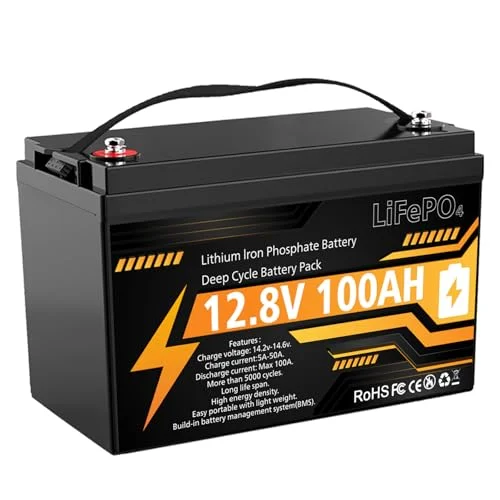
12V 100Ah LiFePO4 Lithium Battery, Group 31 Deep Cycle with 🏆 Editor’s Pick
| Chemistry | LiFePO4 |
| Rated Capacity | 12V 100Ah (1280Wh) |
| BMS Rating | 100A smart BMS |
| Low-Temperature Charging Cutoff | Stops charging below 32°F (0°C) |
What We Found
This 12V 100Ah LiFePO4 battery is clearly aimed at an RV house-battery replacement with a Group 31 drop-in design. The built-in smart 100A BMS is meant to cover the protections you actually worry about—overcharge, over-discharge, over-current, and short circuits. What stands out is the automatic low-temperature cut-off that prevents charging below 32°F (0°C), which is exactly the kind of cold-weather safeguard many RV setups need. The listing also pairs longevity claims (15,000+ deep-cycle life at 60% DOD, plus a stated 10-year service life) with a lightweight design at about 24 lbs—around 70% lighter than comparable lead-acid options. For system growth, it also supports 4S4P expansion up to 51.2V and 400Ah.
Who It’s For
I would shortlist this if you want an easier RV upgrade that fits an existing Group 31 battery compartment. It makes the most sense for owners who camp in colder months or who know their system might get recharged while temps are low, since the low-temp charging cut-off is explicitly called out. The 100Ah capacity is a practical target for typical RV house loads like lighting and electronics, plus refrigeration support, as long as your actual daily energy use stays within a reasonable depth-of-discharge plan. It’s also a fit if you’re building around solar or alternator charging, provided your charger and wiring stay within the BMS current limits.
✅ Pros
- Smart 100A BMS covers overcharge, over-discharge, over-current, and short circuits for added safety.
- Low-temperature charging cut-off at 32°F helps prevent common winter charging mistakes.
- Group 31 form factor and 24 lb weight make installation and swapping simpler than lead-acid.
❌ Cons
- No price or rating data makes total value harder to verify before purchase.
- Expansion claims are strong, but real-world paralleling depends on charger and wiring configuration.
- Capacity claims assume typical cycling practices and depth-of-discharge habits.
💬 Our Take
My read is that this earns the top spot for one reason: it combines an RV-friendly Group 31 fit with clearly stated cold-weather charging protection. It hits the balance between safety features, installability, and the kind of lifespan claims you want to see for a 12V house-battery upgrade.
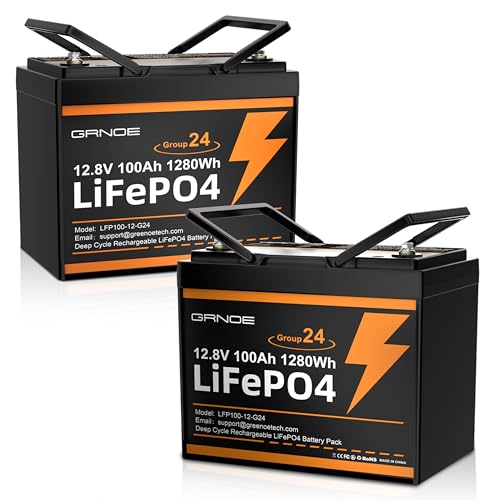
2 Pack 12V 100Ah LiFePO4 Batteries, Ultra-Light 21.9lb Each,🥈 Runner-Up
| Chemistry | LiFePO4 |
| Pack Configuration | 2× 12V 100Ah |
| BMS Rating | 100A smart BMS per battery |
| Expandability | Up to 4S4P |
What We Found
This listing is essentially two 12V 100Ah LiFePO4 batteries bundled together, and each unit includes a 100A smart BMS. On the safety side, the claims cover overcharge, over-discharge, over-current, overvoltage, and short-circuit protection. It also calls out environmental resistance—dustproof, moisture-proof, and salt-spray resistance—which matters for road conditions and wet storage. The pair approach increases available capacity for an RV house bank without forcing you into a completely different physical setup. Weight is also friendly at about 21.9 lb per battery, which makes lifting and installation more manageable. The listing is built around longevity too, with 15,000 cycles claimed at 60% DOD per battery, and it supports 4S4P expansion for larger multi-module systems.
Who It’s For
This is best for RVers who want more reserve capacity than a single 100Ah battery can provide—especially if you run refrigeration more often, rely heavily on onboard electronics, or stay off-grid longer. Group 24 fitment is part of the pitch here, so it can work well for compact boxes that still need more energy. I would also see this as a good route for solar setups, since spreading energy across two BMS-managed modules can reduce how aggressively you’d need to cycle a smaller single unit.
✅ Pros
- Two batteries provide immediate capacity growth for RV house loads.
- Dual 100A BMS protection increases safety margins during charge and discharge spikes.
- Group 24 size supports drop-in upgrades for many RV and marine compartments.
❌ Cons
- Price and rating data are missing, which limits value comparison against single-battery alternatives.
- Running two units still requires correct wiring and a compatible charge profile for LiFePO4.
- Capacity-per-cycle claims depend on maintaining typical DOD and temperature ranges.
💬 Our Take
My take is that the 2-pack format is a smart compromise when you need more amp-hours right away, without jumping to an oversized single battery. It stays dependable thanks to the included 100A BMS on each unit.
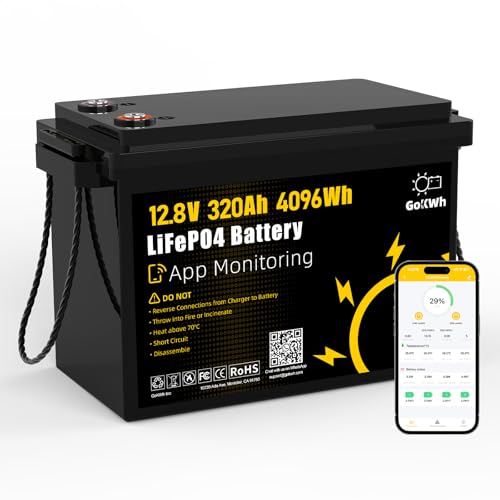
GoKwh 12V 320Ah LiFePO4 Lithium Battery with Bluetooth APP,
| Chemistry | LiFePO4 |
| Rated Capacity | 12.8V 320Ah (4096Wh) |
| BMS Rating | 200A with protection |
| Low-Temp Discharge Protection | Cutoff below -20°C (-4°F) |
What We Found
This GoKwh 12V 320Ah LiFePO4 battery is positioned around two themes: monitoring and higher capacity for longer runtime. The Bluetooth 5.0 app monitoring is described as real-time tracking of voltage, current, battery level, and temperature, with alerts meant to help you manage your power system while traveling or when solar output changes. On protection, it includes a built-in 200A BMS, with overcharge, over-discharge, short-circuit, over-current, and overheating protection listed. Low-temperature behavior is referenced through a cut-off aimed at discharge below -20°C (-4°F), helping protect performance during colder travel. For expandability, the listing supports a 4P4S system configuration, with marketing up to 51.2V / 65.54kWh. For RV buyers, the headline energy is 4096Wh from the 12.8V 320Ah design.
Who It’s For
I would point this toward full-time RVers, larger travel trailers, or off-grid cabins that need long runtime for refrigeration and constant electronics. The 320Ah size is also a good fit if you’d rather use fewer battery modules while covering more daily energy demand. If you like the idea of oversight without adding extra hardware like a shunt display, the Bluetooth monitoring is a strong reason to consider this unit. The 200A BMS is helpful too when inverter loads or charging currents are higher—assuming your system wiring and charger are matched properly.
✅ Pros
- Bluetooth 5.0 monitoring adds convenience for tracking voltage, current, and temperature on the go.
- A 200A BMS supports stronger load and charging headroom than many 100A class units.
- High 320Ah capacity supports long RV stays without deep cycling.
❌ Cons
- Battery expansion to large kWh systems increases complexity and requires careful balancing and configuration.
- No explicit low-temperature charging cutoff details were provided in the listing text.
- Missing price and rating data makes the cost per watt-hour hard to validate.
💬 Our Take
This is a strong option for people who want both capacity and app visibility. Cold-discharge protection plus a 200A BMS puts it a step above many smaller 100Ah-class batteries for higher-demand RV setups.
12V 100Ah LiFePO4 Lithium Battery, BCI Group 24 Deep Cycle S
| Chemistry | LiFePO4 |
| Rated Capacity | 12V 100Ah (1280Wh) |
| BMS Rating | 100A |
| Cold Charging Behavior | Charging pauses below 32°F (0°C) |
What We Found
This SUPER EMPOWER 12V 100Ah LiFePO4 battery focuses on RV drop-in compatibility and clear cold-weather charging rules. It’s targeted at BCI Group 24 sizing, with listed dimensions of 6.49″D x 10.24″W x 8.98″H and a weight of 21.6 lb. The built-in BMS is described for overcharge, over-discharge, overcurrent, short circuit, and temperature extreme protection. The listing includes a specific charging logic: charging pauses automatically below 32°F (0°C), and discharge stops at -20°C (-4°F) with resuming above 5°C (41°F). Cycle life is also described, including about 5,000 cycles at 100% DOD and up to 15,000 cycles at 60% DOD. It also reinforces that the battery is for energy storage only, not engine starting or cranking.
Who It’s For
I’d consider this if you’re working with a Group 24 battery bay and you want a straightforward lead-acid/AGM-style replacement. The explicit charging pause below freezing is especially useful when shore power or a generator might attempt to recharge the battery during winter. 100Ah is a practical capacity target for many RV “house power” systems that rely on efficient loads like LED lighting and thoughtful inverter use. If you want a predictable LiFePO4 charging experience with a listed cold-weather behavior, this reads like a more controlled option than vague listings.
✅ Pros
- Group 24 sizing and 21.6 lb weight support easier drop-in swaps in common RV battery boxes.
- Clear low-temperature charging pauses below 0°C reduce cold-damage risk.
- Multiple cycle-life scenarios provide more realistic expectations than one-number claims.
❌ Cons
- The text does not specify an exact charge current limit for the BMS in amps, which affects planning.
- No price or rating data limits confidence in value versus competing 100Ah models.
- It requires LiFePO4-compatible charging profiles, which may involve replacing an existing charger.
💬 Our Take
This one’s strongest for its detailed low-temperature charging behavior and compact Group 24 fit. My only hesitation is value confidence—because pricing and ratings weren’t available in the provided listing data.
ECO-WORTHY 12V 280Ah Metal Case LiFePO4 Lithium Battery with
| Chemistry | LiFePO4 |
| Rated Capacity | 12V 280Ah (3584Wh) |
| BMS Rating | 200A with protection |
| Enclosure Type | Metal case with mounting feet |
What We Found
The Eco Worthy 12V 280Ah LiFePO4 battery emphasizes a physical, enclosed design plus installation convenience. It uses a heavy-duty metal enclosure intended for better heat resistance and fire protection, and it includes a weak-current one-touch output switch for safer maintenance. The listing claims you don’t need an extra battery box, using four mounting feet for direct installation in an RV or camper. Like other LiFePO4 options here, it also includes Bluetooth monitoring and a built-in BMS that cuts off charging in low temperatures. It highlights shock and vibration resistance for road use, and it states a 200A BMS. While the listing positions this for RV, off-grid solar, and home use, the cold-weather specifics and cycle-life clarity are less detailed in the provided text than with some competitors.
Who It’s For
This is a good match for RV owners who want a rugged battery they can mount directly without reworking cabinetry. The 280Ah size is aimed at mid-to-large house banks with frequent fridge and entertainment loads. Bluetooth monitoring helps if you want temperature and power status without relying on extra meters. I’d also see it as a fit for rougher routes—where vibration tolerance and a metal enclosure are more than just marketing.
✅ Pros
- Metal case construction supports improved heat resistance and safer installation habits.
- Built-in Bluetooth monitoring gives real-time status via a mobile app.
- Low-temperature charging cutoff and reinforced mounting make it suitable for travel on rough roads.
❌ Cons
- Low-temperature thresholds are not stated precisely in the provided text, which complicates winter planning.
- Missing explicit cycle-life figures reduces confidence versus competitors with specific cycle claims.
- No price and rating data makes value comparison uncertain.
💬 Our Take
I’d lean toward it for RV builds that need a tough enclosure and direct-mount flexibility. The limitation is that the low-temp thresholds and cycle-life specifics aren’t as precisely communicated here as they are on some better-documented units.
12V 600Ah LiFePO4 Lithium Battery with 200A BMS 7680Wh, Up t
| Chemistry | LiFePO4 |
| Rated Capacity | 12V 600Ah (7680Wh) |
| BMS Rating | 200A BMS |
| Weather Protection | IP65 waterproofing |
What We Found
This 12V 600Ah LiFePO4 battery is aimed at maximum stored energy, with a stated 7680Wh capacity and a heavy-duty 200A BMS. The listing claims extended cycle life—often exceeding 8000 cycles at 80% DOD—and it mentions a BMS feature that activates balancing when voltage exceeds 14.1V. Low-temperature charging support is included as part of the protection set, along with over-current and short-circuit protection. It also positions the battery for harsher conditions with an IP65 waterproofing claim, which aligns with outdoor-friendly installations. For system design, it supports series/parallel expansion to build a 48V system (4 in series) or increase capacity (4 in parallel), with a recommendation not to exceed four units. The warranty is listed as five years, and the overall design reads more like a power-wall or solar/inverter system component than a compact RV battery bay solution.
Who It’s For
I’d see this as a fit for large RV builds, full off-grid systems, and residential-style power setups that need maximum energy at 12V. 600Ah is designed for long stretches without charging and for supporting heavier inverter loads. The IP65 and metal build suggest a more outdoor-oriented installation strategy too. In practice, it’s typically a project battery—meaning wiring, fusing, and expansion planning matter a lot before you mount anything.
✅ Pros
- Massive 600Ah capacity fits high-demand RV and off-grid storage plans.
- IP65 waterproofing supports outdoor and weather-exposed installations.
- BMS balancing behavior helps maintain consistency when charging reaches higher voltages.
❌ Cons
- Weight at about 104 lb makes installation and maintenance significantly more difficult.
- Expansion guidance can limit future growth to avoid exceeding recommended configurations.
- No explicit low-temperature charge cutoff temperature is included in the provided text.
💬 Our Take
This is a serious storage option for big RV energy systems and solar backup. The tradeoff is complexity, plus the provided text doesn’t include specific low-temperature charging cutoff thresholds.
12.8V 300Ah Self-Heating LiFePO4 Lithium Battery with APP Mo
| Chemistry | LiFePO4 |
| Rated Capacity | 12.8V 300Ah (3840Wh) |
| BMS Rating | 200A |
| Cooling Protection Feature | Self-heating for low-temperature performance |
What We Found
This 12.8V 300Ah LiFePO4 battery is centered on cold-weather resilience through a self-heating function. It claims over 5,000 cycles at 100% DOD and includes an enhanced 200A BMS to protect against overcharging, over-discharging, low-temperature charging, overcurrent, and short circuits. It also describes automatic cell balancing to help keep performance more stable over time. For day-to-day visibility, there’s an app that monitors current, voltage, temperature, and cycle count in real time—useful for understanding what the battery is doing while solar output or driving-charging behavior changes. The self-heating feature is intended to improve charge/discharge consistency in cold conditions so the battery stays ready for camp use. The battery is positioned at 3840Wh for RV appliances, trolling motor use, and backup applications. The listing text provided doesn’t include exact heating watt limits for the heating behavior.
Who It’s For
This is the type of battery I’d consider if you regularly camp in freezing conditions and you want fewer charging interruptions. Self-heating is especially relevant if you’ve dealt with batteries that struggle to accept charge when they’re cold-soaked. The 300Ah size supports longer off-grid stays with refrigeration and frequent electronics. App monitoring is also a plus if you want visibility into temperature and charging status without adding extra meters.
✅ Pros
- Self-heating reduces cold-weather charging issues compared to batteries that simply pause charge.
- 200A BMS adds strong protection headroom for RV inverter and solar systems.
- APP monitoring supports more accurate day-to-day energy management.
❌ Cons
- Self-heating behavior details are not quantified in the provided listing text.
- No pricing and rating data limits confidence in value versus standard LiFePO4 units.
- Cycle-life claims may depend on using recommended charging profiles and temperature conditions.
💬 Our Take
This model fits RVs that face cold mornings and want more dependable charging behavior. The self-heating feature is the main differentiator—even if the exact heating specs and value signals aren’t clear from the provided text.
dumfume 12V 150Ah Lithium LiFePO4 Deep Cycle Battery Recharg
| Chemistry | LiFePO4 |
| Rated Capacity | 12V 150Ah (1920Wh) |
| BMS Rating | 100A |
| Operational Temperature Note | Reliable performance at 5°C or higher |
What We Found
The DUMFUME 12V 150Ah LiFePO4 battery is aimed at mid-size RV and solar storage with an emphasis on lightweight installation and safety. The listing claims 1920Wh of energy and 4000+ cycles, with service life described as an improvement over lead-acid. Safety is based on a built-in 100A BMS covering overcharge, over-discharge, short circuit, and overheating protection. Low-temperature protection is referenced via a temperature protection requirement, with reliable operation stated at temperatures of 5°C or higher. It supports series and parallel expansion up to 4S4P, so you can build custom voltage/capacity arrays. One practical note is that extended storage requires a full maintenance cycle every six months, which matters for seasonal RV storage. It also mentions that return shipping for low-temperature charging issues isn’t covered.
Who It’s For
This is best if you’re coming from lead-acid and want a smaller step than many 200Ah+ systems. The 150Ah capacity can suit many travel trailers with moderate inverter usage and steady fridge performance. It’s also a reasonable match for solar storage when charging happens above the stated temperature requirement. The lighter build helps when access is tight in cabinets or under-bed compartments.
✅ Pros
- 150Ah capacity offers a practical middle ground for many RV house banks.
- A 100A BMS provides essential protection against common lithium failures.
- Compact weight and dimensions simplify placement in RV storage areas.
❌ Cons
- Low-temperature capability is described more as a requirement than a quantified cutoff.
- A maintenance-cycle note suggests extra care for seasonal storage.
- Missing price and rating data makes value and reliability harder to verify.
💬 Our Take
My read is that this works well for moderate-load RVs in temperate conditions. For winter use, the cold-weather limitation and unclear cutoff details reduce my confidence.
Dyness 12V 100Ah LiFePO4 Lithium Battery (2 Pack) BCI Group
| Chemistry | LiFePO4 (A+ grade) |
| Rated Capacity | 12V 100Ah |
| BMS Rating | 100A smart BMS |
| Low-Temp Charging Cutoff | Disconnects below 32°F (0°C); resumes at 41°F (5°C) |
What We Found
Dyness offers a 12V 100Ah LiFePO4 battery designed for Group 31 fitment and quick replacement in common RV battery compartments. It’s listed at about 25.3 lb and uses A+ grade LiFePO4 cells. The low-temperature charging protection is stated clearly: charging disconnects when battery temperature drops below 32°F (0°C), and charging resumes at 41°F (5°C). It also claims power cut-off at -4°F (-20°C). For safety, the listing describes a smart 100A BMS with protection against overcharge, over-discharge, overheating, and short circuits, plus dust and salt-spray resistance and an IP65 waterproofing claim. The listing also pushes LiFePO4-specific charging and mentions a recommended recharge rate. Expandability supports 4S4P, with multi-module scaling up to 20.48kWh.
Who It’s For
I would shortlist Dyness for RV owners who want a compact Group 31 solution with clear cold-weather charging behavior. The charging cutoff/resume temperatures help reduce the risk of winter misuse when you’re shore charging. The 100Ah capacity works for typical weekend camping loads and shorter off-grid trips. The IP65 and safety coverage also make it attractive for marine-like environments and vibration exposure where protection matters.
✅ Pros
- Explicit cold-weather charging cutoff and resume temperatures are clear for winter planning.
- IP65 and salt-spray resistance claims support travel and marine suitability.
- Group 31 sizing and reasonable weight support straightforward RV battery box replacement.
❌ Cons
- Listed as a 2-pack product, but capacity planning must account for the pair’s total system wiring.
- Charging guidance references a specific charger model and recharge rate, limiting flexibility.
- No price or rating data is provided to confirm value.
💬 Our Take
Dyness stands out because the low-temperature charging thresholds are precise, not implied. It looks like an excellent winter-capable option—as long as your charging setup is truly compatible with LiFePO4.
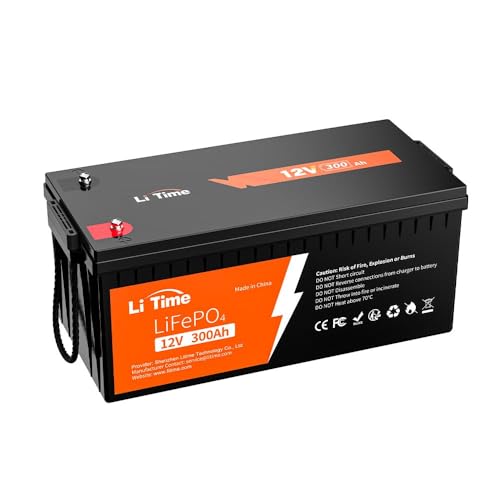
Litime 12V 300Ah LiFePO4 Battery, 12 Volt RV Lithium Battery
| Chemistry | LiFePO4 (EV grade cells) |
| Rated Capacity | 12V 300Ah (3840Wh) |
| BMS Rating | 200A ETL tested BMS |
| Expandability | Up to 4P4S |
What We Found
Litime’s 12V 300Ah LiFePO4 battery is built around EV-grade cells and an ETL-tested 200A BMS. The protection list includes overcharge, over-discharge, over-current, and short circuit. The listing positions cycle life as 15,000 deep cycles and also references 10+ year lifespan, along with 4000 cycles at 100% DOD, aiming at long service intervals. Expandability supports 4P4S configurations for scaling to higher systems, and it’s presented as suitable for solar storage growth. The battery is rated at 3840Wh energy and includes an approximate load rating of 2560W. The design leans on weight savings and energy density compared to lead-acid. One notable omission in the provided text: it doesn’t include a specific low-temperature charging cutoff temperature.
Who It’s For
This is a good pick for RV owners who want 300Ah capacity with more BMS headroom than 100A-class units, especially if you plan for inverter loads or solar-heavy use. The 200A BMS suits more demanding use cases, as long as your wiring, fusing, and charging profile match the system. Expandability is helpful if you want to add batteries later rather than rebuilding everything from scratch. It also fits off-grid RVs and travel trailers where a larger single 12V module is manageable and the charging profile stays aligned with LiFePO4 needs.
✅ Pros
- EV-grade cells and a 200A ETL tested BMS strengthen safety and usability for higher loads.
- 300Ah capacity supports longer RV off-grid runtime without frequent deep cycling.
- Expandable architecture fits buyers planning system growth.
❌ Cons
- Specific low-temperature charging cutoff temperatures are not stated in the provided text.
- Cycle life claims conflict in emphasis between 15,000 deep cycles and 4000 cycles at 100% DOD.
- Missing price and rating data reduces ability to judge cost-effectiveness.
💬 Our Take
This is a capable 300Ah-class option with a BMS that’s sized for more serious RV demands. If you camp in cold weather, my advice is to confirm the charging cutoff details before choosing.
What to Look For Before Buying
A good RV lithium battery choice comes down to three things: safety, fitment, and how it behaves under the real conditions of travel. I would start by matching the battery’s capacity and voltage to your system needs, then check that the BMS current limits can actually handle both charging and inverter draw. Cold-weather use is where vague claims fall apart, so you want explicit low-temperature charging and discharge cutoffs—not just “works in winter” language. Finally, verify the battery physically fits your compartment—Group 24 or Group 31 is often the deciding dimension—before thinking about expandability.
Check Match BMS rating to your charging and inverter loads
I look at the BMS rating as protection for worst-case moments: alternator peaks, inverter startup, and any sudden load spikes. Make sure the BMS covers over-current and short-circuit safeguards, not just overcharge/over-discharge. A higher BMS rating can add robustness, but it still has to match your wiring gauge and fuse sizing. And if the listing mentions a low-temperature cutoff, confirm it applies to charging behavior—because that’s what matters most when shore power or a generator is still trying to charge a cold battery.
Value Compare real energy (Wh) and usable capacity
For RV planning, I prioritize energy in Wh over marketing Ah alone. Check cycle life at a stated depth of discharge (DOD), since “more cycles” at 60% DOD is often more realistic for daily use than numbers at 100% DOD. If you want predictable runtime for refrigeration, fans, and electronics, estimate how many of your daily watt-hours you can realistically pull without pushing the battery too hard.
Rating Use rating signals and documentation quality
When ratings and reviews are available, I focus on consistency—especially comments about real-world longevity and cold charging. When rating data is missing, documentation quality becomes more important: clear cutoff temperatures, charger compatibility notes, and installation guidance should be easy to find. I also like listings that clearly state scope—energy storage only vs. starting battery—and include wiring warnings. If both charging and discharge temperature behavior are spelled out, that usually reduces surprises later.
Verify Verify physical fit and charger profile compatibility
RV battery boxes are often built around Group 24 or Group 31 sizing, so measure the compartment before ordering. Confirm terminal type and mounting points match what you already have, and double-check the battery will actually drop in. Then make sure your charging system uses a LiFePO4-compatible profile—often CC/CV around the 14.4–14.6V range—and avoid chargers that aren’t lithium-tuned. If you’re planning to expand, confirm modules will work together with compatible BMS logic and a wiring design that respects current and fusing requirements.
Frequently Asked Questions
What low-temperature protection should a lithium RV battery have?
For real cold-weather safety, I look for both charging and discharge protections. A common setup is a charging pause below 32°F (0°C) and discharge protection at colder temperatures like -4°F (-20°C). The key is that the listing explains both sides—charging cutoff and discharge limit—so a shore power or generator charge attempt doesn’t damage cold cells.
Can a lithium battery replace an RV lead-acid battery directly?
Many LiFePO4 batteries are designed as drop-in replacements in Group 24 or Group 31 sizes, but it’s not automatically guaranteed. You still need to verify terminal layout, battery box dimensions, and that your charging system matches a LiFePO4 voltage profile. If your RV charger or alternator expects lead-acid behavior, you may need a lithium-compatible charger profile or a DC-DC converter. Also confirm it’s rated for energy storage, not engine starting.
Is Bluetooth monitoring necessary for an RV lithium battery?
Bluetooth monitoring isn’t strictly required, but it can be a practical upgrade. It can supplement or replace a shunt display by showing voltage, current, and temperature in real time. For buyers who don’t already have monitoring equipment, app monitoring can reduce guesswork and improve daily power management. If your RV already has a battery monitor system, you may not need extra Bluetooth features.
What happens if the battery is charged with a non-lithium charger?
Non-lithium chargers can apply voltage profiles that aren’t safe for LiFePO4 chemistry. That may trigger BMS shutdowns or, in worst cases, accelerate wear. Many listings specifically say to use LiFePO4-compatible chargers and correct CC/CV settings (often with a lithium mode). If you’re unsure, use a charger tuned for LiFePO4 or a system controller/MPPT that’s compatible with the chemistry.
How many batteries are needed for a typical RV weekend off-grid?
Battery count depends on daily watt-hour usage and how much depth of discharge you’re comfortable with. For example, a 12V 100Ah battery is about 1280Wh at the pack level, but many RV setups try to stay at partial DOD for longevity—so usable energy might be closer to 60% for daily cycling. Start by estimating your daily loads, multiply by the number of days, then divide by your expected usable Wh to size the pack.
🎯 Final Verdict
In this lineup, the best lithium battery for RV use is the 12V 100Ah LiFePO4 Group 31 model with the smart 100A BMS and an explicit low-temperature charging cut-off below 32°F. That combination targets the biggest winter problem—unsafe charging in the cold—while still lining up with the 15,000+ cycle claim. If you need more capacity immediately, I would shortlist the 2-pack Group 24 alternative as the strongest backup because it effectively doubles your available amp-hours with 100A BMS protection on each unit. Pick the Group 31 top option if winter charging behavior is your priority, and go with the 2-pack when your daily house loads are the main concern.