Choosing the best lithium battery for off grid solar usually comes down to compatibility—and that’s where most buyers stumble. It’s easy to grab a “bigger is better” battery, only to realize the inverter voltage, BMS limits (charge/discharge current), and low-temperature charging behavior don’t line up with the way your solar is set up. Another common trap: buying a “solar kit” where the battery size can’t realistically cover overnight loads like refrigerator start-up. The result is shortened runtimes, nuisance cutouts, and a setup experience that turns into troubleshooting instead of commissioning. My take is to compare the battery on real stored capacity, safe operating limits, and whether the monitoring and protection features match your off-grid day-to-day needs.
A good off-grid lithium battery choice depends on the system voltage, how many watt-hours you actually use per day, and what you can physically install (space, wiring, and weight). If you’re building a full off-grid cabin or a home backup setup, 48V batteries are often easier to manage because they reduce current and make wiring and inverter load handling more efficient. For RVs and travel applications, 12V packs still make a lot of sense since many inverters and accessories are built around that ecosystem. Most of the options here are LiFePO4 because it tends to deliver long cycle life and better thermal stability, but BMS quality still matters—especially current limits, low-temp cutoffs, and balancing behavior. Monitoring also plays a real role: off-grid systems benefit when you can see SOC, charge activity, and any abnormal events before they become a problem.
⚡ Quick Verdict
Our Top Picks at a Glance
| Image | Product | Score | Link |
|---|---|---|---|
![[Ultra] ECO-WORTHY 1200W 24V 5.52KWH Lithium Battery Solar S](https://m.media-amazon.com/images/I/51P5Lhco8WL._SL500_.jpg) |
[Ultra] ECO-WORTHY 1200W 24V 5.52KWH Lithium Battery Solar S 💰 Best Value |
7.6/10 |
View on Amazon Free Shipping & 30-Day Returns |
 |
ECO-WORTHY 12V 280Ah Metal Case LiFePO4 Lithium Battery with 🥈 Runner-Up |
8.7/10 |
View on Amazon Free Shipping & 30-Day Returns |
 |
DJLBERMPW 48V 100Ah LiFePO4 Lithium Battery,8000+ Deep Cycle | 8.1/10 |
View on Amazon Free Shipping & 30-Day Returns |
 |
LiTime 12V 20A Lithium Battery Charger 14.6V LiFePO4 Battery | 7.3/10 |
View on Amazon Free Shipping & 30-Day Returns |
 |
ECO-WORTHY Powermega 48V 314Ah(2 Pack) LiFePO4 Battery Energ 🏆 Editor’s Pick |
9.3/10 |
View on Amazon Free Shipping & 30-Day Returns |
 |
ECO-WORTHY 12V 100AH LiFePO4 Lithium Battery with SOC Displa | 7.9/10 |
View on Amazon Free Shipping & 30-Day Returns |
 |
ECOBOSS 12V 200Ah LiFePO4 Battery, 2560Wh Deep Cycle Lithium | 8.4/10 |
View on Amazon Free Shipping & 30-Day Returns |
 |
AOUSK 48V 314Ah Lifepo4 16.07kWh Lithium Battery, Build in 2 | 8.8/10 |
View on Amazon Free Shipping & 30-Day Returns |
 |
1200W 25.6V 2.56KWH Lithium Battery Solar System Off Grid wi | 7.4/10 |
View on Amazon Free Shipping & 30-Day Returns |
 |
ECO-WORTHY 200 Watt 12V Complete Solar Panel Starter Kit for 💵 Budget Pick |
6.8/10 |
View on Amazon Free Shipping & 30-Day Returns |
📋 How We Evaluated
Each product was evaluated on storage capacity realism, voltage compatibility for common off-grid systems, and the presence of practical safety features like BMS current limits and low-temperature protection. Build quality signals included metal cases, circuit breakers, and claims that align with installation needs. Value and suitability were assessed by feature completeness for off-grid solar use, plus the likelihood of reliable operation based on available rating signals, even when specific Amazon ratings were not provided.
Detailed Reviews
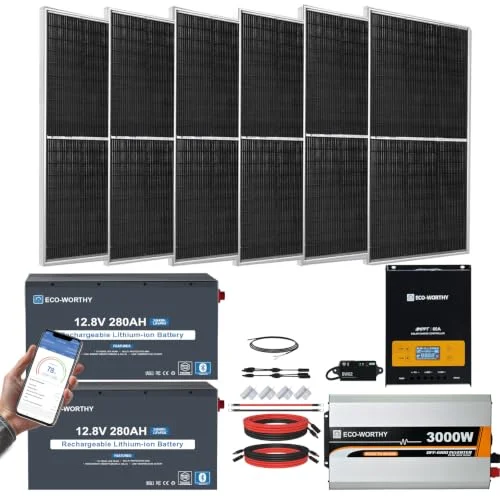
[Ultra] ECO-WORTHY 1200W 24V 5.52KWH Lithium Battery Solar S💰 Best Value
| Battery Chemistry | Li-ion (as listed) with built-in BMS |
| Battery Capacity | 7168Wh (12.8V 280Ah dual pack) |
| MPPT Charge Controller Rating | 60A |
| Inverter Type And Power | 3000W pure sine wave |
What We Found
The ECO-WORTHY 1200W 24V 5.52KWH bundle is built as a starter “system” rather than a battery-only pick. It combines six 195W panels with a solar charge controller (the listing talks about MPPT tracking) and a pure sine inverter, while the storage section is described as a dual-pack Li-ion setup totaling 7168Wh (using 12.8V 280Ah packs) and a built-in BMS for protection. The listing also leans on high-efficiency claims for the solar side and highlights monitoring-style features through Bluetooth. What I would flag is that the naming and the power figures read a bit inconsistent across the kit description: the product is labeled 1200W/24V, but the panel and storage numbers are presented in separate places with phrasing that doesn’t always line up cleanly. That doesn’t automatically mean it’s wrong—but it makes it harder to trust the “at a glance” sizing for long-term off-grid planning.
Who It’s For
I would shortlist this for buyers who want fewer components to source and prefer an all-in-one off-grid starting point for RVs, sheds, cabins, and smaller backup setups—especially when mixed AC loads are on the menu. It’s also a better fit if you’re comfortable validating compatibility during commissioning, because a 24V-class design has to line up with inverter and controller settings. If you mainly want a straightforward battery performance comparison, the combined “kit” claims and inconsistent-looking power labels make it harder to benchmark.
✅ Pros
- Bundled MPPT controller and pure sine inverter reduce compatibility work for new off-grid systems.
- Bluetooth monitoring supports operational visibility without adding extra meters.
- Large reported storage capacity (7168Wh) supports longer overnight runtime than small kits.
❌ Cons
- Inconsistent wattage naming and mixed capacity phrasing make it harder to confirm real daily performance.
- The battery type is described as Li-ion, while many off-grid buyers prefer LiFePO4 for cycle-life and safety predictability.
- No explicit charge/discharge current limits are provided for the inverter and battery pair, which complicates load planning.
💬 Our Take
Great for convenience as a complete-system starter, but the confusing naming and mismatched-looking power details reduce confidence if you’re planning a system for the long haul.
ECO-WORTHY 12V 280Ah Metal Case LiFePO4 Lithium Battery with🥈 Runner-Up
| Nominal Voltage | 12V |
| Capacity | 280Ah (3584Wh max listed) |
| Chemistry | LiFePO4 |
| Monitoring And Safety | Bluetooth + built-in 200A BMS and low-temp protection |
What We Found
This ECO-WORTHY 12V 280Ah LiFePO4 battery puts installation safety and cold-weather behavior front and center. The listing emphasizes a heavy-duty metal enclosure aimed at heat resistance and fire protection, plus a one-touch low-voltage cut-off switch that helps with safer handling during setup and maintenance. It also states you don’t need an external battery box, which is a practical win for RV and camper builds where space is tight. On the electrical side, it includes a built-in BMS for protection and low-temperature charging cut-off behavior, and it adds Bluetooth monitoring so you can view key stats like voltage, capacity, and charge/discharge status. The metal-case approach and rugged build are the core “why,” especially for off-grid users who want less fuss around mounting and protection.
Who It’s For
I’d recommend it for RV owners and off-grid users building a 12V solar system who want a rugged, direct-install style battery without extra enclosure hardware. It also fits trolling motor and camper setups where vibration and durability matter. If you’re in a colder climate, the low-temp charging protection is specifically the kind of feature that can prevent cold-damage charging. It’s at its best when your system is already designed around 12V and you can accommodate the physical size/weight of a 280Ah pack.
✅ Pros
- Metal case construction improves safety and helps buyers skip a separate battery box.
- Low-temperature protection helps prevent unsafe charging conditions in cold weather.
- Bluetooth monitoring adds practical day-to-day SOC and health visibility.
❌ Cons
- Direct-install convenience may still require careful venting and mounting compliance with local practices.
- A 12V 280Ah choice can increase cable current demands compared with 48V systems for high-power inverters.
- The listing provides limited detail on exact continuous charge/discharge ratings beyond BMS headline.
💬 Our Take
A strong 12V off-grid battery pick focused on safety and installation convenience—exactly the kind of feature set you want when your system stays 12V.
DJLBERMPW 48V 100Ah LiFePO4 Lithium Battery,8000+ Deep Cycle
| System Voltage | 48V (4-pack series) |
| Capacity | 100Ah (5120Wh listed) |
| BMS Rating | 100A BMS with low-temp cut-off |
| Protection Level | IP66 waterproof (as listed) |
What We Found
DJLBERMPW’s 48V 100Ah option is assembled from multiple 12V 100Ah LiFePO4 units in series, positioning it for off-grid and marine-style loads. The listing calls out a 100A BMS with protection against overcharge, over-discharge, over-current, overheating, and short circuits, and it also includes low-temperature cut-off behavior. I would consider that useful for off-grid solar planning because the listing provides operating and charging temperature windows, which helps when winter sun is weaker and colder. It also claims very high deep-cycle potential (with cycle-life and service-life numbers stated) and includes guidance on charging current. The other standout angle is its protection and practical commissioning guidance for balancing across the multi-pack configuration. The listing mentions outdoor suitability (including an IP66-style claim), but the enclosure details aren’t deeply laid out.
Who It’s For
This battery set fits people who want 48V storage without getting into a fully custom battery-bank build. It’s especially relevant for marine trolling motor setups and home storage systems that are already moving toward 48V inverters. If you operate in places with temperature swings, the explicit charging/discharge ranges are a big help for planning. I would not choose it if you want a single, monolithic battery experience—because the series multi-pack design means commissioning and configuration matter.
✅ Pros
- Clear temperature guidance supports safer solar charging planning in cold climates.
- BMS protection covers common failure modes like overcurrent and short circuits.
- Deep cycle and longevity claims align with LiFePO4 expectations for off-grid cycling.
❌ Cons
- As a multi-pack series system, installation and balancing care increase setup complexity.
- The listing focuses on trolling motor compatibility, but inverter integration specifics are not deeply detailed.
- Some performance claims depend on correct charger and balance procedures that are not guaranteed by default.
💬 Our Take
A well-specified 48V LiFePO4 choice with strong protection and helpful temperature specs, but it requires careful multi-pack commissioning.
LiTime 12V 20A Lithium Battery Charger 14.6V LiFePO4 Battery
| Battery Chemistry | LiFePO4 |
| Charging Voltage | 14.6V |
| Charge Current | 20A |
| Special Function | 0V activation for deeply discharged BMS-protected batteries |
What We Found
LiTime’s 12V 20A LiFePO4 charger is not the battery itself, but it directly affects how well your off-grid lithium battery is treated over time. The unit is built for 14.6V LiFePO4 batteries and supports up to 20A charging. A key feature for real-world off-grid situations is 0V activation, which is meant to restore deeply discharged LiFePO4 batteries that may be BMS-protected and otherwise “stuck.” The charger uses a standard charging approach (with CC/CV transitions and float) and adds protections for heat, voltage, current, low voltage, and polarity faults. The metal housing with an included cooling fan is also aimed at durability in enclosed spaces like RV compartments or solar sheds. LED indicators help confirm status without needing an app.
Who It’s For
I would consider this if you’re adding solar storage and want a reliable AC-DC charger for generator downtime, cloudy stretches, or routine top-ups. It’s also useful for RV owners who seasonally store LiFePO4 packs and occasionally face deep discharge that triggers BMS protection. The 20A limit fits smaller 12V battery banks and maintenance-style charging. If you’re building a much larger system that needs higher bulk charge rates, it’s probably not the match.
✅ Pros
- 0V activation helps recover batteries after deep discharge events.
- CC/CV/float control reduces overcharging risk and supports longer battery life.
- Multi-level protections and fan-cooled housing improve reliability in off-grid environments.
❌ Cons
- This is a charger-only product, so it does not solve battery capacity or BMS sizing for off-grid runtime.
- It suits 12V LiFePO4 packs only, limiting compatibility with 24V and 48V systems.
- No remote monitoring or communications interface is provided beyond LED status.
💬 Our Take
A helpful charger accessory for 12V LiFePO4 maintenance and recovery—but it doesn’t replace the need to size and select the battery properly.
ECO-WORTHY Powermega 48V 314Ah(2 Pack) LiFePO4 Battery Energ🏆 Editor’s Pick
| Nominal Voltage | 48V (51.2V stated in BMS context) |
| Capacity | 314Ah (16.07kWh listed) |
| BMS And Balancing | 200A BMS with active cell balancing |
| Safety Features | Aerosol fire protection + dual breakers |
What We Found
ECO-WORTHY’s Powermega 48V 314Ah storage battery is aimed at higher-capacity off-grid installs and whole-home backup. The listing states 16.07kWh per unit and supports scaling with parallel expansion up to 15 units (reaching 241kWh in the stated configuration). The BMS is rated 200A and includes active cell balancing, which is important if you want the cells to stay aligned over time for consistent charging and reduced long-term capacity drift. For safety, the listing highlights a breaker-based setup plus an integrated aerosol fire protection module intended to reduce thermal runaway risk. On monitoring and integration, it supports communications options like LCD with Bluetooth/WiFi, and it also mentions interfaces (RS485/CAN/RS232) for compatibility with inverter systems. This is the kind of feature mix that reads more like stationary backup hardware than an RV-focused pack.
Who It’s For
I’d point this toward buyers designing off-grid solar for home backup who want scalable capacity and layered safety features. It fits best when you’re already in a 48V inverter ecosystem and you want multiple monitoring pathways for troubleshooting. If your plan includes parallel expansion, the active balancing and high parallel ceiling are especially relevant. It’s not the easiest choice for compact RV installs because of size, and it takes more careful system design than smaller 12V packs.
✅ Pros
- Active cell balancing helps stabilize performance and extend service life under repeated cycling.
- Aerosol fire suppression adds an uncommon, high-impact safety layer for indoor storage use.
- 48V architecture plus RS485/CAN/RS232 support simplifies integration with modern inverters.
❌ Cons
- High capacity increases upfront cost risk and demands proper inverter and wiring engineering.
- Parallel expansion requires disciplined installation and balancing practices across units.
- The listing does not provide granular continuous charge/discharge specs beyond headline BMS current.
💬 Our Take
A premium 48V storage battery built for serious off-grid solar backup—where the active balancing and aerosol protection justify the investment.
ECO-WORTHY 12V 100AH LiFePO4 Lithium Battery with SOC Displa
| Nominal Voltage | 12V |
| Capacity | 100Ah (SOC display model) |
| BMS Rating | 100A BMS with low-temp protection |
| Monitoring | Bluetooth app + LED SOC/status panel |
What We Found
ECO-WORTHY’s 12V 100Ah LiFePO4 focuses on day-to-day usability for RV and compact off-grid applications. The listing includes an LED SOC/status panel for quick checks, plus a built-in Bluetooth module for app monitoring—so you can track voltage, current, capacity, SOC, runtime, and cell voltages. It also includes a 100A BMS with low-temperature protection and a buzzer for abnormal detection alerts. The battery is built with a metal fixture approach designed to reduce cell expansion hazards and short-circuit risks, which the listing frames as contributing to safety and longevity. It also claims expandability up to 4P2S for larger system energy needs (with 10.24kWh stated for the expanded setup). Overall, it’s feature-rich for a 12V class battery, even if 100Ah is more “mid-capacity” than “whole-home overnight” territory.
Who It’s For
This makes sense for RV owners and compact off-grid users who want 12V power with clear monitoring convenience. It’s a good match for camping setups, small solar systems, and trolling motor use where knowing SOC matters. The LED panel helps when you don’t want to rely on a phone connection in low-signal spots. If you need a lot of overnight energy for refrigeration or frequent high loads, you’ll likely end up paralleling/expanding—adding system complexity.
✅ Pros
- On-board LED SOC display plus Bluetooth monitoring improves day-to-day management.
- Low-temperature protection reduces risk of charging LiFePO4 cells in cold conditions.
- Built-in abnormal detection buzzer supports faster fault response.
❌ Cons
- 100Ah capacity limits whole-night autonomy for high-draw appliances without expansion.
- Expansion guidance exists, but adding packs increases balancing and wiring effort.
- A 12V setup typically requires higher current than 48V for the same inverter power.
💬 Our Take
A practical, easy-to-monitor 12V LiFePO4 battery that works best as a modular building block rather than a single-package whole-home answer.
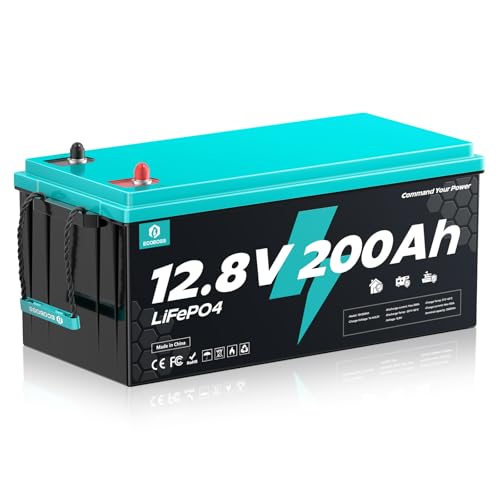
ECOBOSS 12V 200Ah LiFePO4 Battery, 2560Wh Deep Cycle Lithium
| Nominal Voltage | 12V |
| Capacity | 200Ah (2560Wh listed) |
| BMS Rating | 200A smart BMS |
| Temperature Protection | Stops charging below 0°C and resumes at 5°C |
What We Found
ECOBOSS’s 12V 200Ah LiFePO4 battery is positioned for heavier off-grid cycling than 100Ah-class packs. The listing highlights 15,000+ cycle life and states it supports up to 200A continuous discharge with 100A max charge, supported by a 200A smart BMS. It also includes low-temperature protection that stops charging below 0°C and resumes above 5°C, which is directly relevant for off-grid solar setups where winter charging conditions can be tough. The battery supports expansion up to 4S4P, which could allow much larger system voltages and capacities when you plan for scaling. It also claims IP65-rated protection, making it suitable for outdoor installations. In short, the listing frames this as a robust backup battery for RV, marine, trolling motors, and solar applications.
Who It’s For
I’d suggest it to RV and off-grid users who want more capacity than a 100Ah battery and who anticipate occasional higher-load discharge. It’s also a strong fit for colder-weather deployments where the charge cut-off behavior protects the cells. If you want the option to expand the system over time, the series/parallel scaling support is a meaningful advantage. It may be less ideal if you’re chasing very specific “extra safety add-ons” (or if you’d rather move to 48V to reduce current levels).
✅ Pros
- High 200A discharge capability suits heavier inverter and off-grid load profiles.
- Explicit low-temperature charging cut-off improves safety in winter conditions.
- Strong expansion flexibility supports future capacity growth.
❌ Cons
- 12V at 200Ah can require heavier wiring and higher current than a 48V alternative.
- The listing does not specify active cell balancing, which can matter in larger parallel/series builds.
- IP65 helps outdoors, but indoor thermal management requirements still apply.
💬 Our Take
A high-discharge 12V workhorse with cold-weather protection—well suited for scalable off-grid solar banks that can operate comfortably within 12V current levels.
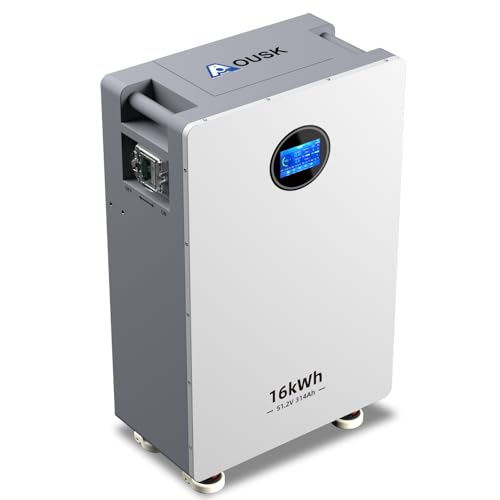
AOUSK 48V 314Ah Lifepo4 16.07kWh Lithium Battery, Build in 2
| Nominal Voltage | 48V |
| Capacity | 314Ah (16.07kWh listed) |
| BMS | 200A BMS with six-layer protection and dual breakers |
| Communication | RS485/CAN/RS232 with LCD, Bluetooth, and Wi-Fi |
What We Found
AOUSK’s 48V 314Ah LiFePO4 battery is built around high-capacity off-grid storage with strong monitoring and integration features. The listing calls out a 200A BMS with multi-layer protection and dual breakers on both positive and negative poles. It also claims up to 8,000 cycles at 80% state of health, which is reasonable for LiFePO4, though it’s not as “longevity-first” as some competitors that emphasize balancing or longer-life profiles. For monitoring, you get a full-color LCD, plus Bluetooth/WiFi app access, along with RS232 connectivity for PC-based control. Integration is supported through RS485 and CAN interfaces, and the listing mentions compatibility with common inverter brands. Mechanically, built-in handles and wheels are included to make it easier to install in a utility space. That mix of communications and physical install features points toward whole-home backup use.
Who It’s For
This suits buyers running 48V inverters who want remote monitoring and multiple control interfaces. It fits whole-home backup and off-grid solar designs—especially if you prefer LCD/app visibility and inverter-level communication rather than relying only on inverter screens. The wheel-assisted installation may also help when you’re moving a heavy storage unit into a garage or utility area. If your priority is maximum cycle-life guarantees or active cell balancing, I would still compare against models that explicitly highlight balancing as a feature.
✅ Pros
- Multiple interfaces (RS485, CAN, RS232) support integration and professional monitoring workflows.
- Dual breakers and layered BMS protection strengthen safety against overload and short circuits.
- LCD, Bluetooth, and Wi-Fi provide flexible monitoring options for off-grid troubleshooting.
❌ Cons
- Cycle-life claim depends on operating conditions and does not clearly exceed competing balanced systems.
- Large capacity increases installation planning needs for wiring, fusing, and heat management.
- Active cell balancing is not explicitly stated, which may matter in long parallel-expansion scenarios.
💬 Our Take
A strong 48V home-backup battery with excellent communications and monitoring, but it’s worth comparing to models that explicitly include active balancing.
1200W 25.6V 2.56KWH Lithium Battery Solar System Off Grid wi
| Battery Capacity | 2.56kWh (25.6V 100Ah) |
| MPPT Controller Rating | 120A |
| Inverter Rating | 3600W |
| Monitoring | Mobile app monitoring and charging control |
What We Found
This 1200W 25.6V 2.56KWH kit is positioned for smaller off-grid setups where app monitoring and managed power behavior matter. It pairs six 200W panels with a 120A MPPT controller and includes a 3600W inverter. Storage is listed as a 25.6V 100Ah lithium battery rated at 2.56kWh, with a built-in BMS and safety documentation like MSDS and UN38.3. The listing stresses app monitoring for battery level and solar output, along with charging settings customization. One distinctive feature is load prioritization logic—when battery levels drop, the system can prioritize essential devices like a fridge and router. It also claims high charging efficiency (up to 98%) and includes installation-related components like cables and Z-brackets, which can reduce setup friction.
Who It’s For
I’d point this toward cabin and RV buyers who want compact capacity and simplified commissioning. It’s a reasonable fit for people running essential electronics and refrigeration, but it’s not aimed at covering full-time whole-home loads. The 25.6V battery class can be efficient for certain inverter setups, but it’s still more niche than the more common 24V and 48V ecosystems. Before buying, I would confirm the inverter’s surge/start-up requirements and make sure the app and MPPT/controller settings match the battery profile.
✅ Pros
- Load prioritization can protect essential electronics during low SOC conditions.
- App-based control improves off-grid awareness and reduces guesswork.
- Complete kit packaging lowers installation friction for first-time solar builders.
❌ Cons
- 2.56kWh is limited for extended outages or high AC demand without expansion.
- System wattage and efficiency claims are high but require confirmation against real-world load profiles.
- 25.6V battery ecosystem may require extra compatibility checks with future upgrades.
💬 Our Take
A convenient smaller-capacity kit with smart low-battery behavior—but with 2.56kWh, you’ll need careful load planning because you can burn through it faster than you expect.
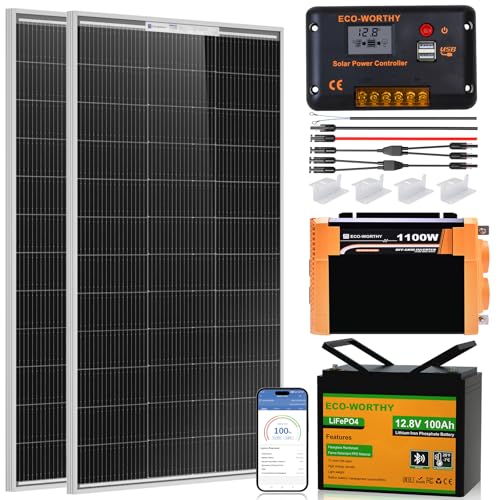
ECO-WORTHY 200 Watt 12V Complete Solar Panel Starter Kit for💵 Budget Pick
| Panel Output | 2 x 100W solar panels (200W total) |
| Controller | 30A PWM charge controller |
| Battery | 12.8V 100Ah lithium battery |
| Inverter | 1100W solar inverter |
What We Found
ECO-WORTHY’s 200W 12V starter kit targets light-duty off-grid power with an easy package. It includes two 100W solar panels, a 30A PWM charge controller, a 1100W solar inverter, and a 12.8V 100Ah lithium battery. The kit estimates daily generation around 800Wh and stored capacity of 1.28kWh, which matches the included 100Ah-style battery class. The main differentiator here is simplicity: it bundles core components and uses a straightforward installation process. They also market customer support as 7/24. The trade-off is that the PWM controller can be less efficient than MPPT in variable conditions, so day-to-day harvesting may not be as strong as MPPT-based systems.
Who It’s For
This fits RV travelers and casual off-grid users who want basic backup for lights, phone charging, and small appliances. It’s well suited for short trips and lower load profiles where weekend autonomy matters more than running heavy AC devices. The included 12V 100Ah battery is also a comfortable starting point if you’re learning how off-grid solar sizing works. It’s less ideal for refrigeration-heavy setups or for extended cloudy-season runtimes unless you plan to expand.
✅ Pros
- All-in-one starter package reduces parts sourcing and compatibility mistakes.
- Beginner-friendly installation steps make setup quicker for new off-grid users.
- Adequate capacity for basic RV charging and low-power loads.
❌ Cons
- PWM charging reduces energy harvest compared with MPPT, especially in less-than-ideal sun.
- 1.28kWh storage limits overnight runtime for high-draw appliances.
- No advanced monitoring details are provided in the kit description.
💬 Our Take
A budget-friendly entry kit for light duty off-grid use, but it won’t compete with MPPT + larger batteries for overnight autonomy and efficiency.
What to Look For Before Buying
For off-grid solar, the “best” lithium battery is really the one that matches your voltage and charging path—and that starts with compatibility, not marketing names. I would begin by estimating your daily watt-hours and checking that the battery capacity covers overnight loads with a buffer. Next, I’d look at BMS limits for both charge and discharge current, because fridge start-up surges and inverter peak draws can expose weak points fast. Finally, I’d prioritize safety details that matter in real installs: low-temperature charging cut-off, appropriate breakers/fusing, and monitoring that gives you enough visibility (SOC and abnormal events) to troubleshoot before problems cascade.
Check Match Battery Voltage to the Inverter and Controller
Start by confirming the battery’s nominal voltage (12V, 24V/25.6V, or 48V) matches the inverter’s battery input rating. Then make sure the MPPT charge controller supports the battery voltage and chemistry profile you’re using. If you’re building a multi-pack battery bank, check how series/parallel wiring changes voltage and current—because that affects what the BMS and inverter will “see.” I would not rely on kit marketing labels when the wiring diagrams and voltage class aren’t presented clearly.
Value Size Storage for Real Daily Energy, Not Just Capacity
Estimate watt-hours per day using actual appliance power and runtime, then multiply by your off-sun hours. Add headroom for system inefficiency and cloudy days, not just the ideal-sun scenario. Small systems like ~1.28kWh or ~2.56kWh typically cover essentials, not continuous high-AC loads. If refrigerator runtime and longer nights are part of your plan, stepping up to larger options like 12V 280Ah or 48V 314Ah tends to make the system feel less fragile.
Rating Weight Safety and BMS Behavior More Than Cycle-Life Claims
LiFePO4 often has strong cycle durability, but the BMS behavior is what determines how reliable the battery feels day-to-day. Check for low-temperature charging cut-off (and resume behavior) plus overcurrent protection that fits your environment. I also look for breakers and multi-layer safety rather than assuming BMS-only protection is enough. When ratings or protection thresholds aren’t spelled out, I treat very high cycle claims as marketing until specs are clearer.
Verify Verify Monitoring and Integration Before Checkout
If you’re relying on off-grid power, monitoring isn’t optional—it’s how you catch issues early. Look for SOC visibility via app, LCD, or Bluetooth. If you’re planning an integrated inverter setup, confirm the communication interfaces (RS485/CAN/RS232) you’ll need. For starter kits, verify the controller type (MPPT versus PWM) and what charging performance you can realistically expect. Finally, if you might expand later, make sure balancing strategy and system voltage design won’t fight you.
Frequently Asked Questions
What lithium battery chemistry is safest for off-grid solar?
LiFePO4 is usually the safest mainstream chemistry because it’s thermally stable and has a strong cycle record. Many of the options here use LiFePO4 and include a built-in BMS for protection, but safety still depends on the BMS limits and how charging is handled in cold weather. I would also look for practical protections like low-temperature charging cut-off, correct inverter charging settings, and physical safety features such as breakers or metal enclosures—rather than trusting chemistry alone.
How much battery capacity is needed for overnight use?
Start with daily watt-hours for everything you’re running, then multiply by the number of off-sun hours. Add a buffer for inefficiency and avoid planning for 100% usable capacity. Smaller kits around 1.28kWh or 2.56kWh generally cover lights, charging, and brief electronics—not continuous high AC loads. Larger packs like 12V 280Ah or 48V 314Ah better support refrigerators and longer overnight autonomy.
Does a 48V battery always perform better than a 12V battery?
48V systems typically run at lower current for the same power, which can improve efficiency and reduce wiring/battery current demands. That’s why 48V often shows up in whole-home backup planning. But the biggest factor is compatibility: your inverter and charge controller ecosystem must support 48V correctly. For compact RV builds, 12V can still be the practical choice.
Why is low-temperature protection important for solar batteries?
LiFePO4 batteries shouldn’t be charged when cells are too cold, since charging in those conditions can damage cells and shorten lifespan. Low-temperature cut-off prevents unsafe charging until temperatures recover. Since winter sun is weaker, the battery may sit near low SOC while remaining cold, so cut-off thresholds (and the resume temperature) are especially important for winter off-grid reliability.
What should be checked for expansion in off-grid battery banks?
Expansion is all about matching voltages, compatible cell/battery units, and consistent charge/discharge behavior. I would check whether the BMS supports parallel scaling and whether balancing is active or passive. Plan your wiring, fusing, and breakers for the total combined current you’ll create. Also confirm communication compatibility and inverter settings so the system behaves consistently as you add more batteries.
🎯 Final Verdict
For off-grid solar storage, I would pick ECO-WORTHY Powermega 48V 314Ah as the most complete option here because it emphasizes active cell balancing and integrated aerosol fire protection, backed by a 200A BMS and multi-interface monitoring. That feature set lines up well with whole-home backup where safety, scalability, and integration matter most. My runner-up is ECO-WORTHY 12V 280Ah for RV and smaller off-grid systems because the metal case and low-temperature protection target common real-world install needs. If you’re serious about backup capacity, lean toward 48V—but always confirm inverter compatibility and commissioning settings before ordering.