When I’m shopping for the best lipo battery for RC cars, the “it works” checklist starts before the specs—because fitment is where most orders go sideways. You can have the right voltage, but the pack still won’t fit the tray, or the connector won’t match your ESC/battery leads. And even when the battery label looks right, high C ratings only matter if your charger is set up for the correct 2S or 3S balance charging. In this review, I focused on the details that actually prevent problems: voltage and series count, capacity, hard-case dimensions, and the balance/discharge plug ecosystem across common 7.4V (2S) and 11.1V (3S) LiPo options.
For RC cars, a good LiPo comes down to three match-ups: cell count (2S vs 3S), physical size (hard-case length/height and lead clearance), and the connector pair (discharge lead plus the balance plug). Capacity and C rating influence how long you can drive and how steady your throttle stays, but those benefits only show up with a charger that supports balance charging for the correct S count. Hard-case construction adds protection, yet the connector standards are what reduce the most common wiring/charging mistakes. Since RC setups vary a lot between 1/10 and 1/8 cars, the most reliable picks here are the ones that spell out dimensions and charger/balance plug info clearly—so you’re not guessing.
⚡ Quick Verdict
Our Top Picks at a Glance
| Image | Product | Score | Link |
|---|---|---|---|
 |
Zeee 7.4V Lipo Battery 2S 50C 5200mAh Lipos Hard Case with T 🥈 Runner-Up |
8.1/10 |
View on Amazon Free Shipping & 30-Day Returns |
 |
Zeee 3S Lipo Battery 2200mAh 11.1V 50C Shorty Pack Battery w 🥈 Runner-Up |
7.6/10 |
View on Amazon Free Shipping & 30-Day Returns |
 |
EMEPOVGY 7.4V Lipo Battery 2S 5200mAh 80C Lipos Hard Case wi 👑 Premium Pick |
8.9/10 |
View on Amazon Free Shipping & 30-Day Returns |
 |
Tosiicop 7.4V 1000mAh Li-ion Battery – 2 Pack 2S 30C Batteri | 6.5/10 |
View on Amazon Free Shipping & 30-Day Returns |
 |
OVONIC 2s Lipo Battery 50C 5200mAh 7.4V Lipo Battery with De 🏆 Editor’s Pick |
9.3/10 |
View on Amazon Free Shipping & 30-Day Returns |
 |
OVONIC 7.4V Lipo Battery 5000mAh 50C 2S Lipo Battery Pack Ha | 8.6/10 |
View on Amazon Free Shipping & 30-Day Returns |
 |
LiPo Battery Charger, 150W 10A RC Balance Fast Battery Charg | 7.9/10 |
View on Amazon Free Shipping & 30-Day Returns |
📋 How We Evaluated
Evaluation focused on voltage and series count suitability for RC cars, capacity for realistic runtime, and advertised continuous discharge performance. Build details such as hard-case design and connector compatibility (T/Dean/XT60/EC3/JST-XHR) were weighted heavily for real-world usability. Value and risk signals also mattered, but Amazon rating data was unavailable here, so the review relied on the completeness of specs, safety guidance clarity, and whether the charger requirements aligned with the pack’s balance lead system.
Detailed Reviews
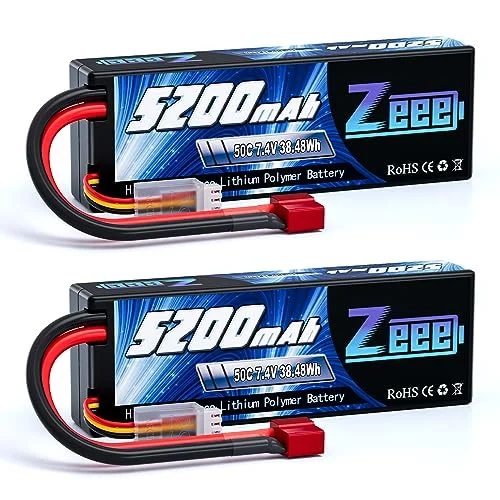
Zeee 7.4V Lipo Battery 2S 50C 5200mAh Lipos Hard Case with T🥈 Runner-Up
| Voltage (Nominal) | 7.4V (2S1P) |
| Capacity | 5200mAh |
| Continuous Discharge | 50C |
| Connector Type | T Connector |
| Hard-Case Dimensions (L×W×H) | 138×47×25mm |
| Approx Weight | 250g |
What We Found
Zeee’s 7.4V 2S 5200mAh hard-case LiPo is aimed at the common 1/8 and 1/10 RC car class, and it uses a T-connector discharge lead. It’s rated 50C and sized at about 138×47×25mm, with an approximate 250g weight, which supports longer sessions than the smaller-capacity packs. On the charging side, the listing points to 2S balance charging expectations and mentions a recommended charging current range (2.6A–5.2A) for that capacity class. My read is that the straightforward “2S voltage + T-plug ecosystem + clear size” approach is exactly what you want when shopping for a plug-and-play-feeling replacement—just double-check the listed footprint against your battery bay before ordering.
Who It’s For
I’d put this in the cart for drivers who want more runtime on a 7.4V (2S) setup without switching to 3S voltage. It’s best when your RC truck/buggy can physically accommodate roughly 138mm length and about 47mm width, and when you already use a T-connector style discharge lead. It’s a reasonable option for everyday running as long as your charger is set for 2S balance charging and your space constraints match the listed hard-case dimensions.
✅ Pros
- Clear 2S 5200mAh spec with a full charger guidance section for balance charging.
- 50C rating supports stronger bursts while maintaining a practical 1/8 to 1/10 fit intent.
- Hard-case construction and listed dimensions reduce uncertainty during installation checks.
❌ Cons
- T-connector ecosystems vary, so compatibility depends on the exact car harness and plug gender.
- No Amazon rating data was provided, so real-world reliability signals cannot be verified here.
- Larger physical size may limit fitment in tight battery bays.
💬 Our Take
This is a strong 2S 5200mAh fit for T-plug cars that need extra run time—with the usual caveat that you should confirm the battery bay dimensions because this hard-case footprint is on the larger side.
Zeee 3S Lipo Battery 2200mAh 11.1V 50C Shorty Pack Battery w🥈 Runner-Up
| Voltage (Nominal) | 11.1V (3S1P) |
| Capacity | 2200mAh |
| Continuous Discharge | 50C |
| Connector Type | XT60 |
| Hard-Case Dimensions (L×W×H) | 75×34×26.5mm |
| Approx Weight | 137g |
What We Found
Zeee’s 3S 2200mAh shorty pack is built for compact 11.1V setups and uses an XT60 discharge connector. It’s rated 50C, which suits quick throttle response and racing-style bursts where space is tight. The pack is listed at about 75×34×26.5mm and weighs around 137g, so it’s clearly intended for chassis that can’t fit bigger hard-case 2S packs. On charging, the listing aligns with 3S balance charging and includes a charging current range (1.1A–2.2A). The standout for me is the mix of 3S voltage with a truly short “shorty” format—handy when your battery tray is the limiting factor.
Who It’s For
This battery makes the most sense for RC cars and trucks that are already approved for 3S and have room for a pack around 75mm long. If you’re chasing faster speed and stronger acceleration than typical 2S setups, it’s an easy way to get there. XT60 users should also find it simpler to line up with common modern harnesses. I’d still verify the charger balance port and series count first, especially if you run more than one vehicle.
✅ Pros
- 3S voltage in a shorty footprint helps when battery space is constrained.
- XT60 discharge connector is common and typically easy to integrate.
- Charger guidance clearly matches 3S balance charging requirements.
❌ Cons
- 2200mAh capacity prioritizes fit and punch, not long run times.
- No real rating data is included, limiting confidence in long-term cycle performance.
- High discharge claims still require correct C-rate mindful use to avoid overheating.
💬 Our Take
Good pick for compact 3S builds where space decides everything. Just don’t expect it to be an endurance monster, since 2200mAh is naturally smaller than the 5000–5200mAh class.
EMEPOVGY 7.4V Lipo Battery 2S 5200mAh 80C Lipos Hard Case wi👑 Premium Pick
| Voltage (Nominal) | 7.4V (2S) |
| Capacity | 5200mAh |
| Continuous Discharge | 80C |
| Charge Plug | JST-XHR |
| Discharge Plug | EC3 |
| Hard-Case Dimensions (±2mm) | 25×47×139mm (H×W×L) |
| Approx Weight | 283.5g |
What We Found
EMEPOVGY offers a 7.4V 2S 5200mAh hard-case LiPo with an 80C continuous discharge claim. It lists a JST-XHR balance plug for charging and an EC3 discharge plug for the drivetrain, which matters because compatibility isn’t just about voltage—it’s about the connector ecosystem. The dimensions are stated with a tighter tolerance note (about 25×47×139mm, noted as H×W×L), plus an approximate 283.5g weight. The listing also includes compliance/safety-style claims (RoHS, CE, MSDS, UN38.3) and emphasizes not exceeding a 1C charge rate, which lines up with the idea that you should use a proper LiPo balance-capable charger. My read is that the 80C marketing only becomes meaningful if you actually have an EC3-equipped car harness and a charger that can balance-charge 2S via the JST-XHR lead—both are clearly called out here.
Who It’s For
I’d shortlist this for 1/10 or 1/8 RC cars running 2S that use EC3 discharge connectors. It’s a fit when you want punchier throttle response and you’re planning to run heavier vehicles where sustained output matters. Because the listed weight and footprint can be significant, it may matter in chassis with strict battery placement rules. It’s also a strong option if you already have an EC3 car harness and a charger with JST-XHR-3P balance support.
✅ Pros
- 80C rating targets stronger sustained performance than typical 50C packs.
- Explicit JST-XHR charging plug and EC3 discharge plug improve connector match confidence.
- Compliance and safety claims add structure for safer handling expectations.
❌ Cons
- No Amazon rating data is provided, so long-term cycle reliability cannot be confirmed here.
- Physical size uncertainty risk remains because the dimension order is unusual.
- Exceeding 1C charge is cautioned, which can restrict quick turnaround charging routines.
💬 Our Take
A performance-leaning 2S 5200mAh option with an EC3/JST-XHR ecosystem. The 80C claim feels more “serious” here because the listing pairs it with explicit connector types and charger-related guidance.
Tosiicop 7.4V 1000mAh Li-ion Battery – 2 Pack 2S 30C Batteri
| Voltage (Nominal) | 7.4V (2S) |
| Capacity | 1000mAh |
| Continuous Discharge | 30C |
| Connector Type | T Plug |
| Suggested Use Case | 1/16 and small RC trucks |
| Hard-Case Dimensions | 51.1×30.3×14.4mm |
| Approx Weight | 47g |
What We Found
Tosiicop’s 7.4V 1000mAh 2S pack (sold as a 2-pack) is aimed at smaller RC trucks and micro setups. The listing highlights a T plug and includes two USB charging cables, plus it targets HBX and 1/16 scale compatibility in the examples. It states a 30C discharge rating and provides compact dimensions (51.1×30.3×14.4mm) with very low weight (about 47g per battery). The “USB charger” concept could sound convenient, but charging performance depends on the cable and the power source you use. It’s also described as rechargeable, but the practical limiter here is capacity—1000mAh isn’t built for long sessions.
Who It’s For
This is best for tiny 1/16 scale trucks and battery bays that simply can’t swallow a 5000mAh hard-case pack. It fits for casual running, testing, and short speed bursts where shaving weight matters more than maximum runtime. If your vehicle uses a T plug, you’ll likely appreciate the direct plug fit. I wouldn’t choose it if your priority is longer driving time, because 1000mAh will have you recharging sooner.
✅ Pros
- Very small, lightweight pack fits micro RC builds where larger LiPos won’t fit.
- Includes two USB charger cables, supporting quick home charging setups.
- Clear voltage and capacity specs support correct charger selection at 2S.
❌ Cons
- 1000mAh capacity will feel short on runtime versus mainstream 5000mAh packs.
- Charger completeness is unclear, since cable-based charging does not guarantee balanced LiPo charging.
- “Li-ion” wording conflicts with the typical LiPo expectations for many RC chargers.
💬 Our Take
A niche fit for micro chassis and short runs. If you want consistent charge behavior and longer sessions, I’d step up to a higher-capacity LiPo with clear balance-charging support.
OVONIC 2s Lipo Battery 50C 5200mAh 7.4V Lipo Battery with De🏆 Editor’s Pick
| Voltage (Nominal) | 7.4V (2S) |
| Capacity | 5200mAh |
| Continuous Discharge | 50C |
| Material/Chemistry | LiCoO2 (as stated) |
| Charging Plug | JST-XHR-3P |
| Discharge Plug | Dean-Style connector |
| Hard-Case Dimensions (±3mm) | 137×46×24mm |
| Approx Weight (±5g) | 245g |
What We Found
OVONIC’s 2S 5200mAh 7.4V hard-case LiPo targets the mainstream 7.4V RC car setup with a 50C discharge rating. For discharge, it uses a Dean-Style connector, while charging is supported through a JST-XHR-3P balance plug—an important pairing because balance lead compatibility affects how straightforward your charging workflow is. The dimensions are listed around 137×46×24mm with an approximate 245g weight, which matches what many buyers expect from a typical 2S hard-case class. The listing also leans into safety/cycle-life style claims and even directs users to use OVONIC dedicated charging equipment for safer operation. For me, the biggest win is the complete “capacity + hard-case protection + balance lead” package that fits a very common RC charging pattern.
Who It’s For
This works well for 1/10 (and compatible 1/8) RC cars running 2S with Dean-style discharge connectors. It’s a good choice if you want longer bash sessions without moving up to 3S voltage. JST-XHR-3P balance support helps if you’re using a proper 2S balance LiPo charger. I’d especially consider it when you value clear, everyday charging-lead compatibility rather than juggling adapters and assumptions.
✅ Pros
- JST-XHR-3P balance lead plus a Dean-style discharge connector improves compatibility clarity.
- 5200mAh capacity pairs long runtime with a mainstream 7.4V platform.
- Cycle-life and low-resistance claims suggest efficiency for frequent use.
❌ Cons
- No price or rating data is provided, so value and durability cannot be verified from Amazon signals here.
- Dean-style connector variants can still differ by gender and pin style between cars and chargers.
- Hard-case size can limit fitment in tight battery compartments.
💬 Our Take
This is the most practical 2S 5200mAh layout for the common RC workflow. The balance lead and capacity combination make it feel like the easiest “no drama” pick in this group.
OVONIC 7.4V Lipo Battery 5000mAh 50C 2S Lipo Battery Pack Ha
| Voltage (Nominal) | 7.4V (2S) |
| Capacity | 5000mAh |
| Continuous Discharge | 50C |
| Charging Plug | JST-XHR-3P |
| Discharge Plug | Dean-Style T connector |
| Hard-Case Dimensions (±3mm) | 137×45×24mm |
| Approx Weight (±5g) | 245g |
What We Found
OVONIC’s 2S 7.4V 5000mAh pack follows the same general compatibility pattern as its 5200mAh sibling, but with slightly less capacity. It lists a 50C discharge rating and uses a Dean-Style T connector for discharge, while the charging side uses a JST-XHR-3P balance plug. Dimensions are provided at about 137×45×24mm with a roughly 245g weight, so it should be close to a drop-in fit for many standard 2S hard-case battery bays. The listing repeats cycle-life/efficiency type claims and again points users to OVONIC dedicated chargers for safety. My read is that it’s mainly for people who want consistent connectors and a typical hard-case footprint—without necessarily prioritizing the absolute max capacity in this list.
Who It’s For
I’d recommend this for buyers who need a 2S hard-case battery for Dean-style T connector RC cars. It’s a good alternative for Arrma, Axial, Losi, and similar platforms when the stated dimensions match your tray. You’ll still get more runtime than tiny 1000mAh packs, but you’re giving up a bit versus the 5200mAh class. It’s also a natural fit if you already have the charger/balance lead setup that works with JST-XHR-3P.
✅ Pros
- Dean-style discharge and JST-XHR-3P balance plug help ensure correct charger matching.
- Common 2S hard-case footprint makes replacement shopping easier.
- 50C rating supports responsive throttle under typical RC car loads.
❌ Cons
- Capacity is 5000mAh rather than 5200mAh, with minor runtime impact.
- No rating and no price data are provided, limiting value assessment.
- Connector naming can hide differences between “Dean-style T” implementations.
💬 Our Take
A consistent 2S 5000mAh Dean/JST-XHR package for standard 7.4V builds. It just edges below the top pick because the capacity is slightly lower and the listing doesn’t create as many “decision-easy” signals as the 5200mAh option.
LiPo Battery Charger, 150W 10A RC Balance Fast Battery Charg
| Max Charge Power | 150W |
| Max Discharge Power | 10W |
| Supported LiPo Range | 1S–6S (3.7V–22.2V) |
| Supported Chemistries | LiPo/Li-ion/LiHV/LiFePO4/NiMH/NiCD/PB (as stated) |
| Balance Charging | Yes |
| Battery Protection Features | Delta-peak, limits, temperature threshold (as stated) |
| Included Cables/Harness | AC/DC cables, balance extension, multi-harness connectors |
What We Found
This listing is for a smart RC LiPo balance charger as a companion to your batteries. It’s designed for 1S–6S LiPos and supports balance charging, with a maximum charging output of 150W and up to 10W discharge power. It includes protection features like delta-peak sensitivity, capacity and time limits, and temperature thresholding, plus end-voltage control. It also has a 20-memory data store and mentions firmware update capability, which can make repeat charging routines easier. For RC buyers, the key benefit is reducing the guesswork around series count selection and getting balance charging right for 2S and 3S packs. The stand-out is the bundled adapter harness aimed at common connector families, which helps when connector variety would otherwise force you to buy extra parts.
Who It’s For
This makes sense if you’re pairing new LiPos with an RC system (or charging setup) that doesn’t already include a balance-capable charger. It’s also a good pick for multi-battery owners because it covers 1S–6S LiPo and more than just one chemistry type. The harness bundle can reduce adapter shopping by supporting many discharge/balance connector styles. I’d view it as a safety-first upgrade for hobbyists who want repeatable, correct balance charging for both 2S and 3S packs.
✅ Pros
- Balance charging support helps safely charge 2S and 3S LiPo packs.
- 150W capacity accommodates faster, yet bounded, charging sessions for hobby use.
- Connector harness variety reduces friction when switching between battery ecosystems.
❌ Cons
- No battery-specific performance claims apply here, since this product is a charger rather than a LiPo pack.
- End-voltage adjustment is described as expert-only, which can confuse new users.
- Price and rating signals are unavailable, limiting assurance beyond listed specifications.
💬 Our Take
A strong companion charger for 2S and 3S LiPo packs—especially when connector variety is part of your setup. It doesn’t replace choosing the right battery, but it does improve the overall charging safety picture.
What to Look For Before Buying
The best lipo battery for RC cars starts with series count (2S vs 3S) and then moves to connectors—because the label “T plug” or “Dean style” doesn’t guarantee compatibility with your specific leads. After that, I’d verify the hard-case dimensions using length/width/height, not just the marketing capacity. Finally, I would match the charger to the exact S count so you can balance-charge the pack correctly and avoid guesswork on charge current and settings.
Check Match voltage, series count, and connector types
Confirm the pack is 2S (7.4V nominal) or 3S (11.1V nominal) for your car. Then match the discharge connector to the car’s battery lead (T/Dean/XT60/EC3). After that, check the balance plug type—often JST-XHR-3P—against your charger port. Don’t assume one “style name” means the same physical connector. I always cross-check both the discharge and balance sides before buying.
Value Choose capacity and C rating for your driving style
Capacity (mAh) affects runtime, so bigger generally means longer driving sessions. C rating influences how well the pack can sustain throttle draw, but it doesn’t fix a mismatch charging setup or overheating. For many street and bash use cases, 50C packs are often plenty when paired with the correct charger and reasonable cooling. For heavier vehicles or more aggressive punch, higher discharge can help—but I’d avoid pushing a battery hard if the battery bay can’t manage heat.
Rating Use Amazon rating signals and spec completeness as safety proxies
Since some product pages don’t show rating data, I treat spec completeness like a safety proxy. Look for listings that clearly state dimensions, connector types, and the balance/charge plug details (plus basic safe charging guidance like charge rate limits). If you see consistent safety language—unattended charging warnings, charge rate notes, and balance charging emphasis—that’s a good sign. Compliance claims can be a secondary trust signal, but I weigh them less than connector/dimension clarity.
Verify Verify fitment using hard-case measurements
Hard-case LiPos can be off by a few millimeters, and that’s enough to prevent installation or force awkward lead routing. Compare the listed length, width, and height against the tray and strap/closure clearance—not just the case size. If the listing uses an unusual dimension order (for example H×W×L), I’d pause and confirm which measurement is which. For shorty packs, I’d also pay attention to thickness and how the leads are bent so nothing gets pinched.
Frequently Asked Questions
What is the simplest way to confirm a LiPo pack fits an RC car?
Match series count first (2S for 7.4V systems, 3S for 11.1V systems), then match both connectors: the discharge plug for the car and the balance plug for the charger. Finally, compare the hard-case dimensions to your battery tray using length, width, and height, and check lead placement/strap clearance so the pack installs cleanly.
Is a higher C rating always better for RC cars?
Not always. A higher C rating can support stronger sustained discharge, but real-world performance depends on the car’s current draw, gearing, and cooling. If capacity is low, you’ll still run out of battery quickly no matter how high the C rating is. You still need correct charging and safe temperature handling—cooling and throttle discipline matter as much as C numbers.
Do RC LiPo batteries require a balance charger?
Yes—balance charging is strongly recommended for LiPo packs to keep cell voltages aligned. Your charger must support the correct S count (2S/3S), and the balance lead should match the charger port type (often JST-XHR-3P on many common packs). Using a non-balance charger increases the risk of imbalance over time.
How should charging current be chosen for 2S and 3S packs?
Many listings suggest charging around 0.5C to 1C for safety. You can estimate current using capacity—for example, a 5200mAh pack supports about 2.6A at 0.5C and up to about 5.2A at 1C. Your charger may limit current automatically, but you still need to select the correct settings for 2S vs 3S. Never leave charging unattended and charge within the temperature guidance provided for the battery.
Can a 3S battery be used in a 2S RC car?
Usually no, unless your ESC and motor are rated for 11.1V operation. A 3S pack can overvolt the electronics and cause damage, even if the connector fits. The bigger risk is voltage mismatch, so always check the manufacturer’s recommended battery specification before switching from 2S to 3S.
🎯 Final Verdict
OVONIC’s 2S 5200mAh 7.4V hard-case pack is my top pick because it pairs practical capacity with a clearly stated JST-XHR-3P balance plug and a Dean-Style discharge connector. That combination cuts down the most common mistakes: wrong series count and charger lead incompatibility. If you want an alternative, Zeee’s 2S 5200mAh hard-case pack is a good match for T-plug cars—just verify dimensions and confirm your battery bay can fit the listed footprint before you buy. After that, pair it with a proper 2S balance-capable charger set for the correct S count.