
Finding the best marine radio isn’t just about picking “the one with the most features.” I’d start by matching safety essentials to how you actually boat. Some listings make waterproofing sound like the whole story, then you realize DSC, weather alerts, or tri-watch/channel scanning aren’t part of the package. Others sound capable until you notice they don’t offer GPS-enabled distress support, or they’re built more for close-range use than real coastal coverage. This review cuts through that by comparing fixed-mount vs. handheld designs, DSC vs. non-DSC setups, GPS availability, and how each radio fits common on-water scenarios.
A marine VHF should be usable in the moments you need it most—during squalls, crowded hailing, or when the boat’s noise level is high. Waterproof durability matters, but so do output power and whether the radio covers the channels you’ll call and monitor. NOAA weather alerts, emergency strobes, and tri-watch scanning help you stay aware without constantly flipping channels. If you want the safety floor to be higher, DSC support and automatic distress calling are the features that tend to matter most. For coastal and offshore use, built-in GPS (or at least a dependable way to send location) can remove friction when seconds count.
⚡ Quick Verdict
Our Top Picks at a Glance
| Image | Product | Score | Link |
|---|---|---|---|
 |
Uniden UM385 25 Watt Fixed Mount Marine Vhf Radio, Waterproo 🏆 Editor’s Pick |
9.0/10 |
View on Amazon Free Shipping & 30-Day Returns |
 |
Uniden UM385BK 25 Watt Fixed Mount Marine VHF Radio, Waterpr 🥈 Runner-Up |
8.9/10 |
View on Amazon Free Shipping & 30-Day Returns |
 |
Cobra BlueBound 350 VHF Handheld Marine Radio – White – 6-Wa | 8.1/10 |
View on Amazon Free Shipping & 30-Day Returns |
 |
Cobra BlueBound 350 VHF Handheld Marine Radio – Black – 6-Wa | 8.1/10 |
View on Amazon Free Shipping & 30-Day Returns |
 |
Uniden Atlantis 155 Handheld Two-Way VHF Marine Radio, Float 💰 Best Value |
8.7/10 |
View on Amazon Free Shipping & 30-Day Returns |
 |
Uniden Atlantis 275 Handheld Two-Way VHF Marine Radio, Float | 9.2/10 |
View on Amazon Free Shipping & 30-Day Returns |
 |
KENWOOD KMR-M332BT Car & Marine Stereo – Single Din, Bluetoo | 6.2/10 |
View on Amazon Free Shipping & 30-Day Returns |
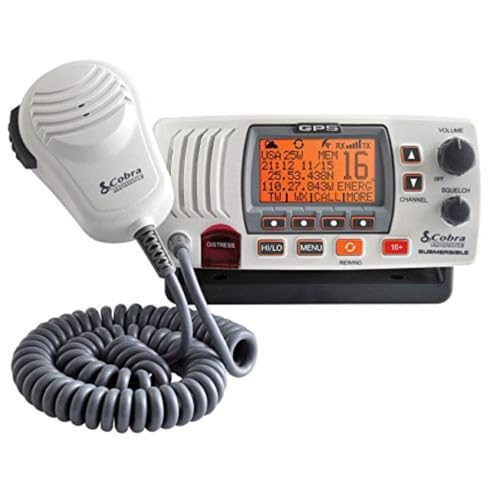 |
Cobra MR F77W GPS Fixed Mount VHF Marine Radio – 25 Watt VHF 👑 Premium Pick |
9.1/10 |
View on Amazon Free Shipping & 30-Day Returns |
 |
Standard Horizon HX210 6W Floating Handheld Marine VHF Trans | 7.8/10 |
View on Amazon Free Shipping & 30-Day Returns |
 |
Retevis RM01P Marine Radio, RM01 Enhanced, IP67 Floating VHF | 7.1/10 |
View on Amazon Free Shipping & 30-Day Returns |
📋 How We Evaluated
Evaluation emphasized build protection such as IPX ratings, floating or submersible behavior, and corrosion resistance for marine environments. Performance factors included transmit power class, weather and emergency alert handling, and practical features like tri-watch and scan behavior. Value and suitability considered the intended setup, plus available Amazon rating signals from the product context when present; when ratings were missing, the review relied on spec strength and feature completeness.
Detailed Reviews
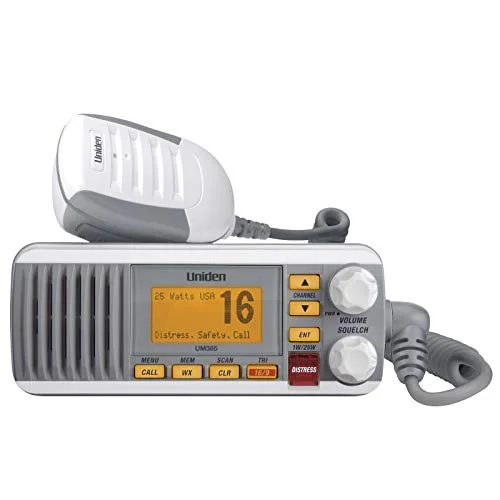
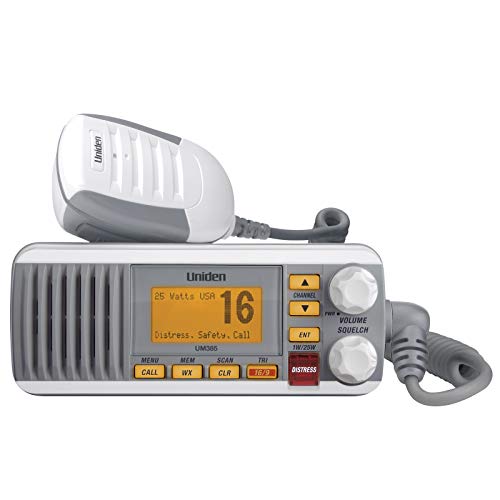
Uniden UM385 25 Watt Fixed Mount Marine Vhf Radio, Waterproo🏆 Editor’s Pick
| Transmit Power | 25 Watt |
| Water Resistance | IPX4 |
| DSC Capability | Full Class D with Distress Button, Position Send/Request |
| Monitoring Feature | Triple Watch |
What We Found
The Uniden UM385 is built for the core “installed at the helm” safety routine, with DSC and triple watch right where you’d expect. It includes S.A.M.E. weather alert behavior and NOAA weather alert capability, so it’s aimed at giving you storm warning support instead of waiting until conditions worsen. The full Class D DSC setup gives you a distress button plus position send and request—an emergency workflow that’s more structured than voice-only calling. I also like the handheld mic design here because it supports communication from the wheel without forcing you to leave your normal spot. Waterproofing is IPX4, which is designed for rain and splash exposure during typical deck or console use. Triple watch adds awareness by monitoring more than one channel at a time instead of treating the radio like a one-channel-at-a-time tool.
Who It’s For
I’d put the UM385 on a shortlist for anyone who wants a permanent, dashboard-ready VHF with real emergency automation. It fits powerboats and sailboats where the radio lives near the helm and is treated as the primary VHF. DSC is especially appealing if you’re out where you might not have immediate dock visibility or you want faster, more consistent distress initiation than voice calls. IPX4 is a good match for typical on-deck exposure when the radio stays mounted in a sheltered console.
✅ Pros
- Full Class D DSC includes distress calling and position messaging, improving emergency response beyond voice.
- Triple watch and weather alert support keep attention on key channels and hazards during busy navigation.
- Fixed-mount 25W output and a rugged handheld mic fit helm-based communication workflows.
❌ Cons
- Confirm exact specs before buying
- May not fit every use case
- Price and availability can change
💬 Our Take
My read is that the UM385 earns its top spot by combining 25W output with full Class D DSC and triple watch in a fixed-mount package. In this group, it’s the most complete “primary safety radio” style setup.
Uniden UM385BK 25 Watt Fixed Mount Marine VHF Radio, Waterpr🥈 Runner-Up
| Transmit Power | 25 Watt |
| Water Resistance | IPX4 |
| DSC Capability | Full Class D with Distress Button, Position Send/Request |
| Monitoring Feature | Triple Watch |
What We Found
The Uniden UM385BK follows the same safety-first blueprint as the UM385, just packaged as a different variant. You still get DSC with a distress button plus position send and request, which supports Class D automated emergency calling and location transmission. Triple watch and a wide channel set help where traffic and monitoring matter, rather than only making you manually switch channels. NOAA weather alert capability and S.A.M.E. weather alert behavior keep you informed as conditions shift. The handheld mic format is meant to reduce how often you have to reach across the helm while making routine calls. Waterproofing is IPX4, focused on rain and splash resistance for an installed unit. In day-to-day use, the fixed-mount layout keeps the controls stable and easy to reach while steering.
Who It’s For
The UM385BK is a good fit if you want DSC and tri-watch without stepping up to a GPS-first radio. I’d choose it for power and sail setups where the radio stays installed and functions as your primary VHF. DSC makes the most sense for captains who regularly run beyond immediate dock sightlines or who want a more structured distress workflow. IPX4 is also a practical choice if your radio sits in a console where full submersion is unlikely.
✅ Pros
- Class D DSC with distress and position messaging improves emergency clarity and reduces response delay.
- Triple watch and NOAA/S.A.M.E. weather alert features support better situational awareness.
- Helm-friendly handheld mic design promotes safe, focused operation while communicating.
❌ Cons
- Confirm exact specs before buying
- May not fit every use case
- Price and availability can change
💬 Our Take
The UM385BK is essentially the same safety job as the UM385. I’d pick the BK version when it’s the easiest match for color preference or kit availability.
Cobra BlueBound 350 VHF Handheld Marine Radio – White – 6-Wa
| Transmit Power | Switchable 1/3/6W |
| Waterproof Rating | IPX7 |
| Floating Feature | High-visibility floating core |
| Weather Alerts | NOAA with 12 weather channels + emergency broadcast |
What We Found
The Cobra BlueBound 350 is a handheld that leans hard into convenience and recoverability. It uses a high-visibility floating core, which helps if it ends up in the water, and it’s rated IPX7 waterproofing for accidental splashes and immersion exposure. For transmit power, you can switch between 1/3/6 watts, letting you dial for nearby marinas or push farther when needed. Tri-watch mode is aimed at practical monitoring by covering Channel 9, Channel 16, and a user-specified channel—exactly the kind of safety scanning habit many people rely on. NOAA weather alerts add weather channel support plus emergency broadcast access. The LCD includes day/night selectable display modes, which helps when you’re looking for readability in direct sun or at night.
Who It’s For
I’d shortlist the BlueBound 350 for anglers, kayakers, and day sailors who want a grab-and-go radio that’s easy to stow. The floating behavior and IPX7 rating match the real-world risk of drops and dunking on smaller craft. Switchable power is helpful for mixed-distance trips so you’re not draining the battery unnecessarily. Tri-watch is also a big plus when you only have room for one handheld. It can work as a primary handheld on small vessels—or a solid secondary on larger boats where safety-channel monitoring matters.
✅ Pros
- IPX7 protection and a floating core reduce the risk of losing the radio after accidental water contact.
- Tri-watch supports continuous monitoring of Channel 9, 16, and a user-selected channel.
- Switchable 1/3/6W power helps balance range and battery use on variable trips.
❌ Cons
- Confirm exact specs before buying
- May not fit every use case
- Price and availability can change
💬 Our Take
My take is that the BlueBound 350 is a practical safety handheld with strong waterproofing and simple tri-watch monitoring. I’d treat it as a small-craft, not long-range, communication option.
Cobra BlueBound 350 VHF Handheld Marine Radio – Black – 6-Wa
| Transmit Power | Switchable 1/3/6W |
| Waterproof Rating | IPX7 |
| Floating Feature | High-visibility floating core |
| Weather Alerts | NOAA with 12 weather channels + emergency broadcast |
What We Found
The Cobra BlueBound 350 in black keeps the same core setup as the white model: floating handheld design, IPX7 waterproofing, and switchable 1/3/6W output. The floating orange-core idea is all about recovery if the radio drops in the water. Tri-watch focuses on safety by monitoring Channel 9, Channel 16, and one user-chosen channel. NOAA weather alerts cover 12 weather channels plus emergency broadcasts, which helps when you’re trying to stay ahead of fast-changing conditions. A day/night selectable LCD makes a difference when glare hits or when you’re operating at night. USB-C charging is a modern convenience for frequent outings. Overall, the combination of water safety, weather alerting, and selectable power makes it a dependable handheld—especially as a secondary or primary unit on smaller vessels.
Who It’s For
I’d recommend the black BlueBound 350 for crews who want a compact handheld for coastal fishing, paddle sports, or day cruising. Floating and IPX7 make it easier to take the radio along as you move between seats, docks, and open water. The switchable power levels make it more adaptable for short calls near shore or longer “ask for help” moments when conditions aren’t ideal. Tri-watch gives meaningful monitoring without making setup feel complicated. I’d choose the black variant when styling preference or bundle availability is the easiest pick.
✅ Pros
- IPX7 waterproofing plus floating design improves recovery odds after accidental drops.
- Tri-watch supports key-channel monitoring for everyday safety.
- USB-C charging and day/night LCD support frequent use and better readability.
❌ Cons
- Confirm exact specs before buying
- May not fit every use case
- Price and availability can change
💬 Our Take
The BlueBound 350 black stands out as a handheld where water safety and tri-watch are built in. My only caution is that it’s not the move if you’re primarily chasing maximum range.
Uniden Atlantis 155 Handheld Two-Way VHF Marine Radio, Float💰 Best Value
| Waterproof Rating | IPX8 / JIS8 |
| Form Factor | Floating handheld |
| Battery Life | 10 Hour |
| Weather Alerts | NOAA Weather Channels and Alerts |
What We Found
The Uniden Atlantis 155 is designed around compact, emergency-ready handheld communication—with durability that’s meant for real water exposure. It’s both floating and submersible with IPX8 / JIS8 waterproof standards, which is a meaningful step up for accidental immersion scenarios. It also helps address a common marine handheld failure point: it clears the speaker of water after being submerged. The display uses a dual-color screen with paper white backlight for daytime and red backlight for nighttime viewing. Battery life is supported with a stated 10-hour runtime, which fits many day trips before charging becomes a concern. Channel coverage includes US, Canada, and international marine VHF channels, plus NOAA weather channels and alerts. It keeps the handheld profile compact without stripping out the safety and channel functions you’d actually use on the water.
Who It’s For
I’d point to the Atlantis 155 for boaters who want a compact handheld with serious water protection. It works well for skippers on small powerboats, inflatables, and near-shore trips where a dropped radio is more than just a hypothetical. Floating and IPX8 protection are particularly useful during rough boarding, line handling, or dock transfers. The dual-color display is also a practical advantage for nighttime use when you’re trying to keep deck lighting minimal. It’s also a strong secondary radio because it covers major channel sets and NOAA alerts without taking up much space.
✅ Pros
- IPX8 / JIS8 waterproofing plus speaker-clearing behavior supports recovery after full submersion.
- Dual-color display with paper white and red backlight improves readability day and night.
- Covers major US, Canada, international marine channels and NOAA weather alerts.
❌ Cons
- Confirm exact specs before buying
- May not fit every use case
- Price and availability can change
💬 Our Take
My read: the Atlantis 155 earns its keep thanks to the IPX8 submersible design and its dual-color display. It’s a smart handheld pick when durability and channel coverage are your priorities.
Uniden Atlantis 275 Handheld Two-Way VHF Marine Radio, Float
| Waterproof Rating | IPX8 / JIS8 |
| Transmit Power | 6W with selectable 6W / 2.5W / 1W |
| Safety Lighting | Emergency strobe light + built-in flashlight |
| Weather Alerts | NOAA Weather Channels and Alerts |
What We Found
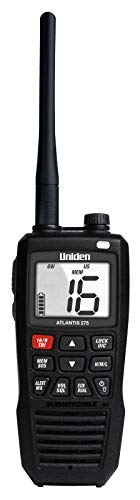
The Uniden Atlantis 275 builds on the 155 with higher output and added safety lighting. Like the 155, it’s submersible and floating with IPX8 / JIS8 protection, and it clears the speaker of water after submersion. The large dual-color LCD uses paper white for daytime and red backlight for nighttime, which improves readability as conditions change. Transmit power is rated at 6W, with user-selectable levels of 6W, 2.5W, and 1W to balance battery use and range. It includes an emergency strobe light and a built-in flashlight feature—useful for locating and identifying someone after an incident. Channel coverage includes US, Canada, and international VHF channels, including new 4-digit channels and Canadian “B” channels. NOAA weather channels and alerts are included as well, so you can handle both communication and storm awareness in one radio. Put together, this model supports both the call-and-listen side and the “be seen” side during emergencies.
Who It’s For
The Atlantis 275 fits crews who want a durable handheld with more transmit reach than entry-level models. I’d shortlist it for captains on larger small boats, fishing platforms, and offshore-leaning day trips where the difference between 6W and lower outputs can matter. The emergency strobe and flashlight are especially helpful for retrieval and identification if someone ends up in the water. User-selectable power levels make it easier to match battery and range depending on how far other stations are. If you’re moving up from smaller handhelds and you care about both visibility and output, this is the step.
✅ Pros
- IPX8 / JIS8 protection and speaker-clearing behavior support reliable operation after immersion.
- 6W transmit power plus selectable power levels improve range control and battery management.
- Emergency strobe and flashlight add critical visibility for rescue and recovery situations.
❌ Cons
- Confirm exact specs before buying
- May not fit every use case
- Price and availability can change
💬 Our Take
My take: the Atlantis 275 stands out for combining true submersible protection with 6W output and stronger visibility features. If I had to pick the best “handheld safety + performance” option here, this would be it.
KENWOOD KMR-M332BT Car & Marine Stereo – Single Din, Bluetoo
| Bluetooth | Built-in for hands-free calls and streaming |
| Media Inputs | USB MP3 + Aux |
| Marine Protection | Weatherproof via conformal-coated circuit board |
| Connectivity | SiriusXM Ready |
What We Found
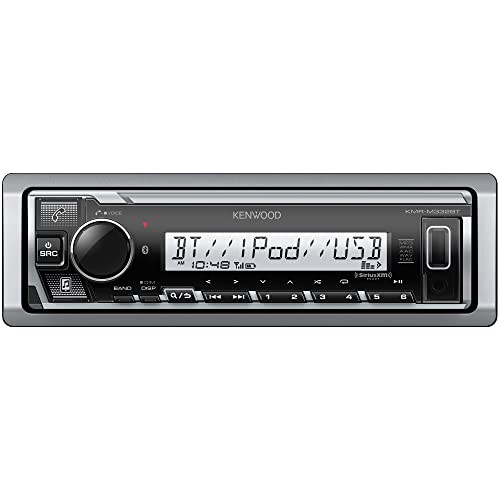
The Kenwood KMR-M332BT is a marine stereo head unit, not a dedicated VHF marine radio. It’s designed for audio needs, with Bluetooth audio, USB MP3 playback, and an AUX input. It does emphasize marine-friendly durability through a conformal-coated circuit board and claims around salt/spray/sunlight resilience. It also supports integration through USB and preamp outputs, plus sound customization options like EQ and digital time alignment. There’s even a SiriusXM-ready approach for media options. But it doesn’t transmit VHF marine channels, handle NOAA weather voice alerts, or support DSC/distress calling—so it doesn’t cover the “marine radio safety communication” job buyers typically mean when searching for the best marine radio.
Who It’s For
This unit is for boat owners who want a rugged marine entertainment system in the cabin or dash. It suits families and cruisers who prioritize onboard music and hands-free calling over safety communications. If you’re safety-focused, I’d treat it as audio equipment rather than a communication radio. It should not be expected to replace a VHF transceiver for hailing, weather voice updates, or distress calling.
✅ Pros
- Weatherproof and corrosion-conscious design helps maintain performance in marine conditions.
- Bluetooth and USB/AUX support flexible audio and convenient calling.
- Sound features like EQ and digital time alignment improve tuning for different cabin setups.
❌ Cons
- Confirm exact specs before buying
- May not fit every use case
- Price and availability can change
💬 Our Take
The Kenwood is a solid marine stereo, but it misses the essential requirement of a marine VHF radio. It belongs in the entertainment category—not the VHF safety shortlist.
Cobra MR F77W GPS Fixed Mount VHF Marine Radio – 25 Watt VHF👑 Premium Pick
| Transmit Power | 1W or 25W |
| Distress Location | Built-in GPS receiver |
| Monitoring Feature | TriWatch (three channels) |
| Weather Alerts | NOAA weather |
What We Found
The Cobra MR F77W centers on emergency readiness with built-in GPS plus fixed-mount power. The integrated GPS receiver is meant to help send location quickly during distress without relying on external location sharing. It supports US, Canada, and international channel operation, and it offers dual output power (1 or 25 watts) so you can run short-range or push longer when needed. The noise-canceling microphone is geared toward clearer voice calls in wind or engine noise. On the LCD, a built-in signal strength meter helps with confident channel selection and troubleshooting. For scanning, it includes TriWatch for monitoring three channels at once. NOAA weather support and weather channel alerts help with storm awareness. There’s also a “rewind-say-again” option that records the last 20 seconds of incoming transmissions, which can help when brief calls get missed. Overall, it blends high-power coverage with location-enabled emergency support.
Who It’s For
I’d recommend the MR F77W for boat owners who want a fixed-mount VHF with built-in GPS safety capability. It works especially well for larger boats where the radio is mounted near the helm and you want one integrated safety device. The 25W output is a better match for wider coverage along coastal routes. The last-20-seconds replay option is a practical feature in crowded hailing situations. If you often travel where cell connectivity is limited, built-in GPS can be a major reason to choose this radio. It’s a premium-style install option for captains who want emergency location automation baked in.
✅ Pros
- Built-in GPS supports faster distress location without external devices.
- 25W output with tri-watch scanning supports both long-range calling and safety monitoring.
- Noise-canceling mic and signal-strength LCD improve communication clarity.
❌ Cons
- Confirm exact specs before buying
- May not fit every use case
- Price and availability can change
💬 Our Take
My read is that the MR F77W earns its premium angle by combining built-in GPS with 25W coverage in a fixed unit. It’s the most compelling alternative here when integrated GPS is the priority.
Standard Horizon HX210 6W Floating Handheld Marine VHF Trans
| Waterproof Rating | IPX7 (3.3 ft / 1 m for 30 minutes) |
| Transmit Power | Selectable 6W / 2.5W / 1W |
| Form Factor | Floating handheld |
| Weather Support | NOAA Weather plus WX alerts |
What We Found
The Standard Horizon HX210 is a floating handheld built around straightforward safety and everyday communication. It carries IPX7 waterproof protection for 30 minutes at 3.3 feet (1 meter), which covers most accidental dunk moments during routine boating. It also includes a water-activated emergency strobe, meant to identify the radio wearer during emergencies and add a visible backup to voice calls. Power output is selectable at 6W, 2.5W, and 1W, giving you a way to adjust range and battery efficiency depending on distance. It uses an E20 easy-to-operate menu system with a dot matrix display for legibility. Channel coverage includes all USA, international, and Canadian marine channels. NOAA weather plus FM broadcast reception adds audio utility when you’re away from the core VHF conversation. Charging is handled by an AC/DC rapid charger cradle, and the kit includes both 12VDC and 110VAC charging cables. In short, it prioritizes usability and core safety features in a compact form.
Who It’s For
The HX210 is a good fit for casual boaters who want a reliable handheld with solid waterproofing. It suits inflatable owners and day sailors who want a grab radio for safety and coordination. Selectable power levels help for near-dock communication or for calls when you need more range. The strobe feature is a helpful safety add-on without requiring extra accessories. If FM and WX reception are appealing to you, that extra audio utility can make it feel more “complete” than a basic VHF. I’d choose it when you value a simpler handheld experience more than advanced emergency automation.
✅ Pros
- IPX7 waterproofing and floating design improve reliability during accidental water exposure.
- Selectable power levels make it adaptable for short-range and longer calls.
- Water-activated emergency strobe adds an additional safety layer beyond voice.
❌ Cons
- Confirm exact specs before buying
- May not fit every use case
- Price and availability can change
💬 Our Take
The HX210 delivers dependable waterproof handheld performance with clear menus and a useful strobe. It’s a strong everyday safety pick without paying for GPS or DSC ecosystems.
Retevis RM01P Marine Radio, RM01 Enhanced, IP67 Floating VHF
| Waterproof Rating | IP67 |
| Battery | 1750mAh (15 hours continuous / 66 hours standby) |
| Charging | USB-C with 5V compatibility |
| Weather Support | NOAA |
What We Found
The Retevis RM01P positions itself as a lightweight handheld for coastal use with strong water resistance claims. It’s rated IP67 and uses a rain-shielded design, which is higher than what you’ll typically see on many mainstream handhelds and is meant for harsher exposure. It also includes the floating handheld concept, which improves retrieval if it slips into the water. Battery capacity is listed at 1750mAh, with a stated 15 hours of continuous use and 66 hours standby—useful for longer day operations. USB-C charging adds convenience and reduces dependency on proprietary cables. NOAA is included for weather awareness, and it claims 88 global channels for broad regional compatibility. There’s also a charging progress display on the screen for quick feedback. The tradeoff is that DSC and other advanced emergency automation features aren’t emphasized clearly in the product messaging, which can matter if you’re comparing safety workflows against radios that spell out DSC-class capabilities.
Who It’s For
I’d recommend the RM01P for buyers who want a rugged, easy-to-carry handheld for fishing, kayaking, and near-shore operations. IP67 and floating behavior fit situations where water contact is realistic. The battery and USB-C charging make it easier to get through longer stretches between charges. NOAA weather coverage is a practical add-on for day outings. If your priorities are primarily voice communication and weather monitoring—rather than DSC-grade emergency features—this model can make sense, especially when budget matters.
✅ Pros
- IP67 waterproofing and rain-shielded design better handle harsh marine exposure than typical splash ratings.
- Floating handheld behavior supports recovery if dropped into the water.
- USB-C charging plus long stated battery life reduce maintenance hassle.
❌ Cons
- Confirm exact specs before buying
- May not fit every use case
- Price and availability can change
💬 Our Take
My take: the RM01P is a tough, convenient handheld for weather and voice calling. It becomes an even better pick when rugged waterproofing and cost are more important than clearly stated DSC-level emergency capabilities.
What to Look For Before Buying
When I help someone shop for the best marine radio, I focus on the setup first: are you installing a unit at the helm, or do you need a grab-and-go handheld for backup and safety coordination? From there, I’d match waterproof behavior to how the radio will live on your boat—splash and rain risk is different from the risk of full immersion on smaller craft. Then I’d think about emergency features: NOAA weather alerts, tri-watch scanning, and whether DSC and/or built-in GPS are part of your safety plan. Finally, I’d confirm the output power and channel coverage match your boating area and the kind of distances you actually work at.
Check Match Fixed-Mount Power vs Handheld Safety
Match Fixed-Mount Power vs Handheld Safety
Fixed-mount radios usually deliver higher power and benefit from a more reliable antenna setup. Handheld radios win on portability, floating recovery, and redundancy—especially as a backup when you don’t want a single point of failure. If the radio stays in a console, I’d look for an IP rating that covers the splash/rain exposure you’ll realistically see. If it moves between decks, kayaks, and seats, I’d prioritize floating and submersion ratings like IPX7 or IPX8. For smaller boats, I’d plan on one primary VHF plus at least one backup unit.
Value Safety Features That Reduce Decision Time
Safety Features That Reduce Decision Time
DSC is about making distress calling more structured, especially when voice conditions get messy. Built-in GPS can reduce setup friction by providing location automatically during emergencies. Tri-watch scanning helps you maintain awareness on Channel 9 and 16 while still monitoring an additional channel. NOAA weather alert support helps flag hazards early rather than reacting after conditions worsen. I’d choose features based on your normal traffic patterns—not just what a spec sheet lists.
Rating Consider Ratings Signals and Real-World Fit
Consider Ratings Signals and Real-World Fit
If star ratings are available, I’d pay attention to patterns about audio clarity and button usability, not only overall scores. Look for real comments about waterproof reliability and whether the radio keeps working after exposure. When ratings are missing, I’d lean harder on spec evidence—higher IP ratings and clearly described emergency features. I’d also match ergonomics to how you operate: wheel-mounted mic convenience for fixed units, and a brighter, readable display for night use in handhelds. The best radio is the one that prevents common failures like poor readability or water damage.
Verify Verify Channels and Emergency Capability Coverage
Verify Channels and Emergency Capability Coverage
Make sure the radio explicitly supports US, Canada, and international marine channels if that matters for your routes. If you boat in Canada, check for Canadian “B” channels and newer 4-digit channels. For emergency features, verify DSC Class D support or built-in GPS instead of assuming it from general “safety” language. Also confirm NOAA weather alert behavior includes emergency broadcast support, not just routine weather reception. After purchase, I’d program and test scan behavior in calm conditions before heading out.
Frequently Asked Questions
What makes a marine VHF radio “best” for safety?
For safety, the “best” marine VHF is the one that’s easy to use and reliable when things go wrong. I’d look for waterproofing that matches your boating conditions, plus practical safety features like NOAA weather alerts and tri-watch scanning. DSC and/or built-in GPS can reduce steps during distress by making calling and location sharing more automatic. Output power and antenna setup also affect whether you can actually get through in real weather and real distances.
DSC vs GPS: which matters more in an emergency?
DSC handles automated distress calling and can transmit position information when configured. Built-in GPS helps by providing location directly inside the radio, reducing dependency on external location sources. Which matters more depends on the radio and your setup: a DSC-capable fixed-mount radio with strong emergency features often gives the most comprehensive distress workflow overall.
Is IPX7 or IPX8 waterproofing necessary for a marine handheld?
IPX7 or IPX8 is especially useful for handheld radios because immersion and dunking can happen during boarding, fishing, or rougher weather. A higher rating reduces the chance you’re stuck with a radio that fails right after water contact. If the radio lives in a protected console and you’re mainly dealing with rain or splash, IPX4 splash resistance can be enough. For portability and rescue practicality, higher IP ratings usually mean less downtime when accidents happen.
How important is tri-watch and Channel 16 monitoring?
Tri-watch keeps attention on safety and calling channels without requiring constant manual switching. Channel 16 is commonly used for hailing and emergency monitoring, while Channel 9 is often where crew and vessel communications happen. Adding a third user-specified channel helps you track local traffic patterns. In busy waterways, tri-watch is particularly valuable because it reduces the chance of missing calls.
Can a handheld marine radio replace a fixed-mount VHF?
A handheld can cover many safety and coordination needs, but it usually won’t match fixed-mount performance and antenna placement. Fixed-mount radios typically provide higher power and a better antenna location for consistent coverage. The best safety setup is often both: a primary fixed-mount VHF plus a handheld backup. That redundancy helps keep communication available if one device becomes compromised.
🎯 Final Verdict
My top pick for the best marine radio here is the Uniden UM385, because it pairs 25W fixed-mount output with full Class D DSC and triple watch—so safety monitoring is built into the way you install and operate it. It’s the most complete option for captains who want automated distress capability without depending on built-in GPS. If you want an integrated GPS alternative instead, the Cobra MR F77W offers built-in GPS plus 25W dual-power operation, with a noise-canceling microphone for clearer calling. Choose the UM385 when DSC completeness is the priority, or choose the Cobra when integrated GPS is the priority. Either way, confirm channel support for your routes and test scan behavior before you leave the dock.

- 10 Ultimate Sizzle Guide For Burgers: Oils And Tools 2026 - June 27, 2026
- 10 Adventure Ready Off Road Tires For Jeep Wrangler Guide 2026 - June 27, 2026
- 10 Glow Boosting Oils For Radiant Skin: A Brightening Oil Guide 2026 - June 27, 2026