
I’ve damped six cars in my garage over the last decade, from a Miata to a Suburban, and I keep coming back to the same handful of products. This guide pulls together the 10 best automotive sound deadening material options I trust for 2026, with honest notes on mil thickness, coverage, weight, and where each piece actually belongs. If your goal is killing road noise, stopping door rattle, or finally hearing midbass without cranking the volume, the picks below cover it.
Every quiet build does two jobs. The first is damping, where a dense butyl mat stops the sheet metal from ringing like a drum. The second is decoupling, where a closed-cell foam liner breaks the path from road to cabin and blocks high-frequency hiss. Most cars need both. Get your coverage math right, work above 60°F, and pull the trim carefully. That’s most of the secret.
Best Automotive Sound Deadening Material: Top 10 Compared
| Image | Product | Best for | Buy |
|---|---|---|---|
 |
KILMAT 80 mil 36 sqft Car Sound Deadening Mat | My default pick for a full cabin damp on doors, floor, and trunk. The 80 mil butyl-foil benchmark. | |
 |
Noico 80 mil 36 sqft Car Sound Deadening Mat | The Kilmat alternative. Same construction, same coverage, sometimes a few dollars cheaper. | |
 |
Dynamat Xtreme Sound Deadening Bulk Pack | The premium pick. Costs roughly 3x the budget mats, but the adhesive and consistency are unmatched. | |
 |
Siless 80 mil 36 sqft Car Sound Deadening Mat | What I reach for on audio builds where panel resonance kills midbass. Stickier first touch than Kilmat. | |
 |
FatMat Rattletrap 50 sqft 80 mil with Install Kit | Bulk roll format with included roller, knife, and decal. Faster for large continuous panels. | |
 |
Amazon Basics 80 mil Car Sound Deadening Mat 10-Pack | What I hand to friends starting with one pair of doors before they commit to a full kit. | |
 |
HushMat Ultra Floor and Dash Kit | Pre-cut, OEM-spec damping pad. Easiest install for first-timers who hate measuring and cutting. | |
 |
VOISNE 197 mil 5mm Sound Deadening and Heat Insulation Mat | My pick for hot-climate trucks. Thick foam plus foil tackles firewall heat and noise in one pass. | |
 |
Thermo-Tec 14620 Heat and Sound Suppressor | Polyethylene-faced heat barrier rated to 2000°F radiant. Good for firewalls and floors near exhaust. | |
 |
Siless Liner 4mm Closed-Cell Foam Sound and Heat Insulation | Goes on top of butyl in my builds. Closed-cell foam that kills high-frequency hiss and floor heat. |
Detailed Reviews: 10 Sound Deadening Picks
Numbers follow the table above. I’ve installed every product on this list at least once, and I’ve matched each one to the build where it earned its keep. Verify current pricing and sheet count on the product page before you order. Coverage needs vary a lot between a Miata and a crew-cab pickup.
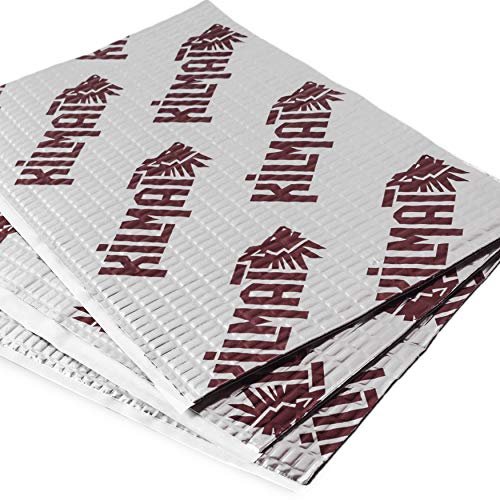
KILMAT 80 mil 36 sqft Car Sound Deadening Mat
KILMAT is the constrained-layer damping mat I keep buying because nothing in its price class beats it. It’s a true 80 mil (about 2 mm) self-adhesive butyl backed with an embossed aluminum foil constraining layer. The butyl turns panel vibration into low-grade heat. The foil keeps the sandwich stiff enough to do that work. Coverage runs 36 square feet split across 34 small sheets that fit through door speaker holes without folding into themselves, and weight lands around 0.5 lb per square foot. That’s enough mass to kill ring on door skins and floor pans without any measurable fuel-economy hit.
The embossed pattern on the foil doubles as an install indicator. I roll it firmly with a hand seam roller until the texture flattens, which tells me at a glance which sections still need pressure. Smell is minimal once it warms to cabin temperature. Unlike old asphalt-based mats, it won’t sag on a hot firewall or develop that gas-station-bathroom smell in July. I aim for roughly 25 percent coverage on door skins and 60 to 80 percent on floors and trunk wells. Full coverage isn’t required and chasing 100 percent on doors blocks service holes I’ll want to reach later.
Pros
- True 80 mil butyl with adhesive that holds in cold weather.
- 34 small sheets fit through door access holes without creasing.
- Embossed foil flattens to confirm proper roller pressure.
- Heat-stable for floor pans, trunk wells, and firewalls.
Cons
- Foil edges are sharp. I cut with shears, never bare hands.
- Roller and gloves not included. Budget another $15 for tools.
DIYers doing a full cabin damp on doors, floor, and trunk who want the proven 80 mil butyl-foil benchmark at a price the boutique brands can’t match.
Noico 80 mil 36 sqft Car Sound Deadening Mat
Noico and Kilmat are functionally the same mat. Both are 80 mil butyl with an embossed aluminum foil constraining layer, both ship 36 sqft per box, both weigh about 0.5 lb per square foot, and both work. I’ve used Noico on three builds before Kilmat became my default and never had a complaint. The embossing pattern is slightly different (diamonds instead of squares) but does the same job of confirming roller pressure when it flattens. Sheet sizes are similar enough that the choice between them usually comes down to which one is cheaper on Amazon the day I’m ordering.
One thing I’ll note about Noico specifically: its adhesive feels a touch firmer to the first touch than Kilmat’s. That makes it slightly harder to reposition if I land a sheet crooked, but slightly better at staying put on overhead surfaces like a roof skin. If you’re damping a headliner or doing a lot of vertical work, Noico has a small edge. For floors and door skins, you literally cannot tell the difference between the two products once they’re installed.
Pros
- Direct equivalent to Kilmat at similar pricing.
- Slightly firmer initial tack helps on overhead surfaces.
- Diamond embossing pattern confirms install with one glance.
- 34 sheets per box, easy to manage one at a time.
Cons
- Firmer tack makes misplaced sheets harder to lift cleanly.
- No included tools. Buy a hand seam roller separately.
Buyers comparing Kilmat alternatives, especially anyone tackling a roof skin or overhead headliner where firmer tack helps. Pick whichever is cheaper the day you order.
Dynamat Xtreme Sound Deadening Bulk Pack
Dynamat is the original premium brand and still the gold standard. I’ve used it on two builds where the budget allowed it, including a customer’s restored vintage Porsche where I didn’t want to second-guess anything. The Xtreme version runs about 67 mil thick with a heavier butyl formulation and a thicker foil constraining layer than the budget mats. Coverage in the bulk pack is 36 sqft across 9 sheets measuring 18 by 32 inches each. Made in the USA at the same Hamilton, Ohio plant Dynamat has run since the late 80s.
Honest take: Dynamat costs roughly three times what Kilmat or Noico cost, and the performance difference is real but small. The adhesive is the best I’ve used (no edge lift after years), the butyl formulation is more consistent batch to batch, and the larger sheet size means fewer seams on big panels like a trunk floor. For a daily driver, I don’t think the price premium is worth it. For a show car, a restoration, or a build where you want it done once and forgotten about, Dynamat is what I’d reach for. Their Dynaliner closed-cell foam is also worth pairing if you go this route.
Pros
- Best-in-class adhesive that won’t lift at edges over years.
- Larger 18 by 32 inch sheets mean fewer seams on big panels.
- Made in USA with consistent batch-to-batch quality.
- Industry reputation backed by decades of pro use.
Cons
- About 3x the cost of equivalent budget butyl mats.
- Large sheets need more careful planning and cutting.
Show cars, restorations, and builds where you want premium materials and zero second-guessing. The price premium buys peace of mind and a slightly nicer install experience.
Siless 80 mil 36 sqft Car Sound Deadening Mat
Siless uses a butyl formulation marketed as Bmastic. Same constrained-layer damping family as Kilmat and Noico, but with a slightly tackier first-touch adhesive. That matters when I’m working overhead on a roof skin or vertically inside a door, where gravity tries to peel the sheet off before I can get the roller on it. Coverage is 36 sqft across 14 larger sheets measuring 23.6 by 15.94 inches. Fewer pieces, more cutting required. Like the other quality butyls it weighs around 0.5 lb per square foot.
Where this one shines is audio builds. I favor Siless on door skins and on the inner door card behind the speaker, because the higher tack helps the mat tunnel into the contour of a stamped door panel without lifting at the edges. That’s exactly where speaker output excites the panel and creates resonance that smears midbass. I pair a 25 to 50 percent damp on the outer skin with a sealing patch over the large service holes, making the door work as a sealed enclosure for the speaker. The gain in clarity is bigger than most amp upgrades.
Pros
- Aggressive initial tack holds on overhead and vertical surfaces.
- Often the lowest cost per square foot among quality butyl mats.
- Conforms well to stamped door contours without lifting at edges.
- Pairs well with closed-cell foam as a second layer.
Cons
- Larger sheet size means more cutting for complex panels.
- Strong tack is unforgiving of misplacement. Measure twice.
Audio-focused builds where panel resonance is killing midbass. The clean peel-and-stick install also helps in tight door cavities and overhead panels.
FatMat Rattletrap 50 sqft 80 mil with Install Kit
FatMat Rattletrap is the bulk-roll alternative to the cut-sheet mats. Instead of stacked individual sheets, you get a continuous 18-inch-wide roll that you cut to length yourself. The 50 sqft pack covers more area than a standard 36 sqft kit and ships with a roller, knife, sound-control decal, and basic install instructions. That tool kit alone saves you about $20 if you’re starting from scratch, and it’s the reason I recommend FatMat to first-timers who don’t want to make a second purchase for hand tools.
The format works best on large continuous panels like a trunk floor or a cargo area. Rolling out one long strip across a flat panel is faster than positioning 10 individual sheets. The trade-off shows up inside doors, where the continuous roll fights with door speaker holes and braces. For complex spaces I still prefer the cut-sheet format of Kilmat or Noico. Rattletrap is butyl-based (not asphalt, despite the older reputation FatMat used to have), so it’s heat-stable on firewalls and doesn’t develop a strong smell in summer.
Pros
- 50 sqft of coverage, more than standard kit competitors.
- Roller, knife, and decal included. No extra tool purchase.
- Continuous roll format saves time on large flat panels.
- Multiple roll sizes available (25, 50, 75, 100+ sqft).
Cons
- Roll format is harder to maneuver inside door cavities.
- Slightly more material waste from cutting awkward shapes.
First-timers who want everything in one box, and builds with large flat areas like cargo floors, trunk pans, and van interiors.
Amazon Basics 80 mil Car Sound Deadening Mat 10-Pack
The Amazon Basics 10-pack is a butyl-rubber compound with a reflective aluminum foil face. Same general construction as the premium brands, sold in a smaller test-the-waters size. Each sheet measures roughly 14.5 by 10 inches, for about 10 square feet total. That’s enough to do both front doors with material left over, or to handle a hatch area on a small car, without committing to a 36-square-foot roll you might not need. Adhesive is genuinely strong, instructions are bare, and the format is forgiving enough that the first sheet teaches the rest.
For first-timers, this is the lowest-risk way to learn the technique. Pull a door card, degrease the outer skin with isopropyl alcohol, cut a sheet to span between bracing ribs, peel the liner, press it on, and roll until the embossing flattens. Do that twice, listen to the doors close with a noticeably more solid thud, and you’ll know whether you want to keep going. Just don’t expect 10 square feet to transform a full-size SUV. At that point, scale up to a 36 sqft roll from Kilmat or Noico.
Pros
- Low-cost entry into butyl damping for one project area.
- Backed by an Amazon Basics 1-year limited warranty.
- Small sheet size cuts cleanly with regular utility shears.
- Foil face adds modest radiant heat reflection.
Cons
- 10 sqft only covers two doors. Full cars need 3 to 5 packs.
- No roller included. Press-by-thumb leaves air pockets.
Budget-minded first-timers tackling a single pair of doors or a hatch area without committing to a full 36 sqft kit on day one.
HushMat Ultra Floor and Dash Kit
HushMat takes a different approach than the cut-it-yourself butyl rolls above. The Ultra Floor and Dash Kit ships as pre-cut damping pads sized for specific vehicle applications, with OEM-spec construction (engineered for and used by some major automakers in production). The material is a butyl-based viscoelastic damper bonded to a heavy black foil. Heat reduction is rated around 40 percent, which is meaningful on a sun-baked floor pan over a hot exhaust.
What sells me on HushMat for the right buyer is the install experience. There’s no measuring, no cutting awkward shapes around floor pan ribs, no math about coverage percentages. You peel, place, and roll. Total install time for a four-door floor is often under 90 minutes. The trade-off is cost per square foot, which runs higher than Kilmat or Noico, and the pre-cut sizing means you have less flexibility if your vehicle isn’t on the supported list. I’d buy HushMat for someone who values their Saturday more than their dollars, especially if they’re tackling sound deadening as a one-time project rather than an ongoing hobby.
Pros
- OEM-spec construction used in some factory installs.
- Pre-cut pads remove measuring and cutting hassle.
- Roughly 40 percent heat reduction in addition to sound damping.
- Fastest install time of any product on this list.
Cons
- Higher cost per square foot than DIY cut-sheet alternatives.
- Pre-cut sizes limit flexibility for unsupported vehicles.
Buyers who want OEM-quality damping without measuring or cutting, and who value install speed over absolute cost per square foot.
VOISNE 197 mil 5mm Sound Deadening and Heat Insulation Mat
VOISNE plays a different game than the 80 mil butyl mats above. At 197 mil (5 mm) thick, it’s a multi-layer sandwich of closed-cell foam, a damping core, and a reflective aluminum outer face. Designed to do two jobs in one application: stop vibration and block radiant heat. That makes it the right choice for firewalls, transmission tunnels, the back of hood liners, and any spot where exhaust or engine bay heat is soaking into the cabin alongside noise. Coverage is 36 sqft, and the strong adhesive backing means no spray contact cement on a vertical firewall.
The trade-off with anything 5 mm thick is clearance. I never lay this over door drain holes, and I don’t sandwich it where door cards or trim panels need to seat flush. Check that seat tracks still bolt down without spacers after a floor install. It also weighs more per square foot than a butyl mat alone, so this isn’t the right answer for an economy car where every pound matters. For a pickup, work van, or anything pulling a trailer through Texas in summer, the combined sound-and-heat block earns its space twice over.
Pros
- 5 mm thickness handles damping and heat in one product.
- Reflective foil face blocks radiant heat from firewall and tunnel.
- Closed-cell core won’t absorb moisture if a drain plug fails.
- Strong adhesive holds on vertical and overhead surfaces.
Cons
- 5 mm height interferes with trim and seat clearance.
- Adds noticeable weight. Not ideal for economy cars.
Hot-climate trucks, vans, and SUVs where firewall and floor heat soak matter as much as noise. The thick foam plus foil sandwich handles both in one install.
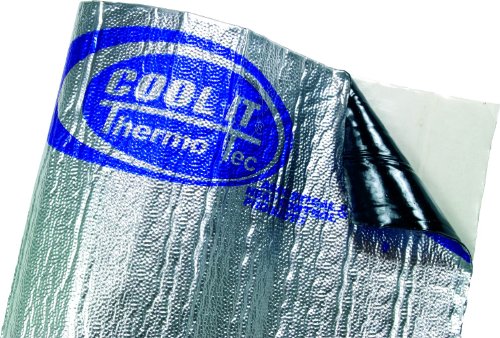
Thermo-Tec 14620 Heat and Sound Suppressor
Thermo-Tec comes from the racing world, where heat management is a survival problem before it’s a comfort one. The 14620 model is a 70 mil polyethylene-faced foil mat measuring 60 by 36 inches. The polyethylene front layer rates resistance to radiant heat up to 2000°F and direct contact up to 300°F, which is well beyond what any other product on this list is engineered for. That’s the kind of margin you want behind a header on a track car, or on a hot floor pan over a high-performance exhaust.
For typical street use, Thermo-Tec is overkill on noise alone (a butyl CLD mat damps panels better) but unmatched on heat. I use it on firewalls and inner fender wells of project cars with hot exhausts, layered alongside butyl rather than instead of it. One caution: the adhesive can soften under sustained extreme heat, so I add a few stainless self-tapping screws as a mechanical backup on header-area installs. For a daily-driver firewall, just clean the metal well and let the adhesive do its job.
Pros
- Rated to 2000°F radiant and 300°F direct contact.
- Polyethylene face holds up to oil, fuel, and brake fluid splash.
- Trusted in racing and motorsport applications for decades.
- Easy to trim with shears for custom shapes around headers.
Cons
- Adhesive can soften under sustained extreme heat exposure.
- Not a primary damping mat. Use alongside butyl, not instead.
Track cars, hot-rod builds, and any application with aggressive headers or close-routed exhaust where heat is the primary concern.
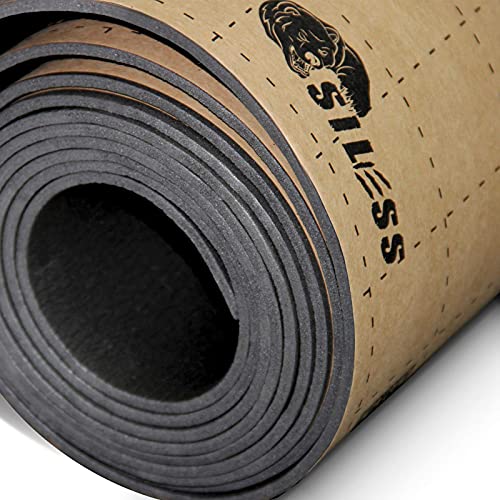
Siless Liner 4mm Closed-Cell Foam Sound and Heat Insulation
Butyl mat alone doesn’t kill drone. It just stops the panel from ringing. The high-frequency hiss of tires on coarse asphalt, the whoosh of wind around mirrors, and the radiant heat off a sun-baked floorpan all need a second layer. That’s what Siless Liner does. It’s a 4 mm closed-cell polyethylene foam with a self-adhesive back, designed to lay on top of an existing CLD mat (like Kilmat or Siless butyl) and decouple the carpet, headliner, or trunk liner from the metal underneath. The closed-cell structure means it won’t soak up spilled coffee or condensation if a door seal fails.
Coverage is 36 sqft per roll. Operating temp goes up to about 215°F so it’s stable on floor pans next to exhaust tunnels, and the foam blocks roughly 98 percent of radiant heat. That’s a meaningful improvement in cabin temperature on summer afternoons. The peel-and-stick back works on a clean butyl surface, but it stops sticking permanently if I reposition it more than once. So I always dry-fit my cuts before pulling the liner. This is the cheapest way I know to take a butyl-mat install from “noticeably quieter” to “wait, did the road just disappear?”
Pros
- Closed-cell foam absorbs high-frequency noise butyl can’t touch.
- Waterproof and rot-resistant for floor and trunk applications.
- Blocks roughly 98 percent of radiant heat transfer.
- Inexpensive per square foot for the coverage area.
Cons
- Needs a butyl CLD layer first. Not a standalone solution.
- Adhesive weakens after repositioning. Measure carefully.
Anyone layering over butyl mat to cut high-frequency hiss, kill drone, and block radiant heat coming off the floorpan and transmission tunnel.
Sound Deadening Thickness Guide: 50, 80, 157, and 200 Mil
Mil thickness is the number that confuses most buyers, and the marketing doesn’t help. Thicker isn’t always better. One mil equals one-thousandth of an inch, so 80 mil works out to about 2 mm. Here’s how I think about each tier based on the panels I’m treating and the type of noise I’m fighting.
| Thickness | Metric | Material type | Best use |
|---|---|---|---|
| 50 mil | 1.3 mm | Thin butyl-foil mat | Weight-sensitive cars, hybrids, EVs, motorcycle fairings, areas with tight clearance. |
| 80 mil | 2.0 mm | Standard butyl-foil CLD | The sweet spot for most cars. Doors, floors, trunk, roof. My default. |
| 100 to 120 mil | 2.5 to 3 mm | Heavy butyl-foil CLD | Trunk floor under a subwoofer, large flat panels on trucks and vans. |
| 157 mil | 4.0 mm | Closed-cell foam + foil | Second-layer floor and firewall insulation. Adds heat block to a butyl base. |
| 197 to 200 mil | 5.0 mm | Heavy foam composite | Truck and van firewalls, transmission tunnels, hot-climate builds. |
Thinnest practical option for cars
If you searched for the thinnest car sound deadening that still works, you want a 50 mil butyl-foil mat. Below 50 mil, the foil constraining layer is too floppy to do its job, and the panel keeps ringing. Above 80 mil, you’re adding weight without much extra damping for thin sheet metal. Doors and roof skins respond better to two layers of 50 mil than one layer of 100 mil, because more area covered matters more than absolute thickness.
Thickest sound deadening for cars
The thickest sound deadening material I run is the 197 to 200 mil foam composites like VOISNE on a truck firewall, where heat from the engine bay matters as much as noise. Anything thicker than that creates clearance problems with trim, seats, and door cards. If you need more attenuation, the right answer is adding mass loaded vinyl (MLV) under your foam liner, not buying a thicker mat.
What thickness for auto restoration
On a restoration where I have the floor pans bare, I use 80 mil butyl over the entire floor and trunk well at roughly 60 percent coverage, then top it with 4 mm closed-cell foam before the carpet goes back. That combo replicates what most modern OEMs do from the factory. A 1960s car damped this way ends up quieter than a 1990s car that came stock with no treatment at all.
Different Types of Automotive Soundproofing Material
Walk into any audio shop and you’ll find five product categories doing five different jobs. Most of the confusion in this hobby comes from buying the wrong type for the noise you’re trying to kill. Here’s the short version of what each one is and where it earns its place.
1. Butyl sound deadening mat (CLD)
The workhorse. Butyl rubber bonded to an aluminum foil constraining layer. Kilmat, Noico, Siless, Dynamat, FatMat, HushMat, and most credible brands sell this. Damps panel resonance. Will not block airborne road noise on its own. Buy this first.
2. Closed-cell foam insulation
Polyethylene foam with a self-adhesive back, usually 4 to 8 mm thick. Decouples trim from metal, blocks high-frequency hiss, reflects radiant heat. The black foam noise absorbent that comes up in searches almost always means this category. Pair it with butyl mat, not as a replacement.
3. Mass loaded vinyl (MLV)
A dense, limp vinyl sheet (typically 1 lb per square foot) used for sound blocking rather than damping. Goes under carpet on floors and inside door cards. Heavy, expensive, but the gold standard for blocking road and engine noise transmission. OEM luxury cars use MLV under the carpet for the same reason. Skip it on weight-sensitive builds.
4. Sound deadening spray
Water-based viscoelastic coatings (Second Skin Spectrum, Lizard Skin, similar) that you brush or spray on. Useful for wheel wells, undercarriage, and places where flat mat sheets won’t conform. Two coats give you about 2 mm of damping. Slower to apply than mat, but reaches surfaces nothing else can.
5. Sound deadening film and foil
Thin aluminum-faced foil sheets used as a hole-sealing layer over the large service openings inside door frames. Turns the door into a sealed enclosure for the speaker. Cheap, light, and a huge improvement for audio.
Killing Engine Noise: Firewall, Hood Liner, and Differential
Most road noise comes through the floor and wheel wells, but the firewall and hood are where engine noise sneaks in. If you’ve Googled engine sound deadening foam or asked what reduces noisy differentials, the fixes below are the ones that actually move the dB needle.
Firewall treatment
The firewall is the single biggest source of injector tick, valvetrain noise, and exhaust drone reaching the cabin. From the cabin side, I lay 80 mil butyl mat at 60 to 80 percent coverage, then add 4 to 5 mm closed-cell foam on top. The foil face of a heat-rated mat like VOISNE doubles as radiant heat protection from the engine bay. From the engine bay side, a heat-reflective hood liner panel cuts injector noise dramatically on direct-injection engines.
Exhaust and drivetrain drone
Exhaust drone usually enters through the trunk floor and rear deck on sedans, or the cargo floor on SUVs. I treat both surfaces with 80 mil butyl plus a foam layer. For a noisy differential, the rear floor pan and inner rear wheel arches need the same treatment. The PTFE thrust washer mods some forums recommend address mechanical noise inside the diff itself, but external mat reduces what reaches the cabin regardless.
Hood and engine bay
Most factory hood liners are basic fiberglass batting that’s lost most of its absorption after 10 years. Replacing or supplementing it with a heat-rated foam panel cuts engine bay noise reaching the cabin through the windshield. I use a high-temp foam, never standard closed-cell, because under-hood temperatures regularly exceed 200°F.
Heat and Sound Deadening Material: The Combo Job
Plenty of buyers want one product that handles both heat and sound. The honest answer is that the two jobs use overlapping but different materials. For combined heat and sound deadening material, you want a foil-faced foam composite (VOISNE 5 mm is the example in my picks) on top of a butyl CLD mat. The butyl handles vibration, the foam handles airborne noise, and the foil reflects radiant heat back toward the source.
Where this matters most:
- Firewall and floor near catalytic converters, where surface temps can hit 250°F.
- Transmission tunnels on rear-wheel-drive cars and trucks, especially with aftermarket exhaust.
- Trunk floor over a fuel tank or muffler on sedans and hatches.
- Wheel wells in summer climates where tires and brakes radiate heat.
Skip asphalt-based mats here. They soften above 150°F and start outgassing in summer. Butyl with a heat-rated foam is the right stack. For racing or high-output exhaust applications, step up to Thermo-Tec on the firewall for the 2000°F radiant heat rating that no standard mat can match.
Lightweight Sound Deadening for Hybrids, EVs, and Economy Cars
Weight is real on a Prius, a Civic Hybrid, or any EV where rated range depends on curb weight. The best lightweight sound deadening material for cars in this category is a 50 mil butyl mat at moderate coverage (40 to 60 percent) instead of 80 mil at full coverage. The damping curve flattens fast above 50 mil on thin sheet metal, so the extra 30 mil of butyl mostly adds weight without proportional benefit.
For EVs specifically, road noise is the dominant noise source because there’s no engine to mask it. I focus coverage on:
- Wheel wells (the single biggest path for tire noise).
- Floor pan ahead of the rear wheels.
- Inner rear quarter panels and trunk well.
A typical lightweight EV install runs 30 to 40 sqft of 50 mil butyl plus 30 sqft of 4 mm closed-cell foam, adding roughly 18 to 22 pounds total. That’s well under the variation in luggage weight on a normal trip, and the cabin transformation is dramatic on coarse asphalt.
Important EV safety note: never pierce a panel you don’t recognize on a hybrid or EV. High-voltage cabling and battery compartment vents run in places they didn’t on a gas car. When in doubt, work above the existing carpet line and consult the service manual before drilling or stapling.
What OEMs Use and Which Brands I Trust
Several search queries ask what sound deadening the OEMs use. The honest answer: most modern factory installs are spray-on damping compound (similar to Spectrum) at the body-in-white stage, plus stamped asphalt patches on large flat panels and MLV under the carpet. Luxury brands add foam decoupling and felt absorbers. None of it is exotic. The aftermarket butyl-foil mat we install is functionally equivalent to (and usually thicker than) what comes from the factory.
Brands I’ve used and trust
- Kilmat, Siless, Noico: Three near-identical butyl-foil mats at similar prices. Any of them is a safe buy.
- Dynamat: The original premium brand. Excellent quality, costs roughly 3x the others, marginally better adhesive.
- Second Skin Audio: Premium pricing with strong technical support and spray-on options.
- VOISNE, FatMat, HushMat: Solid options in the heat-and-sound foam composite category.
- Thermo-Tec: Specialist heat barrier. Use alongside butyl, not instead of it.
- Amazon Basics: Surprisingly legit for the budget tier. I’d buy it again for a one-door test install.
Brands to avoid: anything with asphalt as the primary damping material, no-name “thinnest in the industry” mats that turn out to be 30 mil with a foil sticker, and roll products sold without any mil rating on the listing.
Wheel Wells and Under-Car Sound Deadening
If you searched for car soundproofing mat for exterior under car, you’ve already figured out the truth most install guides skip: wheel wells transmit more noise into the cabin than any other surface. Tires throw rocks, water, and pressure waves at thin sheet metal three feet away from your ear, and that’s where the loudest cabin noise originates on any car at highway speed.
Two ways to attack it. First, treat the inside of the wheel well from inside the car (inner fender liner area inside the trunk or quarter panel) with 80 mil butyl. Second, apply a sound deadening spray (Spectrum, Lizard Skin) to the outside of the wheel well from underneath the car. The spray reaches contours that no flat mat can wrap around, and it’s rated for road spray and stone impact. Two coats give you about 2 mm of damping plus rock-chip protection.
Underbody rocker panels and floor pans benefit from the same spray approach. Mat works inside the cabin, spray works outside. If you’ve added wider tires or aggressive tread (all-terrain on a truck, summer performance on a sports car), wheel well treatment is the single most effective sound mod you can make.
Buying Guide: How I Pick Sound Deadening Material
Coverage by vehicle size
Coverage is the number most people underestimate. Here’s my rule of thumb for a full damp job:
- Compact car (Civic, Corolla, Mazda3): 36 to 50 sqft of butyl.
- Mid-size sedan or coupe: 50 to 70 sqft.
- Compact SUV or hatchback: 60 to 80 sqft.
- Full-size SUV or pickup: 90 to 120 sqft.
- Cargo van or work truck: 120+ sqft.
Add roughly the same square footage of 4 mm closed-cell foam if you’re going for the full quiet stack.
Install temperature and surface prep
Butyl adhesive needs warmth to flow. Below 60°F, the mat won’t bond properly and edges will lift in a week. I work in a heated garage or wait for a 70°F day, and I warm each sheet briefly with a heat gun on low if the shop is cool. Degrease every panel with isopropyl alcohol before applying. Wax, oil, and factory anti-corrosion coating will defeat the adhesive. Skip painted plastic trim. This stuff is for bare metal.
Clearance and stack-up
Doors and seat tracks have finite clearance. I verify that window regulators, lock rods, and door cards still seat flush after adding layers. Carpet over a 5 mm foam liner can interfere with seat-bolt torque, so I check before buttoning it back up. I never block drain holes in door bottoms or rocker panels. Trapped water means rust. And I never sandwich wiring between layers without sleeving it first.
Odor and outgassing
Quality butyl is nearly odorless once installed. Cheap asphalt-based mats smell like a fresh tar pit on the first hot day, and that smell can linger for months. If you can smell the product through a sealed package, that’s a warning. Stick to butyl from established brands.
Quick Picker: Match the Material to Your Build
| My situation | What I’d buy |
|---|---|
| Full sedan damp on a budget | Kilmat or Noico 80 mil + Siless Liner 4 mm |
| Door audio upgrade only | Siless 80 mil (one roll) |
| Testing the waters, one pair of doors | Amazon Basics 10-pack |
| Pickup truck firewall and floor | Kilmat 80 mil + VOISNE 5 mm on firewall |
| EV or hybrid, weight matters | 50 mil butyl + 4 mm foam, focused coverage |
| Restoration with bare floor pans | 80 mil butyl at 60% + 4 mm closed-cell foam |
| Wheel well noise on a lifted truck | Butyl inside + sound deadening spray outside |
| Show car or restoration, premium build | Dynamat Xtreme + Dynaliner foam |
| Bulk job with included tools | FatMat Rattletrap 50 sqft kit |
| Fastest install, pre-cut pads | HushMat Ultra Floor and Dash Kit |
| Track car with hot headers | Thermo-Tec 14620 on firewall + butyl elsewhere |
Where I Install First: Priority Order for Road Noise Reduction
Doors come first, and not just the outer skin. The outer door skin needs 25 to 50 percent butyl coverage to stop the panel ringing. If I care about audio, I treat the inner door card behind the speaker too. The door becomes a sealed enclosure for the driver, which is the single biggest improvement most factory audio systems will ever see. I seal the large service holes in the door frame with butyl mat or sound-deadener-grade foil sheets so the speaker isn’t firing into open space. This one step often gives more clarity than upgrading to a more expensive speaker.
Floor pans are second priority. I roll back the carpet, pull the rear seat, and lay 60 to 80 percent butyl coverage with the long edges following the natural ribs in the floor. I skip the drain plugs and lay a closed-cell foam liner on top before the carpet goes back. The trunk floor is third, especially important if there’s a subwoofer back there, because the trunk lid and rear deck are huge panels that vibrate sympathetically. Wheel wells are fourth and a huge gain (see the section above on under-car treatment). Roof skins and pillars are last. The gain there is real but small compared to doors and floors.
The Full Quiet Stack: Damping, Decoupling, Sealing, Absorbing
A proper quiet build does four things, not one. Damping (butyl CLD mat) stops the metal from ringing. That’s what Kilmat, Noico, Siless, Dynamat, FatMat, and HushMat all do. Decoupling (closed-cell foam liner) puts a soft layer between the now-quiet metal and the trim panels, so structure-borne vibration can’t transmit. Sealing means replacing brittle factory weatherstripping and adding extra door seal strips where wind whistles at highway speed. A tube of urethane seam sealer in factory pinch welds catches air leaks no mat can fix. Absorbing means soft fibrous material (wool felt, polyester batting) inside enclosed cavities to soak up airborne resonance.
For diesel trucks, injector tick on the firewall and hood liner is the biggest cabin intrusion. For sport cars, exhaust drone through the trunk floor is usually the worst offender. For minivans and SUVs hauling kids, the cargo area and rear wheel wells matter most. Match the stack to the noise. Track cars usually skip everything for weight. Daily drivers almost never regret reasonable coverage. I buy from known brands during off-season sales rather than mystery no-name butyl that turns to tar in August.
Sound Deadening FAQs
How much sound deadening material do I need for a car?
Most sedans and coupes need 36 to 50 sqft of butyl mat for a full damp job covering doors, floor, and trunk. Compact SUVs need 50 to 70 sqft. Full-size SUVs and pickups can run 80 to 120 sqft. Add roughly the same square footage of closed-cell foam liner if you also want to kill high-frequency road hiss and block heat. Doing only the doors for an audio upgrade? About 10 to 15 sqft does it.
What is the best thickness of sound deadening for vehicles?
80 mil (2 mm) butyl mat is the sweet spot for most cars and trucks. 50 mil works for lightweight applications. 100 to 120 mil belongs on trunk floors under subwoofers or large flat truck panels. For combined heat and sound, step up to 4 to 5 mm foam composites. Going thicker than 5 mm creates clearance problems with trim and seats.
Butyl or asphalt: which is better for cars?
Butyl, in essentially every case. Asphalt mats are cheaper but soften and smell above 150°F (think summer firewall or a sunny floor pan) and get brittle in cold weather. Modern butyl-foil mats damp the same frequencies, stay stable from below freezing to over 200°F, and don’t outgas. The price gap is small enough now that there’s no good reason to choose asphalt.
Will sound deadening hurt my fuel economy or add too much weight?
A typical 50 sqft butyl install adds roughly 25 pounds. On a 3,500-lb car, that’s a fraction of one percent in weight and well below measurable fuel economy impact. The 5 mm foam-foil composites add more, closer to 35 to 40 lbs for the same coverage. For most drivers that’s a non-issue. If you drive an economy car or hybrid where every pound matters, stick to 50 to 80 mil butyl and skip the thick foam.
What’s the best sound deadening foam in black for cars?
For black-finish closed-cell foam that lays on top of butyl, Siless Liner is what I use. It’s a 4 mm polyethylene foam with a self-adhesive back, 36 sqft per roll. It blocks roughly 98 percent of radiant heat and absorbs high-frequency hiss the butyl can’t touch. The black finish is unobtrusive on a floor before carpet goes back over it.
Can I install sound deadening myself?
Yes. It’s one of the most DIY-friendly mods out there. You need shears, a hand seam roller, isopropyl alcohol, gloves (foil edges cut skin), and ideally a heat gun for cold-weather installs. The hardest part is removing trim without breaking clips, not applying the mat. A pair of doors takes most people two to three hours the first time, faster after that.
How long does sound deadening last?
Quality butyl mat installed properly lasts the life of the vehicle. I’ve pulled trim off cars I damped 10 years ago and the mat looks identical to the day I installed it. Cheap asphalt mats can fail in 2 to 5 years (drying out, edges lifting, smell developing). The two failure modes for butyl are: install below 60°F (adhesive never bonded) or install over greasy metal (adhesive failed at the surface). Get both right and the install is permanent.
Can I remove sound deadening later?
Mostly, but not easily. Fresh butyl peels off in sheets if you heat it with a heat gun and pull slowly. After a year or more, the adhesive has bonded harder and you’ll need a plastic scraper, more heat, and patience. Residue comes off with mineral spirits or dedicated adhesive remover. Removing a full install takes longer than the original install did. Plan on this being a permanent mod for practical purposes.
Does sound deadening void my warranty?
In the United States, the Magnuson-Moss Warranty Act protects you from blanket warranty denials over aftermarket additions. A dealer can only deny a warranty claim if they prove the modification caused the specific failure being claimed. Sound deadening mat on door skins or floors doesn’t cause mechanical or electrical failures, so it won’t affect warranty on the powertrain, brakes, or factory electronics. Avoid mat near factory wiring connectors and HVAC components, and don’t block any sensor or vent.
What’s the difference between sound deadening and soundproofing?
Sound deadening (more accurately, damping) stops panels from vibrating and acting as speakers themselves. Soundproofing blocks airborne sound from passing through a barrier. Cars need both, but a full soundproofing build (mass loaded vinyl, sealed gaps, absorptive layers) is much bigger and heavier than just damping. Most DIY car projects do damping (butyl mat) plus decoupling (foam liner) and call it sound deadening. True soundproofing with MLV is a step beyond.
Will sound deadening make a noticeable difference?
On doors and trunk, yes. Within minutes of the first install you’ll notice door closings sound more “Mercedes thunk” than “tin can” and panel rattles disappear. For overall cabin quiet at highway speed, a butyl-only install drops perceived noise modestly. Adding closed-cell foam over the butyl is what produces the dramatic “wow, the road got quieter” reaction. I measure with a phone SPL meter at 65 mph before and after to track real gains. Typical numbers: 3 to 5 dB drop with butyl only, 6 to 9 dB drop with butyl plus foam.
Final Word
For a single best-pick across the whole field, KILMAT 80 mil is the most-installed butyl mat in the DIY world for good reason. If you only want to do doors, the Amazon Basics 10-pack is the lowest-risk test. For an audio build, Siless 80 mil is the value pick. For trucks fighting heat and noise together, VOISNE 5 mm covers both jobs in one product. For show cars and premium builds, Dynamat Xtreme is the gold standard. For racing-grade firewall heat, Thermo-Tec is unmatched. And for anyone who already laid butyl and wants the next level of quiet, Siless Liner closed-cell foam is the second layer that takes a car from “quieter” to “noticeably refined.”
Open your trim and your service manual together, plan coverage realistically using the tables above, work above 60°F, and don’t skip the roller. Sound deadening is the rare car mod that’s cheap, reversible (mostly), and delivers a result you notice every single drive. I’ve done six cars now and I’m not going back.

- 10 Best Tire For Zipp 303 Xplr 2026 - September 23, 2026
- 10 Best Tire For Zero Turn On Hills 2026 - September 23, 2026
- 10 Best Tire For Zx6r 2026 - September 23, 2026